Japan launches mission to Mars’ moons
Phobos, one of Mars’ moons, is at the centre of the latest space mission: the launch vehicle has now lifted off from the Tanegashima Space Centre in Japan. This is the first mission designed to bring material from the Martian region back to Earth.
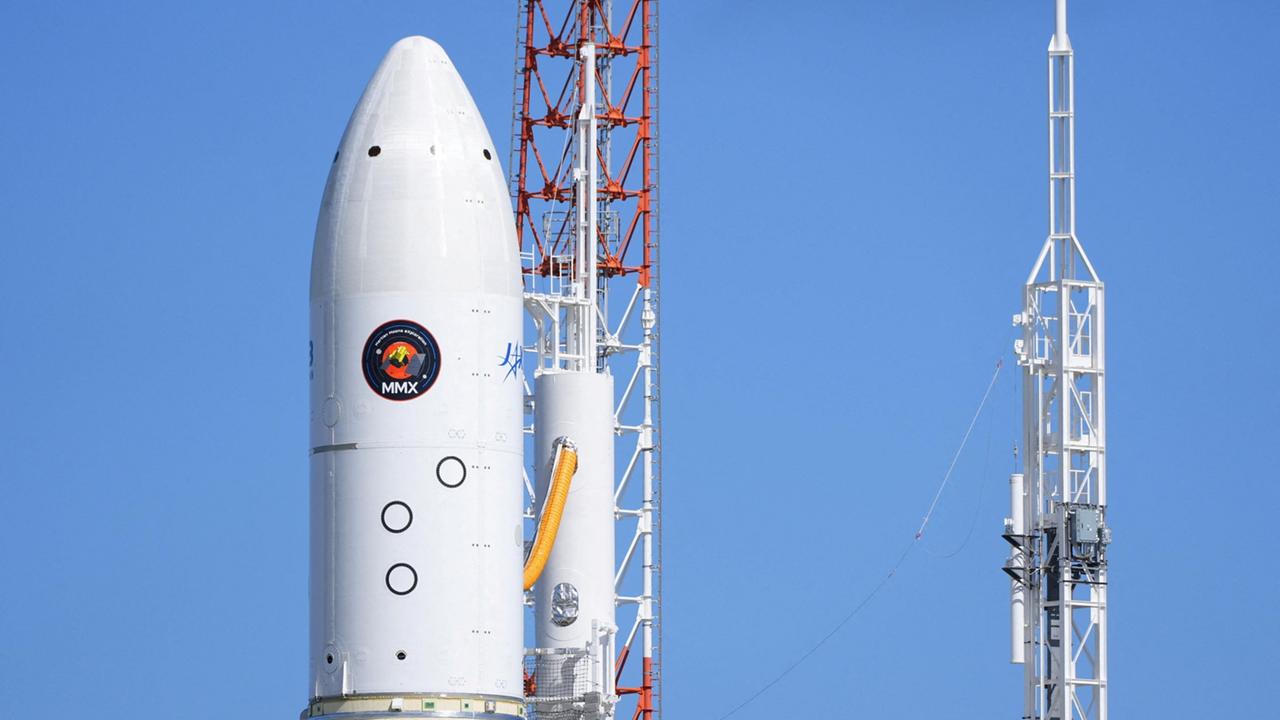
Mars’ moon Phobos is the focus of the latest space mission: the launch vehicle has now lifted off from the Japanese spaceport at Tanegashima. This is the first mission designed to bring material back to Earth from the Martian region. A Japanese space probe, carrying the Franco-German rover ‘Idefix’, has set off for Mars. An H3 rocket successfully lifted off with the probe from Japan’s Tanegashima Space Centre on the island of the same name in the south-west of the country. The mission’s destination is Phobos, one of Mars’ moons. ‘Idefix’, designed by the German Aerospace Centre (DLR) and the French space agency CNES, is scheduled to land there in 2029. Later, the main probe is also due to land there and collect rock samples. In 2031, a return module is then set to bring samples from Phobos back to Earth for the first time. The second Martian moon, Deimos, is to be studied only during several flybys. Five space agencies are participating in the mission. The project, known as ‘Martian Moons Exploration’ (MMX), is led by the Japanese space agency JAXA. The mission is considered to be extremely technically challenging. How did the moons of Mars form? The Martian moons Phobos and Deimos are, alongside the Earth’s Moon, the only two moons in the inner Solar System, which comprises the rocky planets Mercury, Venus, Earth and Mars. They are much smaller than the Earth’s Moon and are not spherical, but irregular in shape. Phobos has a maximum diameter of just under 27 kilometres, whilst Deimos measures 15 kilometres. Phobos orbits Mars at a closer distance than Deimos. The MMX mission to Phobos is intended, amongst other things, to help answer the question of how the two Martian moons were formed – whether they are captured asteroids or were formed following a meteorite impact on the Red Planet. It will also investigate whether a Martian moon is a suitable location for a space station for future manned exploration of Mars. Collecting a wide range of data The joint German-French project ‘Idefix’ is barely larger than a microwave and has four wheels. Apart from the lunar samples, the rover is set to collect a wealth of data and images. To this end, it is equipped with various instruments. A Raman spectrometer on ‘Idefix’ will analyse the chemical composition of the rock, whilst a radiometer will measure the thermal properties of the surface. High-resolution cameras, including so-called ‘wheelcams’ mounted on the wheels, are designed to record the immediate surroundings, the flow of sand and the interaction with the undercarriage. Small blades or ‘ribs’ are attached to the wheels, which are designed not only to improve traction but also to allow conclusions to be drawn about the behaviour of the ground via the cameras. This makes it possible, for example, to determine the material’s porosity and strength. As the rover cannot communicate directly with Earth, radio communications are routed via the MMX probe. “On average, it takes just over two days for the data to reach Earth. That is why – unlike with the Mars rovers – on this mission we have to assess the rover’s condition using older data,” explains DLR project manager Markus Grebenstein. This data will then be used to simulate its current situation in order to decide whether “Idefix” can carry out its next planned task or not. “Idefix” is set to deliver its first findings on the subsurface so that a safe landing site can be selected for the lander. With information from Jan Kerckhoff, BR
Source: tagesschau ›


