‘4,000 people minding our own business’: four decades on, Falklands again face a hostile Argentina
Facing a slump in the polls, Argentina’s president is making economic attacks on the islands’ oil industry, and suggesting its key fisheries industry could be next A dozen local people and a uniformed military police officer (“Do you mind if I sit in?”) took their seats at the back of the handsome wood-panelled courtroom that doubles as the Falkland Islands’ legislative assembly. Outside, it was a typically blowy early evening. It may nominally be spring in the south Atlantic, but Stanley harbour, with its dark grey water speckled with historical shipwrecks, was a cauldron of swells...
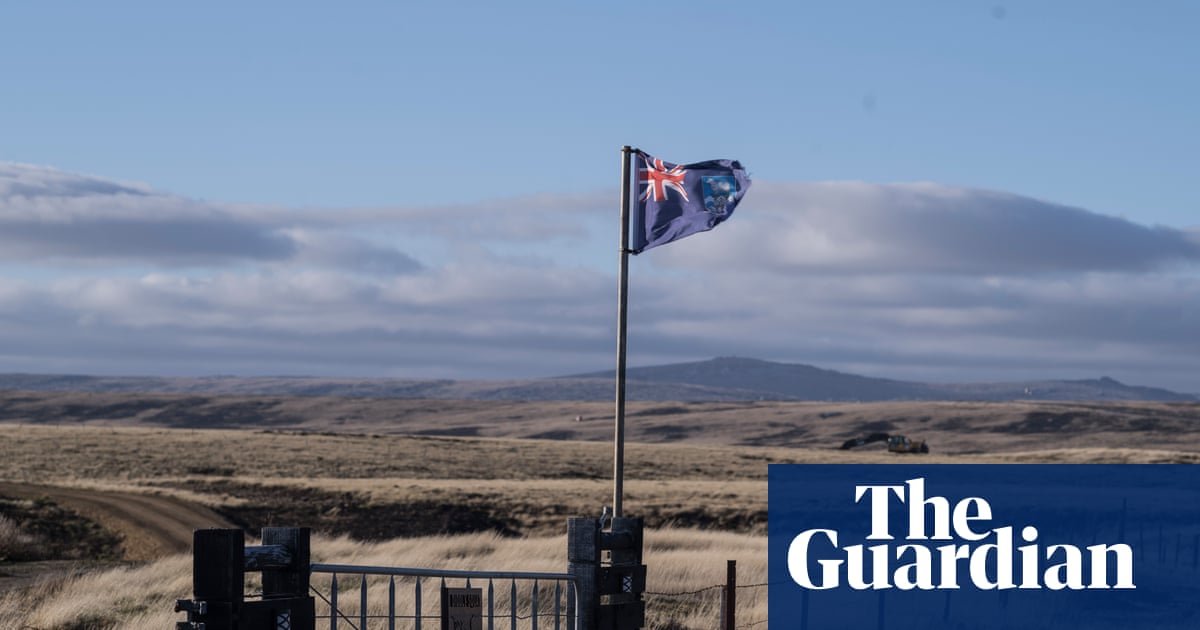
Facing a slump in the polls, Argentina’s president is making economic attacks on the islands’ oil industry, and suggesting its key fisheries industry could be next
A dozen local people and a uniformed military police officer (“Do you mind if I sit in?”) took their seats at the back of the handsome wood-panelled courtroom that doubles as the Falkland Islands’ legislative assembly. Outside, it was a typically blowy early evening. It may nominally be spring in the south Atlantic, but Stanley harbour, with its dark grey water speckled with historical shipwrecks, was a cauldron of swells and churn.
Six of the assembly’s eight members – five men, one woman – waited patiently at a row of desks and microphones. The heating had been turned up to just short of uncomfortable. Behind them, a portrait of King Charles. From the other walls, dusty photographs of governors peered down on the scene.
Proceedings started at the raised hand of a bored-looking young man wearing headphones in the corner. He was transmitting the question and answer session via radio across the dozen or so inhabited islands that make up the 778-strong archipelago.
It was not clear how many of the Falklands’ 3,600 residents were listening in from their farm houses out in the diddle-dee shrub that coats much of the islands, or in the front rooms of Port Stanley’s white clapboard cottages with the pretty coloured roofs; likely not on a par with the number who learned 44 years ago from the Falkland Islands broadcasting station that their lands had been invaded.
“There’s no turning back, we can expect them by dawn,” the governor, Rex Hunt, had said then.
But for those who did tune in on Monday evening, there was much to dwell on. Not so much the answers about the local internet contract or the consultation on the contentious plan for a salmon farm.
“I have another one for you,” piped up one enthusiastic quizzer with a heavy local accent, a West Country burr with a slight antipodean lift. That intervention prompted a little shuffling of tired bums. But a rather more significant announcement was to come.
Lewis Clifton, an assembly member who can date his family’s residence on the Falklands to the late 1870s, advised the islanders that an unprecedented economic war was being waged against them – a community no bigger than an English village – by a country of 46 million people.
“I am concerned that the level of Argentinian thrust this time has been at a different level,” Clifton said. “Perhaps a more vehement and belligerent tone than [seen since] 1982, because it has the potential to threaten our very economic development.”
Facing a downturn in his domestic polling and with an upcoming election, Argentina’s president, Javier Milei, has legislated to criminalise companies and individuals involved in the Falklands’ nascent oil industry, and suggested the fisheries industry on which it currently relies for its prosperity could be next.
The British forces capability at Mount Pleasant airbase – 1,800 personnel there and on Ascension island, four typhoon jets, a ground-based air defence system and with HMS Medway patrolling the waters – makes a military threat from Argentina largely hypothetical. But Buenos Aires has launched a full spectrum attack of another sort.
In response this week, Andy Burnham and his foreign secretary, Ed Miliband, restated the UK’s solidarity with the islanders’ desire to remain British, and promised legislation that might offer some protection against the financial damage imposed by Argentina’s economic sanctions. Interpol received Foreign Office representations suggesting they reject an Argentinian request for arrests relating to the dispute.
For the islanders, it was a welcome show of muscularity. They have never felt entirely confident in the spine of those in power back on the homeland. It was arguably the indifference of Westminster that led Argentina to launch its invasion in the first place back in 1982.
“I have never trusted the Foreign Office and I have been proven right,” said Norma Edwards, 84, whose husband, Roger, 80, a former Royal Marine, was attached to the SAS in the 1982 conflict. “Catching up time,” said Clifton, of what he saw as a belated toughness from London this week. But things remain precarious.
The Falkland Islands might be described as a British success story. Four decades ago, there were 1,800 inhabitants, and its tiny wool-centric economy, 300 miles (480km) east of mainland South America, was dependent on UK government handouts.
Today the population, growing at 3% year-on-year in recent times, includes about 70 different nationalities, attracted by the 26% top rate of tax, good pay and opportunities in a growing and entirely self-reliant economy.
There are Zimbabweans who came to de-mine after the war. Construction workers from South Africa who came to rebuild. Chileans who found something they liked after taking a Latam Airlines flight. The largest minority group is the Filipinos, who came to work in social care and the service industry in the late 1980s and 90s.
Working behind the bar at Groovy’s, a Nepalese waiter said he had come from Dubai. The money was better in the Falklands, he said, and “the people are nicer”. “The locals start at Deano’s bar, then it’s the Victory bar and here – then it is the Globe, for dancing,” he said with a smile. “After that they go to house parties.”
Such has been the Falklands’ success in attracting people that a permanent residency scheme, capped at 90 people a year, has been frozen for 12 months. The islands, for all their challenges, are somewhere people want to be.
All of this had been made possible because of squid, said John Barton, chair of the fishing companies association. “It has been transformational,” he said.
In 1986, the UK allowed the Falklands to establish a 200-nautical-mile exclusive fishing zone in which those wanting to operate had to be licensed by the islands’ government. Licences sold to fleets of Spanish,…
Source: The Guardian ›

Comments (0)
No comments yet.