Attack on Australian politician follows years of threats to public figures
As many as 85% of federal lawmakers and their staff had experienced violent or threatening behaviour.
Sign up now: Get insights on Asia's fast-moving developments
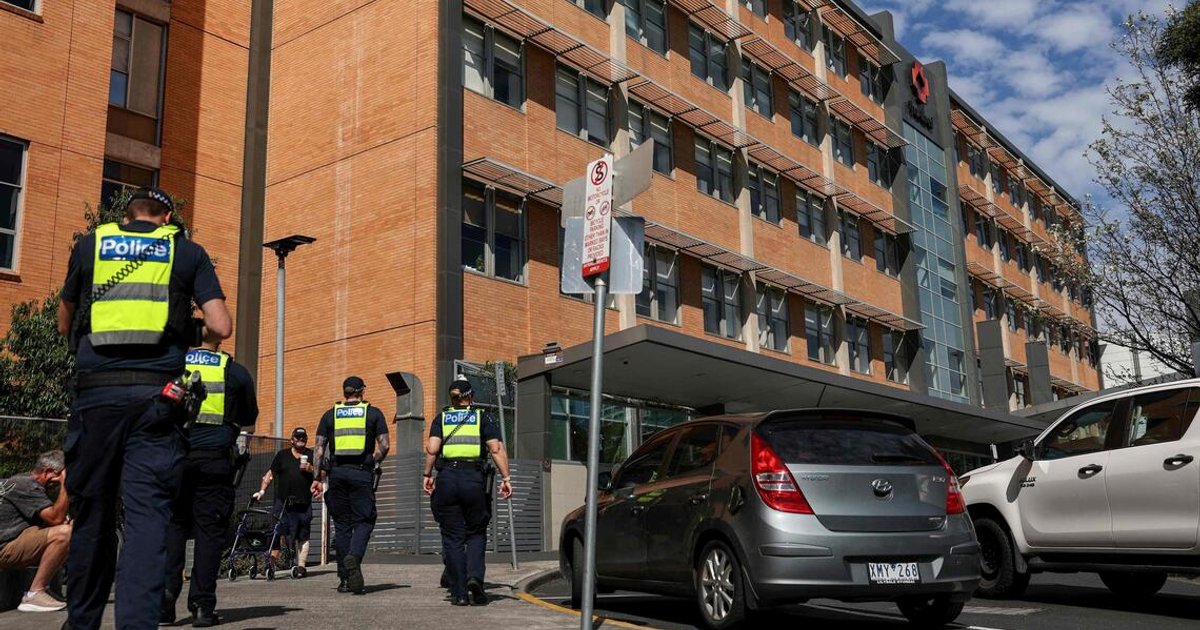
Police arriving at Alfred Hospital in Melbourne, where Australian politician Helen Haines is being treated, on Oct 20.
SYDNEY – Australian lawmakers and enforcers have sought to lower the temperature of political debate and warned about growing threats to public figures since 2021, when anti-lockdown protesters put an effigy of a state leader on a makeshift gallows in Melbourne.
Those fears came to a head on Oct 19 when a man rammed a car into Helen Haines, an independent member of the Lower House, inflicting major injuries, including the loss of a leg, media outlets and officials said, while doctors work to save her other leg.
Police have yet to state a motive for the attack outside Haines’ regional electorate office in Wangaratta, some 240km away from Melbourne.
“We’ve all seen a level of... hate and disrespect and intolerance in our political debate that we never really used to see,” Health Minister Mark Butler told Channel Nine’s Today Show.
His remarks come amid growing debate about increasingly toxic political dialogue in a country that has traditionally prized easy access to politicians who usually live in their electorates among minimal security.
Threats of violence to politicians were “increasing, not decreasing”, said Bridget McKenzie, a senator from the opposition Nationals who has an office in Haines’ electorate.
“Everybody, no matter where they come from in Parliament, left or right, is doing their very, very best to make our country the best. We disagree on the way to do it.”
As many as 85% of federal lawmakers and their staff had experienced violent, threatening or volatile behaviour, a 2025 parliamentary report showed, calling for more consistent security arrangements.
The incidents occurred more than once a month, said nearly half of the respondents cited in the report, who described assaults, spitting, threats, intimidation and objects thrown at them.
“You worry about your family, you worry about the impact of this on whether you can actually continue to do your job,” said Lisa Phillips, a psychological sciences professor at Melbourne University who published a 2023 paper on threats to members of the Victorian state Parliament.
“It’s distressing,” added Phillips, whose paper found 85% of state lawmakers had made lifestyle changes after threats of harm, with female politicians more likely to be abused than men.
In 2021, Mike Burgess, the head of the Australian Security Intelligence Organisation (ASIO), warned of “considerable volatility” in security stemming from the Covid-19 pandemic.
Such conditions fuelled grievance-driven extremism and heightened the risk of lone-actor violence, Burgess added.
Australian politicians were spurred to openly discuss their own vulnerability seven months later, when British MP David Amess was fatally stabbed while meeting constituents.
By 2024, there was a surge in reports of threats, harassment and offensive communications targeting federal politicians.
Politically motivated violence was “flashing red”, Burgess said in 2025, stepping up his warning.
In February, a bomb threat prompted the evacuation of Prime Minister Anthony Albanese from his official residence, while Small-business Minister Anne Aly said she had received 19 death threats in a single week.
Australian Federal Police figures showed 1,067 reports of threats, harassment, nuisance or offensive behaviour against parliamentarians, senior office-holders and protected locations in the latest financial year.
That was up 12% from the prior year and double the figure from five years earlier.
“ASIO has seen direct correlations between inflamed language, inflamed tensions and acts of violence,” Burgess said on Oct 20.
“The temperature of our security environment would be several degrees lower if we recommitted to conversing with civility, debating with respect and disagreeing with restraint.” REUTERS
Source: The Straits Times ›

Comments (0)
No comments yet.