Brazil’s family farming backbone embraces Chinese AI to reverse vital sector’s decline
The family farmers who produce the lion’s share of Brazil’s staple foods are opening their arms to cutting-edge Chinese artificial intelligence in a bid to modernise operations and secure their future. Brazil and China agreed to a five-year cooperation programme in September aimed at giving smallholders – the backbone of the Brazilian agricultural sector – an AI boost after a decade of declining employment and limited access to affordable technology. Representatives of the Brazilian Agricultural...
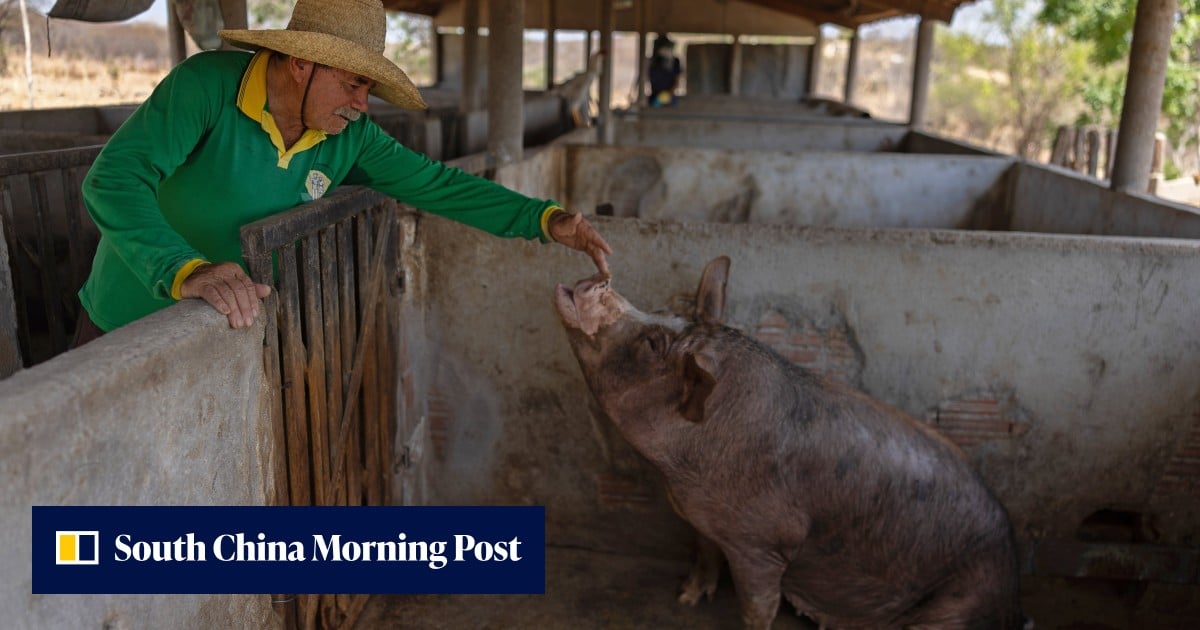
The family farmers who produce the lion’s share of Brazil’s staple foods are opening their arms to cutting-edge Chinese artificial intelligence in a bid to modernise operations and secure their future.
Brazil and China agreed to a five-year cooperation programme in September aimed at giving smallholders – the backbone of the Brazilian agricultural sector – an AI boost after a decade of declining employment and limited access to affordable technology.
Representatives of the Brazilian Agricultural Research Corporation (Embrapa) and four Chinese institutions signed the memorandum of understanding in Nanjing, capital of Jiangsu province.
The Chinese parties were the state-owned Sinomach Digital Technology Corporation, Nanjing Agricultural University, the Jiangsu Academy of Agricultural Sciences and the International Association for People’s Cooperation.
The agreement includes the establishment of the Brazil-China Cooperation Centre for the Application of AI in Agriculture, aimed at strengthening this key sector of the Brazilian economy by developing new technologies and tools.
“The idea is to combine complementary skills from both countries … to develop and adapt technologies to Brazilian production, social, and environmental conditions,” said Luciana Romani, a researcher at Embrapa Digital Agriculture.
According to Romani, these complementary skills include “agronomic knowledge, artificial intelligence, computer vision, automation and smart agricultural machinery”.
The World Bank has reported that family farming accounts for around 77 per cent of Brazil’s five million rural establishments, producing 87 per cent of the country’s cassava and 70 per cent of its beans – a foundational and essential staple of the Brazilian diet.
Family farms are also responsible for 60 per cent of Brazil’s milk, half of its poultry and 34 per cent of its rice.
In its 2017 census of agriculture, the Brazilian Institute of Geography and Statistics (IBGE) found that family farms employed around 10.1 million people – 67 per cent of the agricultural workforce and around 5 per cent of the total population.
Cristhiane Amancio, general head of Embrapa Agrobiology, said “an important milestone is expanding access to digital technologies that reduce arduous labour in the production of healthy and sustainable food. That is an important step to help keep workers in rural areas as well.”
Under the agreement, Smart Agricultural Machinery Centres will be established in pilot family farming areas of Brazil where small and medium-sized machines, sensors, Internet of Things devices and AI will support crop monitoring and management.
“The technologies integrated into agricultural machinery have evolved significantly in recent years and are being adopted in Brazil,” said Jayme Barbedo, another researcher at Embrapa Digital Agriculture.
However, he noted that in many cases “those machines are too expensive or have dimensions that do not suit the conditions found in family farming”.
According to Romani, China and Brazil will work together “to identify needs, develop technology and validate artificial intelligence solutions and other digital technologies aimed at family farming”.
However, the Chinese technologies identified as offering potential applications in Brazil were developed for specific agricultural conditions and must be proven, tested and adapted to Brazil’s diverse production systems and local environments, she said.
Amancio added that Sinomach in particular “has an integrated platform that supports decision-making at different management levels, adding value for both farmers and managers within associations, cooperative unions or in the public sector”.
Romani also highlighted the expertise of the Brazilian research team in artificial intelligence, computer vision and automation, which will be essential to testing and adapting the technologies to local conditions in Brazil.
The initial phase is expected to include an assessment of equipment and systems already being tested at the Brazil-China Centre of the University of Brasilia, alongside technical exchanges with Chinese researchers.
Romani said potential applications included “artificial intelligence-based systems for pest and disease diagnosis, crop monitoring, decision-making support, more efficient use of inputs and natural resources, as well as the integration of those tools with smart agricultural machinery and equipment”.
The history and tradition of China in developing technologies for smallholders and medium-scale farmers, together with its advances in automation and robotics, were an important factor in choosing Chinese partners for the project, she said.
“This knowledge complements what has been developed in Brazil and fits very well with the current needs of smallholders and midscale farmers.”
The researchers said the cooperation was intended to go beyond technology transfer, establishing a continuing process of joint development, adaptation, validation and knowledge exchange to deliver practical solutions for family farming.
According to Barbedo, the use of AI does not represent a new model of farming. Instead, it will “play a central role as a tool to support decision-making, automation and the adaptation of technologies to real family farming conditions”.
By combining data from sensors, machines and other digital tools, these technologies could be used to interpret, identify patterns, optimise resources, support the diagnosis of agricultural problems and improve the use of inputs and natural resources, he said.
“Artificial intelligence should not be seen as an end in itself, nor as a substitute for agronomic knowledge and the experience of farmers, but as a technology that can expand such capabilities.”
According to Barbedo, the project will focus mainly on adapting existing AI models rather than developing new ones. The researchers will need to account for Brazil’s diverse production systems, crops, environmental conditions and producer profiles.
“Consi…
Source: South China Morning Post ›




Comments (0)
No comments yet.