“The Dutch Women” in Berlin: relics of a long journey
Tasting, highly concentrated and aware of the changing abysses: Dorothee Elmiger’s book prize-winning novel “The Dutch Women” is staged at the Deutsches Theater Berlin.
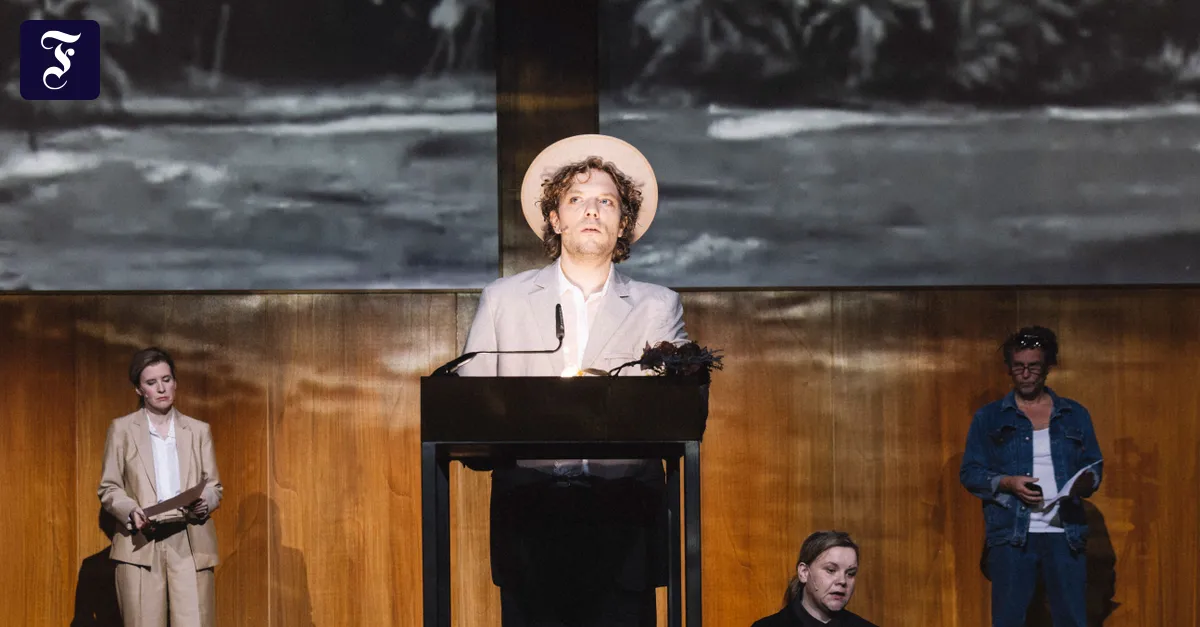
Not quite to determine whether it is trembling or yet gentle rebellion that lies in her voice. At the desk, which seems equally exposed and abandoned in the width of the wooden lecture hall, she begins to speak: cautious, wrestling, unmistakably nervous. She, a writer, is actually here to give a poetics lecture. In order, therefore, as such a format wants, to provide information in a coherent manner about the basics of her literary work. However, she could not, as she confesses into the silence of the auditorium. She had lost her sense of coherence, her work was in a “process of dissolution”. And yet: Despite her crisis, she wanted to speak, not “pull her head out of the noose”. She could talk about a final, never-finished text, about “a jumble of notes and fragments”, about “relics of a journey”. Like Dorothee Elmiger’s intricate, literary expedition, the theatre director Jan Friedrich at the Deutsches Theater Berlin lets the “Dutch women” begin with what takes place on the edges of the saga. The exhausting distress that the writer radiates on the podium is not due to a fear of lectures, no situation that could easily be resolved with a little practice and encouragement. No, rather, in the first lines of Elmiger’s novel it becomes noticeable that it encircles things that are more difficult to grasp, that it takes as its starting point the existentially unsettling experience of a language crisis – and then pursues the possibility of storytelling. Like Hofmannsthal’s Chandos letter on the epochal upheaval to modernity, Elmiger’s contemporary writer is once again confronted with the experience of the disintegration of concepts, the fragmentation of the world. Last year’s novel “The Dutch Women” was the novel that won the German Book Prize last year as a small literary sensation. If the outlined poetics lecture forms the framework plot, it remains almost marginal to the opaque event to which the narrative then grows. Most of it takes place in completely different places than the lecture hall: in the Latin American jungle. Three years earlier, the writer was contacted by an ominous theatre maker with a penchant for megalomania and invited to participate in a theatre project. In this “theater machine”, this “tropical passion”, he wants to “reconstruct” a case: the mysterious disappearance of two young Dutch women in the rainforest of Panama. For the eccentric artist, “reconstruction” does not mean an investigative process, but a mimetic process, a somewhat nebulous method of experiencing “things on one’s own body”. In the novel, the young Dutch women remain a blank, a kind of MacGuffin: they drive the story, indefinitely circled around them, but they never appear themselves. Strictly speaking, the other figures of the strange artist tour group do not appear – at least not in the scenic or dialogic sense. The entire fabric of the story unfolds in subjunctive I, in the indirect speech that the writer develops from the lecture hall as a kind of self-talk. Rich in strange stuff, however. Each of the characters gives stories during the jungle stay: sometimes disturbing, sometimes whimsical, sometimes supernatural. Anecdotes that carry traces of the dream. The circling around a dark void that can never be fully illuminated, the replacement of immediate, lively speech by a detached, potentially suspicious mediation: All this does not cry out for a translation on stage – at least not if theatre is understood above all as a medium of illustration and dramatic dialogue. You would think first. But Jan Friedrich, who debuts with this production at the Deutsches Theater, does not even try to conceal the obstacles, the impossibility of the narrative that the novel explores. He does not want to add to it by over-illustrating the feelings buried in the text or by trying to distill a clear political message from the deep dimensions of the expedition into the unconscious of a civilization. Friedrich, and this is fortunate for this Berlin evening, takes the text seriously first of all: in all its strangeness, in its constant, indissoluble variance between existential (language) distress and its parodistic – but never cynical – content. This serious attention to the text is also made possible by an ensemble that engages in Friedrich’s access with every fibre and a high degree of precision. Over the full three hours, the text is read tastingly, highly concentrated and with full awareness of its changing abysses. Carmen Steinert lends the narrator her existential plight, is truly shocked to tip into lively curiosity for the strange potential of the narrative: into the fascination with the “staring at disaster”, in which lies an “unspoken, secret consent”. Moritz Kienemann does not succumb to the temptation to draw the theatre maker, this role crying out for parody, into the Klamauk. With his calm, slightly flashing eyes, his trotting, but nevertheless obsessed language, the ridiculously eccentric as well as the all-too-human searching, which is laid out in this figure, brings all the more into play. Just as the evening gives space to the text, lets it unfold with trembling calm all its foreignness, all its abysses, so it keeps its possibilities of interpretation open. Sometimes traces of colonial violence flash up, for example when it is imagined how the first European conquerors were not triumphant, but full of lostness in the Dickic
Source: FAZ ›



Comments (0)
No comments yet.