Savings to HU: Death on installments at the Berlin location of excellence
The Academic Senate of Humboldt University is to cancel Berlin’s last professorship for architecture and urban history. The Archaeology Institute will also close.
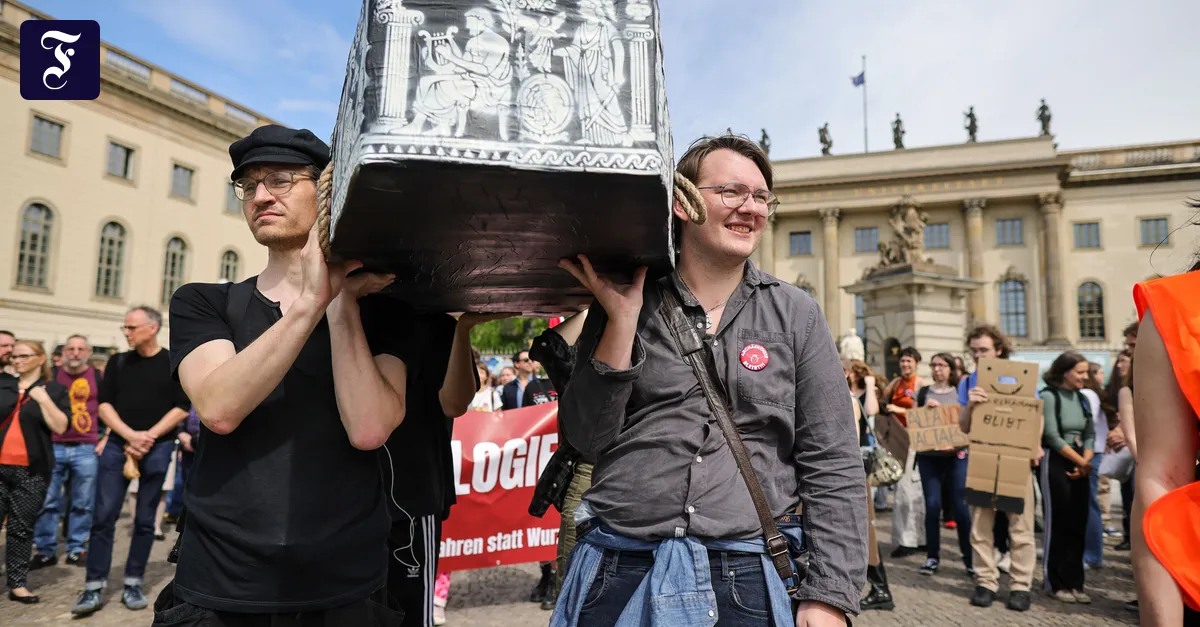
In Berlin, it is currently possible to study how radical financial cuts by one country can destroy university locations and erase unique selling points. The university committees are expected to approve self-circumcision, in some places self-destruction. Although the Berlin science authority has set up a perspective commission. However, it cannot take individual universities away from adopting a structural and development plan for its own institution. Elsewhere, however, it would hardly be conceivable that such fundamental changes as those currently imposed on Berlin universities would be left solely to academic self-management. Although the Excellence Alliance of the Berlin University Alliance (BUA) has brought Berlin universities closer together, it has also led to new competition in the event of cancellations. Here, the scientific authority would be obliged to coordinate and to look at the entire site. Next Tuesday, the Academic Senate of the Humboldt University (HU) in Berlin will deal with the cancellation of the Berlin-wide last professorship of architectural and urban history and the final closure of the Institute of Archaeology with Classical Archaeology and Archaeology and Cultural History of Northeast Africa (AKNOA) in the first reading, without knowing what a reorganization of the Institute of Archaeology could look like. The second reading and final decision is planned for December. After the international protests of renowned classical archaeologists, the Association of Egyptology has now also pointed out that Sudan archaeology has disappeared completely from the German map. Without the associated research, the Sudan Archaeological Collection with pieces from the UNESCO World Heritage Site Musawwarat es-Sufra and the associated excavation archive would also be in the Berlin museums. Even classical archaeology can only be thought of in connection with the Museum Island. Due to the traditional cooperation with the museums of the nearby Museum Island, it would also have a unique selling point in Berlin. Paragraph 2b of the Berlin Higher Education Act states: “Higher Education Structure Planning is a joint task of the Land of Berlin and the Berlin Higher Education Institutions in the general interest of society and in the overall responsibility of the Land.” What is currently happening in Berlin contradicts this provision in the strongest possible terms. Even if it was thought at HU that Freie Universität (FU) would receive its professorship for architecture and city history, the subject is no longer available in Berlin as a result. At the beginning of the year, the University of Technology and Economics had already announced the end of its degree program in excavation technology. All this is happening at a so-called location of excellence. In the HU, there is great displeasure about the perceived lack of transparency in the cuts process, because they have gained the impression that, for example, one criterion such as third-party funding has enormous weight in some cases, but not in others. It is clear, however, that the Institute of Archaeology is expected to make a disproportionately large cut. Intra-university decision-making processes How do such decisions come about within a university? In an interview with the F.A.Z., HU President Julia von Blumenthal refers to the year 2024, in which her university had to react to a structural deficit in the budget. “Back then, we carried out a criteria-driven process and measured research and teaching performance using quantitative and qualitative criteria.” The Presidium considered unique selling points and legal ties such as the State Church Treaty; Teacher training courses were excluded. Back then, we found that the archaeology of third-party funding performance and overall research performance is no longer as powerful as it used to be. There was no cluster proposal, no CRC (collaborative research areas, editor’s note) and at the moment no graduate school, says von Blumenthal. The renowned Pompeii project of Classical Archaeology is funded by the HU Foundation and is therefore not a third-party funded project, argues the President. The financial resources provided by the state are no longer large enough to carry out tasks in the promotion of young talent without third-party funding. ‘We also found that the AKNOA area is very poorly utilized and the relatively high matriculation numbers in classical archaeology are somewhat misleading in that there are far fewer degrees. However, this also applies to other admission-free subjects, says von Blumenthal. The Bureau therefore decided to cancel another fourth professorship at the Institute of Archaeology in 2027 when she became vacant. Open process of reorganization In 2024 it was already clear that the institute had to make do with three professorships and be restructured. However, it only learned about it much later. The Bureau agreed that “a HU without archaeology is not possible”. Therefore, it was agreed that two professorships with equipment and a permanent position to secure the extensive collections must remain. The requirements for an independent institute with three professorships are therefore no longer fulfilled. “We are now starting a completely open process for the repositioning of archaeological competences at HU and will develop a new technical concept in the first step,” von Blumenthal assured. In the current round of cuts, HU has to structurally save 8.2 million euros per year in the academic sector. The Presidium has set a proportionate reduction contribution, “but the faculties decide for themselves how and where they save, and where they ...”
Source: FAZ ›


Comments (0)
No comments yet.