In Frankfurt: Sanofi lays foundation stone for Europe’s largest insulin plant
It is a strategic decision, an investment in European production and in the security of supply of the continent, says head Belén Garijo.
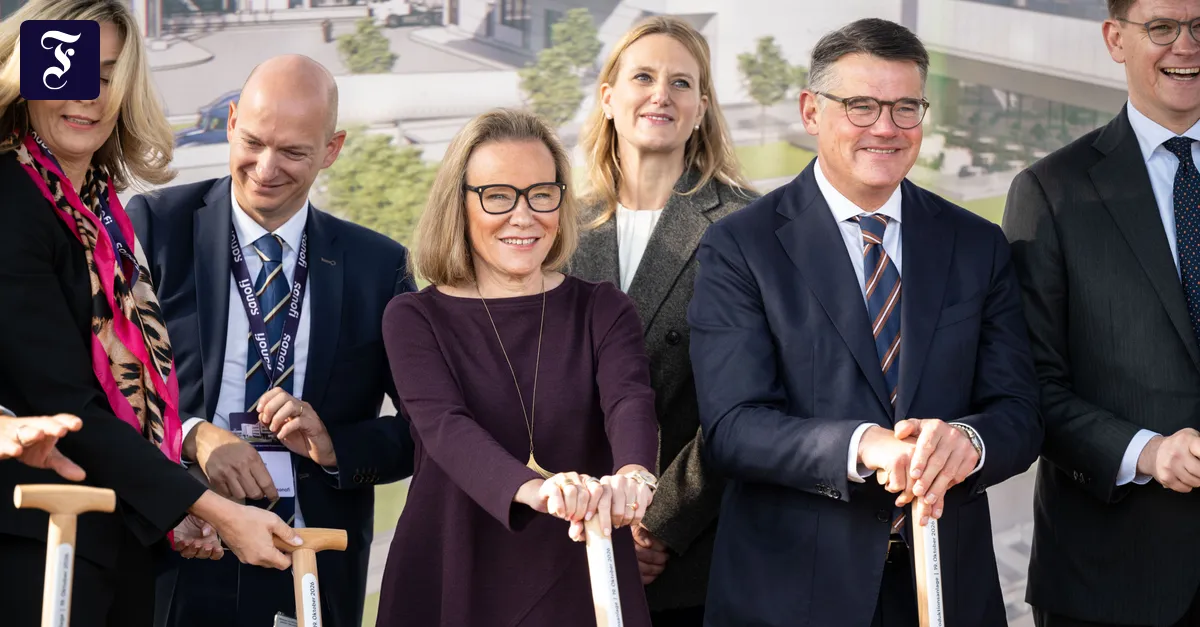
The laying of the foundation stone for Sanofi’s new insulin production plant was Belén Garijo’s first visit to Frankfurt since she moved from Dax company Merck to the head of the French pharmaceutical group Sanofi. Accordingly, her joy on Monday was to return to her “old home”. The Spaniard will also come more often in October – there is a lot to prepare. In 2032, the new facility, which covers an area of five football pitches, is expected to start operations, becoming the largest insulin production in the European Union. In addition to Sanofi, which has been manufacturing insulin in Frankfurt since 1923, only the Danish pharmaceutical company Novo Nordisk operates a plant in Europe. The investment of two billion euros, which Sanofi spends on the construction, has subsidized the city of Frankfurt, the state of Hesse and the federal government with a total of 400 million euros in subsidies. Hessen’s Prime Minister Boris Rhein and Frankfurt’s Mayor Mike Josef performed at the groundbreaking ceremony alongside Belén Garijo. Conditional support The EU had released the German subsidies under the premise that Sanofi produces at least 1.1 tons of insulin annually at the Frankfurt site and also holds a ton of insulin for crisis cases in the next ten years. In the event of an insulin shortage, Sanofi also undertakes to supply the European market as a priority. Brussels justified the decision in September by making the supply of human insulin and so-called insulin analogues more resilient, as supply shortages are not rare. Similarly, the dependence on active substances produced in China and India is increasing strongly. While the pharmaceutical industry purchases about 80 percent of its active ingredients from Asia on average, Sanofi Garijo’s share is only five percent. “And this is no coincidence,” stressed the Sanofi chief. “This is a strategic decision, a conscious investment in European production and in the security of supply in Europe.” In her speech, Garijo recalled the Covid-19 pandemic, which painfully demonstrated the consequences of shortages of vital medicines. For people who need insulin on a daily basis, a disruption of supply is not a mere inconvenience. It can actually be life-threatening, says Garijo. Parallel to the production plant in Frankfurt, Sanofi is also building an insulin factory in China, both of which will work closely together in the future. According to the World Health Organization, more than 70 million people worldwide are treated with insulin. The majority of these are patients who suffer from type 1 diabetes and have to supply insulin for life. Thus, their pancreas is no longer able to produce the hormone itself and regulate blood sugar. The global market for the production of insulin is highly concentrated. In addition to the French group Sanofi, which serves about a third of the market, Novo Nordisk and the US group Eli Lilly have been among the largest manufacturers for decades. However, given the high demand for weight-loss syringes, which sometimes require patients with type 2 diabetes, Novo and Lilly are increasingly shifting production capacities previously earmarked for insulin to weight-loss drugs such as Wegovy and Zepbound. Sanofi boss Garijo explains in an interview with the F.A.Z. that this increases the need for insulin even further. “This means we need more capacity.” In addition, copycat preparations from Asia are entering the world market, which is likely to lower prices.
Source: FAZ ›

Comments (0)
No comments yet.