Youth Conference: What does the climate movement actually do?
The young generation of climate activists is looking for ways to new visibility. For them, this also includes becoming more positive. And more pragmatic.
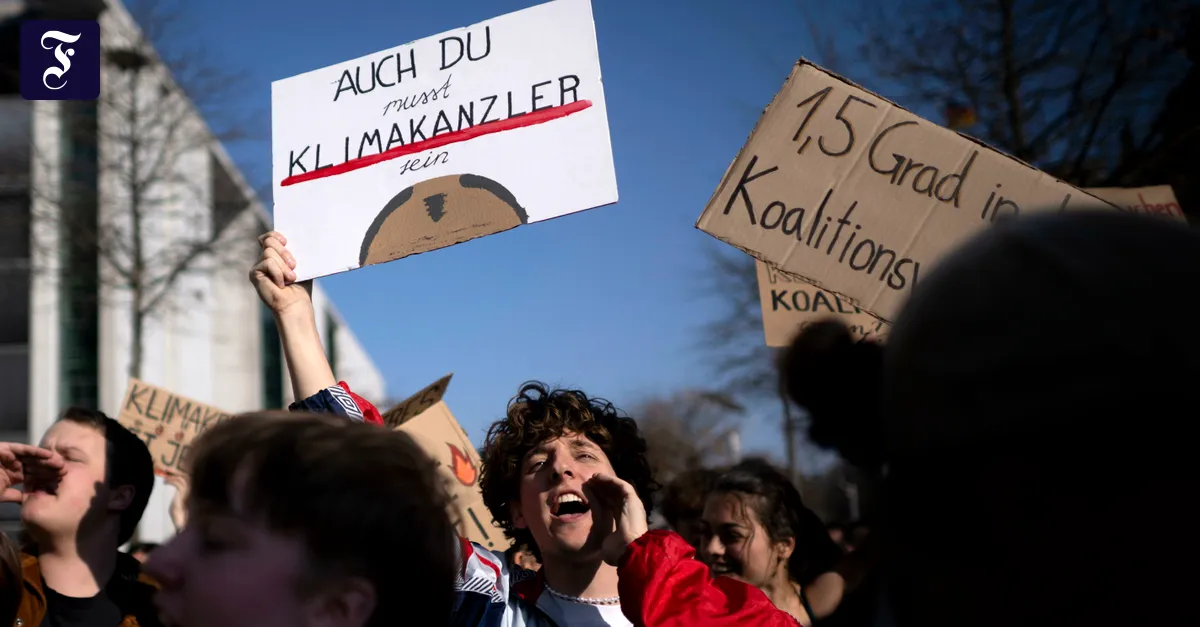
The doubts about the German climate movement have once again become louder in recent months. It was described as crisis-ridden, burnt out or failed from outside, but also from within its own ranks. And because the summer was particularly hot, the question of where the climate activists are was asked especially often. At the weekend they are easy to find: In a vocational school in Munich-Moosach, 1,300 young people gather to talk about the climate. Many of them sleep in the gym, during the day they sit in workshops, discussions and lectures. The Local Conference of Youth, or LCOY for short, is the national offshoot of the Global Climate Change Meeting (COY), where young people meet regularly before world climate conferences. In Munich, the conference is sponsored by the Federal Ministry for the Environment and organised by volunteers. Seven years ago, LCOY took place for the first time in Germany, at that time in Heidelberg. That was two weeks after Fridays for Future had put more than a million people on the streets nationwide with their third climate strike. They protested for compliance with the 1.5 degree target, the climate movement was at its peak. But then it got more complicated. Groups like the Last Generation emerged and polarized with roadblocks, hunger strikes or color at the Brandenburg Gate – with some hesitation Fridays for Future distanced itself from it. At the same time, their list of climate policy demands became longer and more specific. They also increasingly devoted themselves to other construction sites, such as the fight against right-wing extremism. In addition, the Corona pandemic slowed down their protests. And later, at least as many climate activists are convinced today, other crises followed that cost them public attention. However, last summer, which the German Weather Service classified as the second warmest since the beginning of the record and which, according to estimates by the Robert Koch Institute, resulted in 16,000 heat deaths, some had hoped for a wake-up call. Various organizations in the climate movement tried to mobilize for demonstrations. But the masses were no longer on the streets. What has changed? On Saturday morning Maiken Winter stands in a classroom of the vocational school in front of a flip chart. Winter is a sustainability consultant at the Bavarian Consumer Centre. For the Day of German Unity, she and her association “Wissen.Leben” organized nationwide human chains for a new start in German climate policy. The organizers spoke of around 20,000 participants, making it one of the largest climate protests in Germany in recent months. In the past, she supported the last generation, says Winter. “But that is clearly not the way.” It must now be more about reaching the middle and getting out of the climate bubble. She talks to the participants about hurdles that stand in the way of individual commitment to more climate protection. This takes time, because many hurdles come to the young people. Convenience, for example, too little time, or doubt about how much such a demo brings at all. But also a certain competition with other threats is complained. One student says she is undecided about what her activism should be against. Climate change, social inequality, the shift to the right? She feels like she has to decide. This can be heard again and again at the weekend. There are so many other trouble spots, says a political student from Berlin, who has traveled together with a fellow student. It is above all the fight against right-wing extremism that displaces climate issues, says another participant. Many young climate activists see it similarly – the focus has shifted, so the tenor. Even Munich’s mayor Dominik Krause of the Greens, who speaks a greeting at the opening on Friday, considers the discussion to be raptured. It is all about right-wing extremism. But the people who took to the streets seven years ago for climate protection are all still there. On Saturday noon you can hear dishes rattling everywhere on the premises of the vocational school, many eat outside. It is the only time when a workshop is not running somewhere. Shortly afterwards, the whirlwind increases again, the participants stroll to the houses, look for rooms, stand in front of the screens for longer. More than 20 events take place regularly at the same time. They range from insights into Arctic research or climate lawsuits to discussions on left-wing extremism in the climate movement to tips on demo planning. One of the organizers is Julian Hirschmann. He agrees that: The climate movement is still there. It just changed. “It may have become less visible, but it is much better placed.” Hirschmann is 26 years old and holds a doctorate in experimental physics. Meanwhile, many in the climate movement are better connected. More and more, it is possible to bring concrete concerns directly to where they belong: in companies or to local decision-makers, for example. He also talks about climate start-ups that were founded on LCOY. Prominent politicians may not be as easy to win as before for a visit, says Hirschmann. For experts, it is exactly the opposite. He sees the climate movement as a whole on the way to institutionalizing itself. Compared to 2019, it has become more concrete, he finds: “It is now a lot about implementation.” In the municipalities, the climate protectors encounter pragmatism So you look in Munich this weekend also in the Spreewald. More precisely: to Eichwalde, a municipality with about 6500 inhabitants. You have young volunteers of the association “Stadt.Land.Klima!” a few days ago a..
Source: FAZ ›

Comments (0)
No comments yet.