“King Ubu” in Vienna: The dictatorship of unscrupulous comedians
Stefan Bachmann stages Alfred Jarry’s grotesque “King Ubu” at the Burgtheater in Vienna as a dystopian farce about human lust for submission.
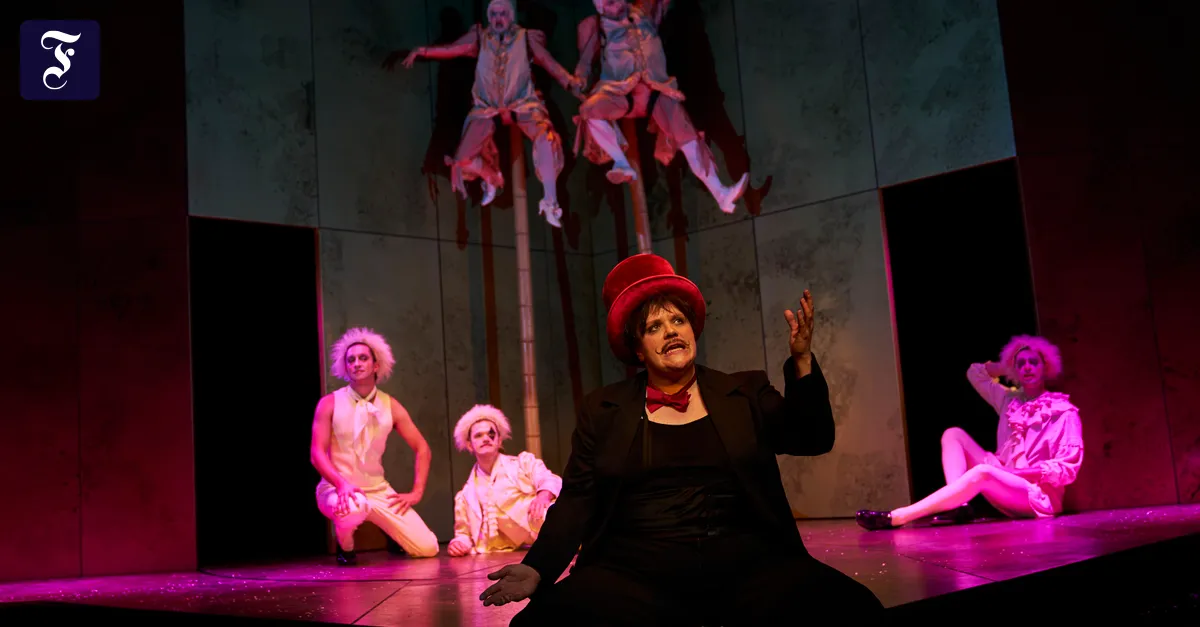
Perhaps it is not the piece of the hour, but perhaps the piece of the mood of the time. In recent years, “König Ubu” has been performed in the entire range of theatre halls: in the Ansbach Theater Kopfüber and in the Stuttgarter Materialtheater as well as at the Weimarer Kunstfest or at the Thalia Theater Hamburg. Although it is created as the first part of a trilogy, the piece often has to prove its existence alone. As an actor, it serves the boldly exaggerated reflection of today’s political conditions in near and far. It is therefore all the more pleasing when a staging, instead of providing ambiguities, trusts the text and its theatrical power, relies on playfulness and stage intelligence as now in Vienna. Burgtheater house owner Stefan Bachmann is not satisfied with Jarry’s first act for his staging and complements “Father Ubu”, as the play literally translates, by the almost dramlett remained “Ubu Hahnrei” and “Ubu in chains”. This is already the right decision because it takes “King Ubu” the harmlessness that the play has adopted over its 130 years. In the changelessness of his two characters father and mother Ubu, it is rather a type grotesque, which is saturated with great language and human wit, but can exhaust itself in a stale clothes. Complemented by the two subsequent parts, it develops into a cold satire of the vain corruptibility of human thought and a brilliantly dystopian farce of human love of order. True freedom is slavery! From the caricature of corruption in the first part, in which Ubu as Macbeth’s revenant murdered the Polish king in order to ascend the throne himself, in the third part Ubu became a terrorist ruler. He has not only revalued all values (which proves Jarry to be a gifted Nietzsche polemicist), but also practices them as hegemonically as usual at the end of a revolution. The post-revolutionary Jacobin rule may have provided Jarry with enough visual material for his caricature. In addition to the arbitrariness of the rulers, the slave morality of those who sacrifice their self-determination to the externally controlled life for the cheap promise of the clarity of a front garden idyllic. “True freedom is slavery!” cry all from left and right. The whole trilogy shows that Alfred Jarry was more than the crazy inventor of the absurd theater, who used a pistol instead of a bicycle bell. He proves to be a merciless portrait of man as a zoon politikon who wants to be seduced as well as seduced. You don’t get that shown too often in the theater anymore. The signs in Vienna were not consistently successful. Some time after the start of the rehearsal, Joachim Meyerhoff, who was appointed as father Ubu, was out of health. Stefanie Reinsperger, who was actually cast as mother Ubu, took on his role, Sebastian Wendelin stepped in as mother – gender exchange represents a not insignificant change in the staging concept. It seems as indulgent as it is consistent not to expect Wendelin to have to step in as father Ubu for a colleague with whom he would have been compared, for better or worse. Thus, the double recast seems less artistically conditioned, but its artistic profit arises. Wendelin proves to be a brilliant cast of the mother Ubu, who is in no way inferior to Reinsperger's father presence. In phenomenal contrast, they are such a congenial Grand Guignol couple that any reference to Stan Laurel and Oliver Hardy proves to be superfluous. Already her first appearance before the darkening of the hall is one of her hussar pieces, which must remain unwritten for reasons of discretion in order to save the pointe. It is a more than worthy replacement of the famous first Ubu word, which of course still falls: “Crap!” Everything fits together this evening. How Wendelin and Reinsperger force the audience to their subjects and vicarious accomplices in a way that rarely works (only a brave spectator, urged to participate, waves them away with resolute “screw it!”); how they rose to become the best “financial masters” of all time (“Get rid of the finances and drink yourselves to death, that’s the luck of the bad guys”), as if Jarry were also the author of the Klingbeil lines “then the Porsche and the Rolex are gone for now”; How both let the first hour before the curtain flash through the wickedness of sadistically based arbitrariness through sillyness, Klamauk, slapstick and grotesque is already great theatre. That it succeeds to turn a meaning-analytically predetermined piece into a firework of wit and subtlety is mainly due to the actors, but what would they be if they were left alone. After the Ubus sailed past the Helsingør Castle, the place where Hamlet's doubts lived, on their escape from the Russians to France, they land in the middle part in the first stage set by Olaf Altmann. Of course, he pulls all the stops of the stage machinery, everything raises and lowers and turns. The iconic house of Ms. and Mr. Achras (equally congenial: Stefanie Dvorak and Gunther Eckes) houses the brilliant performance on the ideals of the Enlightenment, on Leibniz’s calculability of the world, on Goethe’s harmony of politics and spirit, on Voltaire’s harmonious happiness in the world. There stands the parade intellectual couple in minuet shoes, pink silk suit and braid wig (costume: Adriana Braga Peretzki) and presents the aesthetic suspicion of their moral powerlessness from the very top: they are piled. In addition, the excellent live music and choreographed brutality of the Rüpelchor singing through the house..
Source: FAZ ›



Comments (0)
No comments yet.