Rover Idefix on board: Japanese probe to Mars system launched
A Japanese space probe with the German-French rover Idefix on board could write space history: For the first time, the mission is to collect rock samples from the Mars moon Phobos and bring them back to Earth.
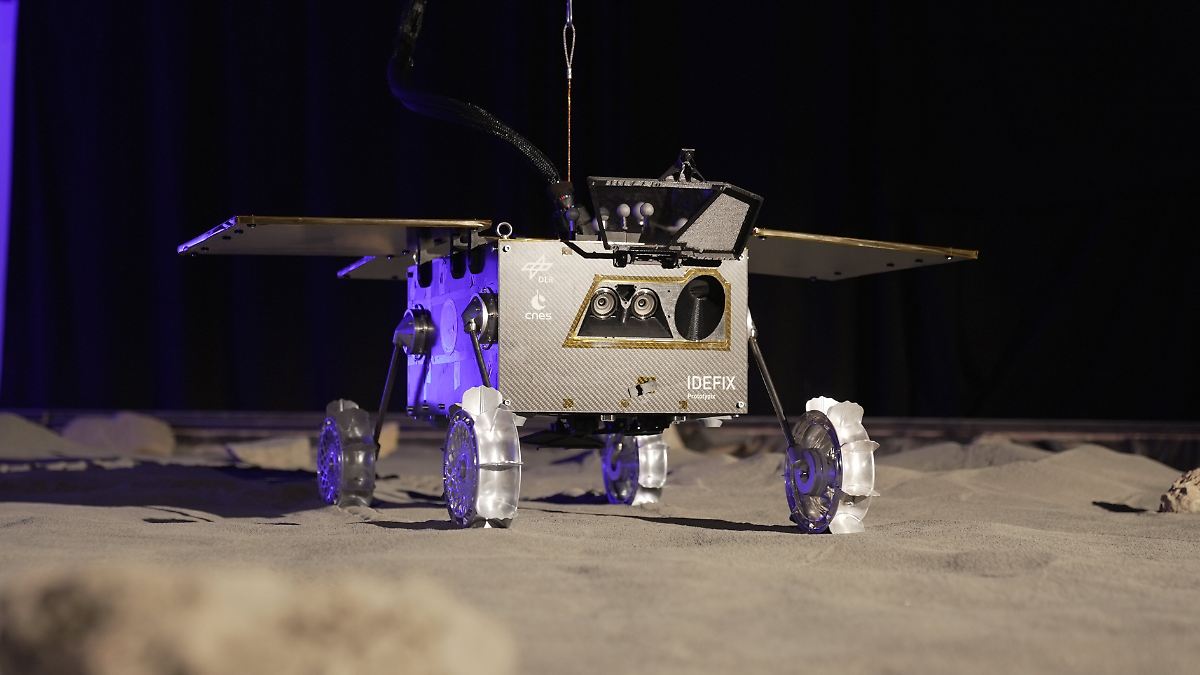
A Japanese space probe with the German-French rover Idefix on board could write space history: For the first time, the mission is to collect rock samples from the Mars moon Phobos and bring them back to Earth.
Launch of a historic space mission with German support: Japan’s space agency Jaxa wants to bring material from the Martian region to Earth for the first time and has sent a space probe into space. A good hour after the launch of the launcher in Japan in early Tuesday local time, according to Jaxa the probe, which is to explore the two Martian moons. On board was the German-French Rover Idefix. Federal Space Minister Dorothee Bär said she was “proud” of Germany’s contribution to the mission.
The H3 launcher launched from the Japanese spaceport Tanegashima. A good hour later, the space probe disengaged and began "their journey to the Mars system", as Jaxa stated in a live broadcast. Jaxa scientist Mari Aida was relieved. “I dreamed of that day, I’m incredibly happy.” Thousands of people followed the live stream and commented on the event with news.
After a long journey through space, the spacecraft is expected to orbit the Mars moon Phobos from August next year, then land on it and finally collect at least ten grams of soil samples to then bring them to Earth. The Rover Idefix - named after the small dog of comic book hero Obelix - is intended for exploration of Phobos. According to the German Aerospace Center (DLR), it was developed and built by DLR and the French space agency CNES.
The landing on Phobos is planned according to DLR about the turn of the year 2028/2029. According to the head of the Martian Moons eXploration (MMX) mission, Yasuhiro Kawakatsu, the planned sampling on Phobos is "a world premiere". In addition, MMX is the first space mission, in which there is a one-way flight to Mars and a return flight to Earth. According to DLR, Idefix Phobos will explore 100 days.
Another part of the mission is observing Deimos, another Mars moon. A landing is not planned there. The capsule of Phobos rock samples is expected to land in Australia in 2031.
Japan is working on the mission with the European Space Agency ESA and the US Space Agency Nasa. DLR has participated in the Mars Moon rover with six of its institutes and facilities at five locations.
The DLR Institute for Robotics and Mechatronics is therefore responsible for overall project management and, together with the Institute for Space Systems, for system engineering. In addition, the DLR Institute for Robotics and Mechatronics has designed a software solution to autonomously navigate the rover on the Phobos surface. The User Center for Space Experiments (MUSC) in Cologne, together with the French University Université Côte d'Azur, is the scientific director for the rover. Control centres in Cologne and the French space agency CNES in Toulouse operate the control centres for Idefix.
Federal Space Minister Bär said that the "space location Germany" shows impressively what it could do: "high-precision technology, which must still work perfectly in the expanses of space on the Mars moon Phobos". Jaxa, DLR and CNES worked together to explore our solar system. "At the same time, with Idefix, we are also entering new technological territory - that is high-tech hand-in-hand." DLR chief Anke Kaysser-Pyzalla said that with the Rover Idefix, Germany and France "sent a piece of European robotics expertise on an extraordinary research trip".
The Japanese space agency hopes that the mission will provide insights into the formation and composition of the Mars moon. In addition, the MMX mission will show whether Phobos can be used as a kind of "natural space station". For a later manned exploration of the Red Planet, as SpaceX chief Elon Musk plans in the long term, this would be essential.
Source: n-tv ›


Comments (0)
No comments yet.