Munich Climate Week: “We are racing towards a much hotter world”
In Munich, the first “climate week” has begun. At the opening ceremony, Luisa Neubauer goes tough with the Federal Government – and announces the next climate strike.
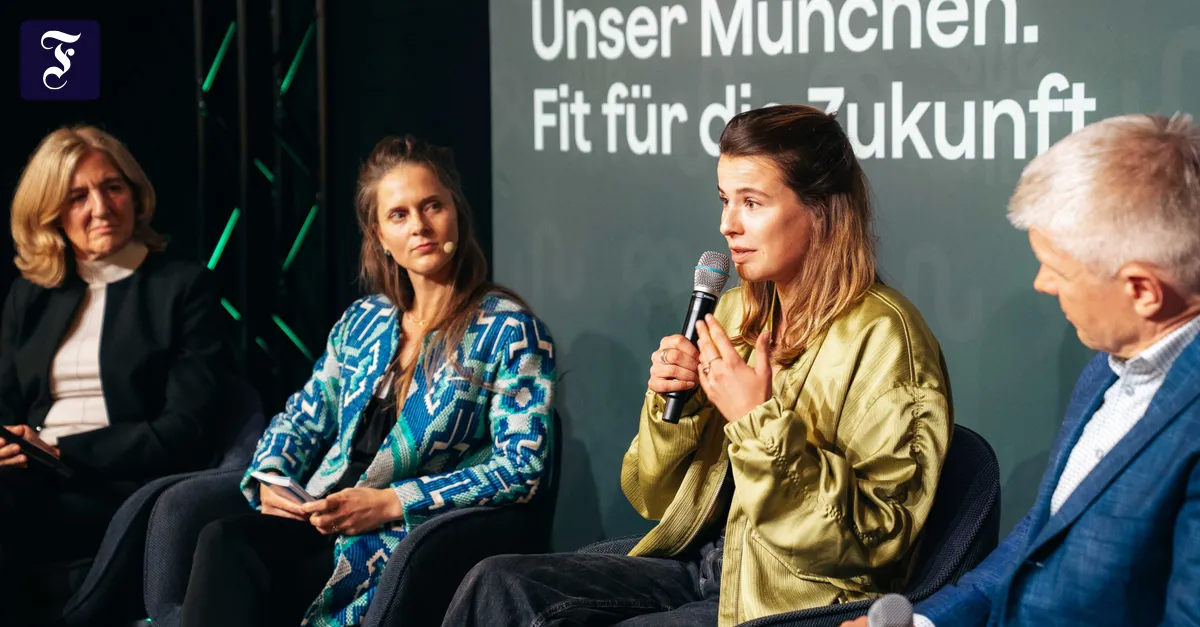
For climate protection activist Luisa Neubauer, the climate issue is anything but “through”. This became clear at the first Munich Climate Week, which was opened on Monday evening in Schloss Nymphenburg. The celebration was well attended: young and old, women and men, entrepreneurs, professionals and activists. The goal is to make climate protection more visible and effective. Several times this evening it will be highlighted how many start-ups, tech hubs, corporations and research centres are represented in the Bavarian capital. If you talk about climate pioneers, if you talk about cities that are pioneers, then internationally it is not yet about Germany. I am delighted that Munich Climate Week is now sending out a signal that they are part of the change, says the face of the Fridays for Future movement, Luisa Neubauer, at the panel. Munich should serve as an example. Young people are angry and disappointed. They see their future being burned, says the thirty-year-old. “It breaks my heart.” After seven years of protest, one could not believe that “eco-depressed youth” could solve the climate problem alone: “This is not how it works.” Even before the opening ceremony, the activist goes hard with the climate policy of the Federal government in the court. In a press round she speaks of a “proactive silence of macroeconomic major crises” and a “structural failure”. In climate policy, much has been delayed and delayed. This is disrespectful and dishonorable to the country. We are going crazy about it. In addition, one should be “honest” about the costs of climate damage. “Doing nothing is the cost factor” This is similar to Mariana Pedraza-Copete. She is the founder of Munich Climate Week (MCW). The investor has Colombian roots and speaks seven languages. You started as a small team, now more than 100 volunteers belong to it. In her speech, the MCW Board of Directors commemorates this summer and the 16,000 heat deaths. “That’s twice as many as in the heat summer of 2018,” she says. “Doing nothing is the cost factor.” She points to an analysis by Triodos Bank. According to the Dutch financial institution, the damage caused by extreme heat and forest fires could rise to a total of 180 billion euros this year. That is why it is clear: “We want to put climate protection at the heart of society.” Pedraza-Copete emphasizes that one has to find a solution “together” and wants to “build bridges”. Over the course of the week, there will be more than 400 events in the state capital, including film evenings, repair cafés, presentations of climate technologies and expert panels. 12,000 participants have now registered. In his short speech, Munich Mayor Dominik Krause emphasises that Germany is in the midst of a “transformation process”. He had heard the question why the climate protests on the German streets, this “wake-up call”, had faded away. “The political pressure is easing,” says the green local politician. “We are at a crossroads.” According to Krause, who is also patron of Munich Climate Week, countless people and institutions have long been working in Munich on a sustainable future – “often without knowing each other”. “The Munich Climate Week brings them together and makes visible how much departure there is in this city.” These networking possibilities must be used. “This is irrational and highly ideological” climate activist Neubauer is happy about “the positive spirit”. “However, we are racing towards a much hotter world,” she says. According to Neubauer, fossil fuel interest groups, powerful Internet corporations and “techno-fascists” are in a “clash” with the global environmental movement. There is no reason to throw the towel. They fight for everything, then we should fight ten times as hard. There will also be setbacks. She finds it wrong that “the economy” is delaying the phase-out of fossil fuels: This is irrational and highly ideological. It is improper to go into collapse instead of protecting people. Günther Thallinger, another panelist, has been on the Allianz Board of Management for around ten years. At the end of the year, he leaves the group. The graduate mathematician describes what the climate crisis means for the insurance industry. “Climate is included in every plan,” he says. “Economic competitiveness cannot exist without sustainability.” Nevertheless, a guiding principle is missing in the implementation of the climate goals: “Where do we want to go?” The policy must go ahead, he demands. The climate crisis should not be minimized, relativized or denied, warns Luisa Neubauer, whose Fridays-for-future movement has been somewhat paralysed in recent years. But she quits for the 13. November the next climate strike to set a sign during the world climate conference in Turkey (COP31). The demand is: Germany must keep its promises and meet its climate debt. #PayYourClimateDebt
Source: FAZ ›


Comments (0)
No comments yet.