Near miss: Indonesia probes crash of suspected Chinese rocket fragment
Indonesia’s National Research and Innovation Agency said the debris appeared to come from a Zhuque-2E rocket.
Sign up now: Get insights on Asia's fast-moving developments
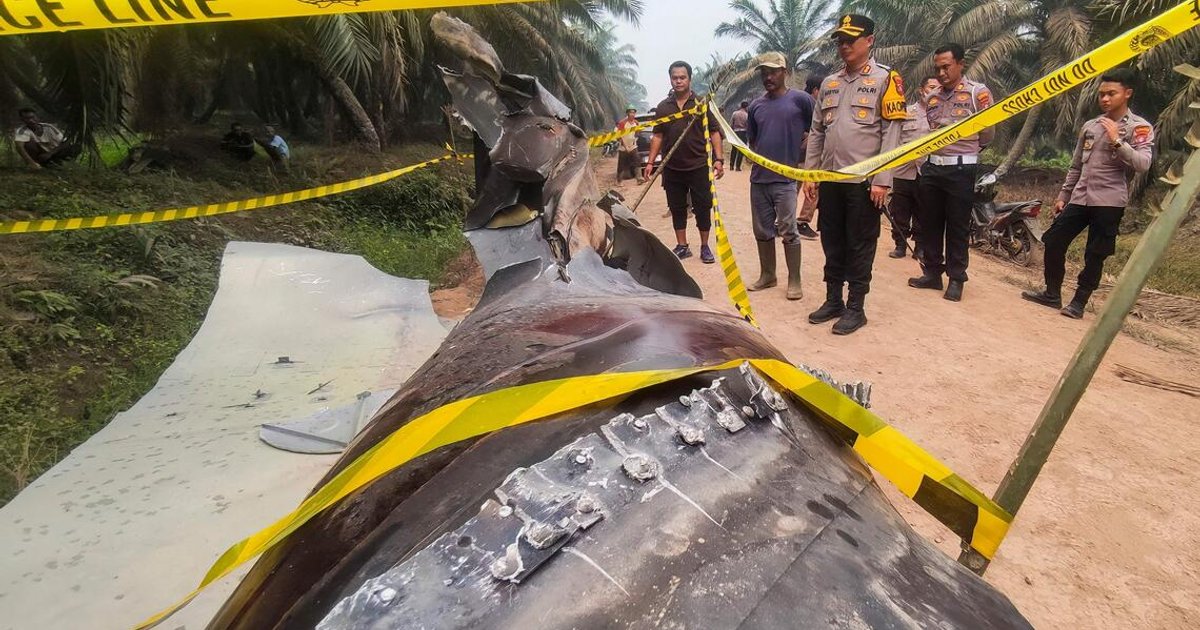
JAKARTA – Indonesian authorities were investigating on Oct 20 after a car-sized piece of debris, possibly from a Chinese rocket according to a government agency, crashed into an oil palm plantation near homes and work sites.
The debris was found on the morning of Oct 19 by a plantation worker in Indonesian Borneo, after residents reported hearing a loud bang the previous evening over a remote area of Central Kalimantan.
“It was just there. At first, I thought it might have been aircraft debris,” Wardi Tamroni told AFP of his discovery near the town of Sampit.
Wardi, 51, said the object had crashed about 3km from the housing complex of the Agro Bukit palm oil company he works for. “We usually carry out our activities in the area where the object fell,” he added. “Fortunately, all the workers had already gone home, so no one was left in the plantation.”
Local police chief I Kadek Dwi Yoga Sidhimantra described the object as “a fairly large aluminium plate measuring up to 9m with an irregular shape and visible burn marks”.
The incident did not cause loss of life or property damage, according to civil aviation spokesman Zachrudien, who, like many Indonesians, has only one name.
The debris also posed no radiation or toxicity risks, he added.
Indonesian authorities were investigating on Oct 20 after a piece of rocket the size of a car crashed into an oil palm plantation.
Indonesia’s National Research and Innovation Agency (BRIN) said the debris appeared to have come from a Chinese Zhuque-2E rocket.
The Chinese government said last week that a Zhuque-2E rocket had launched 10 satellites into space from a commercial launch site in the country’s north-west.
The China National Space Administration could not be immediately reached for comment.
BRIN researcher Thomas Djamaluddin said in a statement that not all parts of a spacecraft necessarily burn up on re-entry into earth’s atmosphere, and more heat-resistant parts may reach the surface. “This phenomenon is one possible explanation for the discovery of a large metal fragment in an oil palm plantation in Sampit,” he said.
Debris usually crashes into the oceans, which cover about 70% of earth’s surface.
On the morning of Oct 20, a second piece of debris thought to be from the same rocket was found about 1km from the first, according to Zachrudien.
“We plan to inspect it. From the photographs, the object appears to be round and related to the first object,” he told AFP.
“Its material also appears to be an aluminium alloy, but we will need to verify this.” The pieces were being examined at a nearby military airbase.
According to the European Space Agency (ESA), the casualty risk to individuals on earth due to uncontrolled re-entry was lower than that for rare accidents such as lightning strikes or shark attacks – though it is rising.
“Although the re-entry risks are still relatively small, they have grown considerably from 2019 to 2024, mainly due to increased space activities,” the ESA Space Debris Office said in a report in 2025.
Wardi, the plantation worker, said of the freak event: “If we had to anticipate something like this happening every day, we wouldn’t be able to do our jobs.
“We have to leave it to fate. What else can we do?” AFP
Source: The Straits Times ›




Comments (0)
No comments yet.