Monger-paid workers, listen to the threat of IHSG Rontok to your purse!
IHSG and compact basement fall. Even if you don't play stock, a small pawnbroker can be impacted. How does the threat of market turmoil into the contents of a citizen's cute wallet?
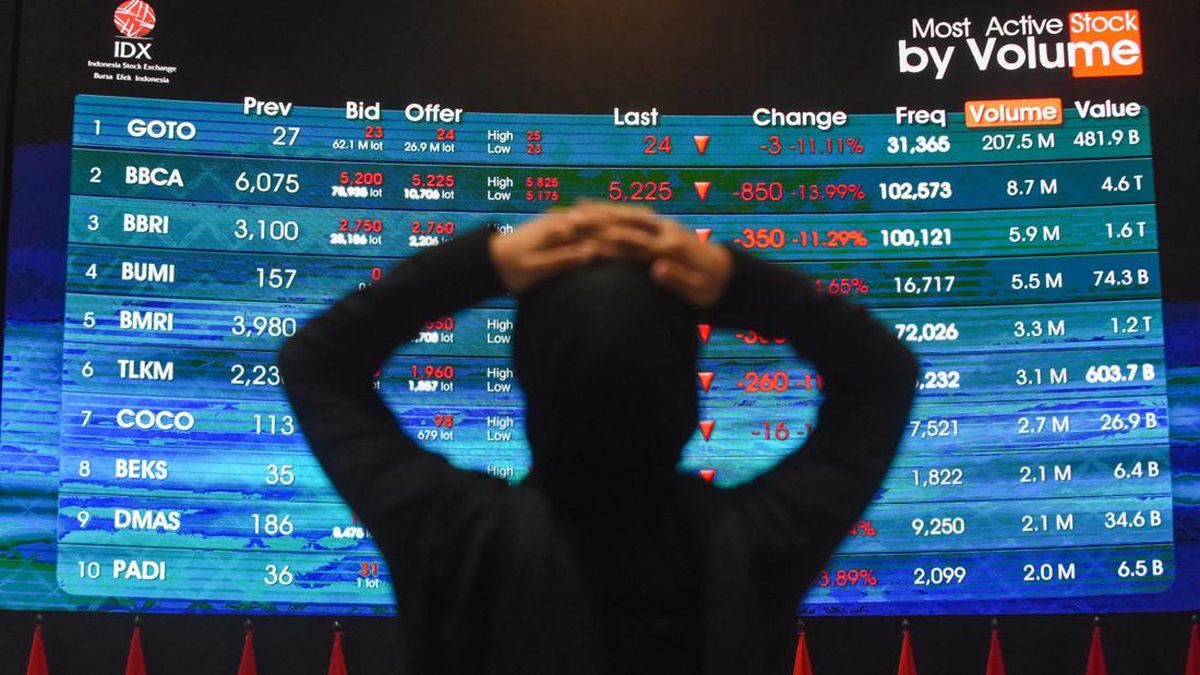
Combined Stock Price Index (IHSG) closed 3.64 percent down to level 4.996 on Monday (19 / 10) over MSCI announced to consider Ran's capital market dropped from Emerging Market to Standalone Market.
The stock index is down 188.49 points compared to the previous trade, with 656 confirmed shares, 100 stocks increasing, and 43 stagnant shares.
To quote RI Infokom, the stock trade value reached Rp25.06 trillion with a volume of about 33.93 billion shares. All 11 stock sectors ended up in the red zone, with the default sector recording the deepest remission of 4.57 percent.
The stock market turmoil is happening in the midst of the pressure surrounding Rp18,000 per US dollar, the conditions are raising concerns about the impact on the wider economy, including the cost of people and job opportunities.
Even though most of the low-income workers don't have stocks, they are potentially impacted indirectly through a price increase of basic needs, changing the business decisions of the company, to slow down the hiring of labor.
Then, how far can IHSG fall affect the life of a small-wage worker? Is the market turmoil potentially cramping the purchasing power so that it drives society down economic grade?
Chief Economist Jewels of Joshua Pardede's Bank assessed the fall of IHSG did not directly reduce labor wages. However, the impact can be ploughing through the rupiah, rising cost of financing, corporate investment, and the market conditions of labor.
"
According to him, when foreign investors withdraw funds from the domestic market, pressure can go to the exchange rate. If it lasts long, the importing costs of raw materials, energy and everyday needs are potentially increased.
The company then faces an increase in production costs that can drive up the sale price, press profit, or make business expansion delayed. In those conditions, the company also has the potential to withstand recruitment, reduce overtime, and delay the raise.
The impact is harder for low-income workers. Because, most of his income is used to satisfy the basic needs. Joshua called the group 20 percent of the population with the lowest spending allocated 64.6 percent of its shopping for food.
"That is, when the price of basic needs increases while the salary doesn't grow, the space to finance transportation, education, health, and savings becomes more narrow," obviously.
He gives us an illustration of Rp3 million a month who allocated 60 percent or around Rp1.8 million in income for food. If food prices go up 5 percent, and the purchase rate is fixed, then the spending increases Rp90 thousand per month.
The addition can feel meaningful to families who still have to pay rent, transportation, electricity and child needs. However, Joshua confirmed the calculation was only illustration, not prediction that IHSG's fall must have caused a 5 percent increase in food prices.
"In that condition, low-income families are forced to reduce consumption, delay important needs, or use savings to sustain daily life," the opening.
According to him, long-term risks appear when financial market pressure makes the company delay investment, factory development, or branch opening. That condition can slow down the creation of jobs and withstand the rise in public income.
Joshua assessed the risk of dropping economic status does exist, but it didn't occur automatically just because IHSG fell. These risks grow when the real revenues, the increase in living expenses, and the uncertainty of jobs takes place simultaneously.
A low middle class group and a society that's a little above the poverty line becomes one of the vulnerable groups because it doesn't necessarily have enough savings to face a few months of income loss.
The families who were previously able to pay home payments, school fees, and daily needs can be forced to reduce consumption, drain savings, sell assets, or add debt when income goes down.
"In the long run, these conditions can lead from middle class groups to vulnerable groups, even increase the risk of poverty if the pressure lasts long enough," obviously.
Nevertheless, economic class changes must be proven through real household spending data, not directly concluded from the IHSG movement.
To face uncertainty, Joshua advised low-income workers to prioritize the financial stability of the household, not pursue high-investment profits in the middle of a raging market.
He oversees public needs, evaluates spending that can wait, build emergency funds gradually, and avoid high-interest consumptive loans.
And then, savings or deposits that meet the terms of the guarantee of the Penitentiary can also be considered for short term needs.
Senada, the Andalas University Economics of Andalas Shaund Karimi assesses the impact of IHSG's downfall on low-income workers depending on how far the market is spreading into the economy.
"IHSG relations with citizen wallets work through trust lines, cost of financing, exchange value, investment, and workspaces," synonymous.
According to him, if the market pressure lasts a long time, the rupiah infusion can increase the cost of imports and raw materials. At the same time, corporate funding costs are potentially increasing so the business world is more careful about investing and recruiting workers.
In the long run..
Source: CNN Indonesia ›

Comments (0)
No comments yet.