US troops in South Korea must be ready for missions beyond peninsula, commander says
The commander of the US Eighth Army in South Korea said his troops must be ready for deployment outside the Korean peninsula if ordered, arguing that it would be “irresponsible” to focus “myopically” on threats there. Lieutenant General Joe Hilbert said that while his command’s focus was on fulfilling US commitments under its mutual defence treaty with Seoul, the Eighth Army’s location did not limit the missions it could undertake. It would be “irresponsible to focus myopically” on threats on...
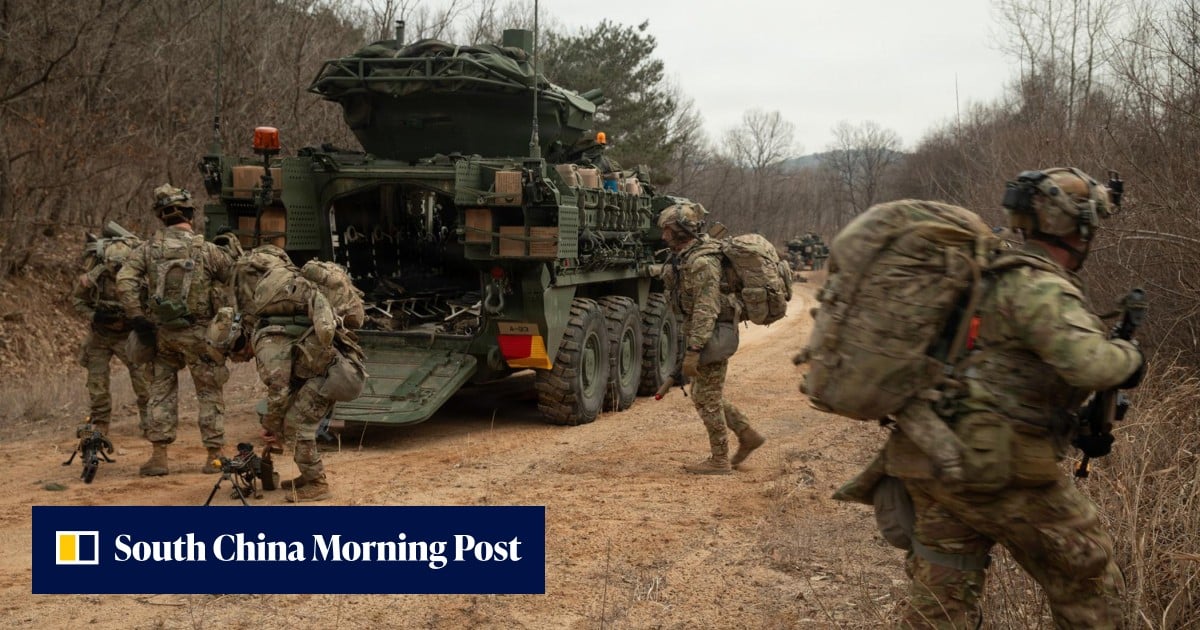
The commander of the US Eighth Army in South Korea said his troops must be ready for deployment outside the Korean peninsula if ordered, arguing that it would be “irresponsible” to focus “myopically” on threats there.
Lieutenant General Joe Hilbert said that while his command’s focus was on fulfilling US commitments under its mutual defence treaty with Seoul, the Eighth Army’s location did not limit the missions it could undertake.
It would be “irresponsible to focus myopically” on threats on the Korean peninsula alone, he told the South China Morning Post by email, or to “suggest that we cannot do other things simply because we are in Korea”.
Describing the Eighth Army as part of a “global force” that trains for “readiness so that we can deploy where needed by our national command authority,” Hilbert cited the Eighth Army’s participation in multinational exercises across the Asia-Pacific as an example of its activities beyond the peninsula.
“We view readiness as largely threat-agnostic. If we have a trained, ready force capable of executing the Army’s assigned missions, we can apply that force against whatever threat is required,” said Hilbert.
“So, we train every day with our Korean allies against our principal threat, while also ensuring we remain available and ready for whatever the nation may require.”
Hilbert’s comments reflect the Trump administration’s push to place greater responsibility on allies for their own defence while increasing the strategic flexibility of United States Forces Korea (USFK), allowing American troops to be deployed beyond the Korean peninsula for contingencies elsewhere in the Asia-Pacific.
Headquartered at Camp Humphreys in Pyeongtaek, south of Seoul, the Eighth Army commands US ground forces in South Korea. It is the only US Army stationed on the Asian continent in the Asia-Pacific region and the sole permanently forward-deployed American field army.
As part of the roughly 28,500-strong USFK, the Eighth Army has traditionally focused on deterring North Korean threats rather than preparing for contingencies elsewhere, such as in the Taiwan Strait. But the Trump administration has signalled a shift towards a broader regional role.
The national defence strategy, published in January, instructed that Washington aim for “strong denial defence along the first island chain,” while calling for Seoul to take “primary responsibility” for deterring Pyongyang with “critical but more limited US support”, noting that the “shift in the balance of responsibility is consistent with America’s interest in updating US force posture on the Korean peninsula”.
The first island chain refers to a string of islands and archipelagos running from Japan through Taiwan to the Philippines and the South China Sea. The Korean peninsula falls within this line.
During a press briefing in August last year, General Xavier Brunson, commander of USFK, said that “strategic flexibility” will be at the centre of the “alliance modernisation” between Seoul and Washington in responding to the “threat” that nuclear-armed China, Russia and North Korea pose to a “free and open Indo-Pacific”.
A more reciprocal US-South Korea alliance
Lami Kim, Korea chair in advanced technologies, national security and defence at the International Institute for Strategic Studies in London, said that the nature of the alliance is shifting towards a “more reciprocal partnership,” instead of Washington’s primarily “one-directional” responsibility to defend Seoul.
“Both countries are expected to contribute to each other’s security and South Korea assumes greater responsibility for its own defence,” said Kim.
“I think this is a natural evolution that reflects South Korea’s significantly enhanced military capabilities – a far cry from its position in the 1950s, when the alliance was first established.”
Troy Stangarone, a visiting senior fellow at the Korea Economic Institute of America, said that the broader trend in US-South Korea defence ties has been towards Seoul taking on a larger role, while growing its domestic defence industrial base, and the US seeking “greater flexibility” to utilise US forces for other contingencies.
“The United States has already moved forces and equipment off the Korean peninsula to support US operations, both in the recent Iran war and the Iraq war in 2003. I would expect it to continue to do so as conditions require,” said Stangarone.
Seoul’s enhanced military capabilities were reflected in its weapons’ recent integration and partnership with the US military. In August, the US Army awarded a contract worth up to US$260 million to South Korea’s Hanwha to deliver prototypes of its K9 Mobile Howitzer for its new Mobile Tactical Cannon programme – a first case of a South Korean weapons system acquired by the US military.
US defence contractor General Atomics also showcased a scale model of the Mojave short take-off and landing (STOL) drone at the Association of the United States Army (AUSA) Annual Meeting and Exposition last week. The drone was co-developed and co-produced with Hanwha Aerospace under a partnership agreement signed last year.
Keeping US forces supplied in the Pacific
Speaking at a panel discussion during the AUSA Annual Meeting, Brunson said the US Army is trying to “change” the “depot mindset” of maintaining US weapons and equipment by travelling back and forth between the continental US and the Asia-Pacific region, which often consumes several days and weeks for those systems to be delivered.
He said partnering with South Korea, which he described as having “an absolutely premier industrial base”, can achieve “admirable endurance” and keep US forces with an “enviable posture” within the first island chain.
“What’s going to be important in the future, in particular in a fight in the Pacific, is our ability to endure, whether that be able to protect the things that we’ve placed forward, or whether that be the ability to stay there because we can sustain ourselves inside the first…
Source: South China Morning Post ›

Comments (0)
No comments yet.