Riots in France: bewilderment and finger-pointing
Many people in France have reacted with shock and bewilderment to the violence during the protests. The political camps are vying for control of the narrative – and blaming each other for the escalation. By C. Dylla.
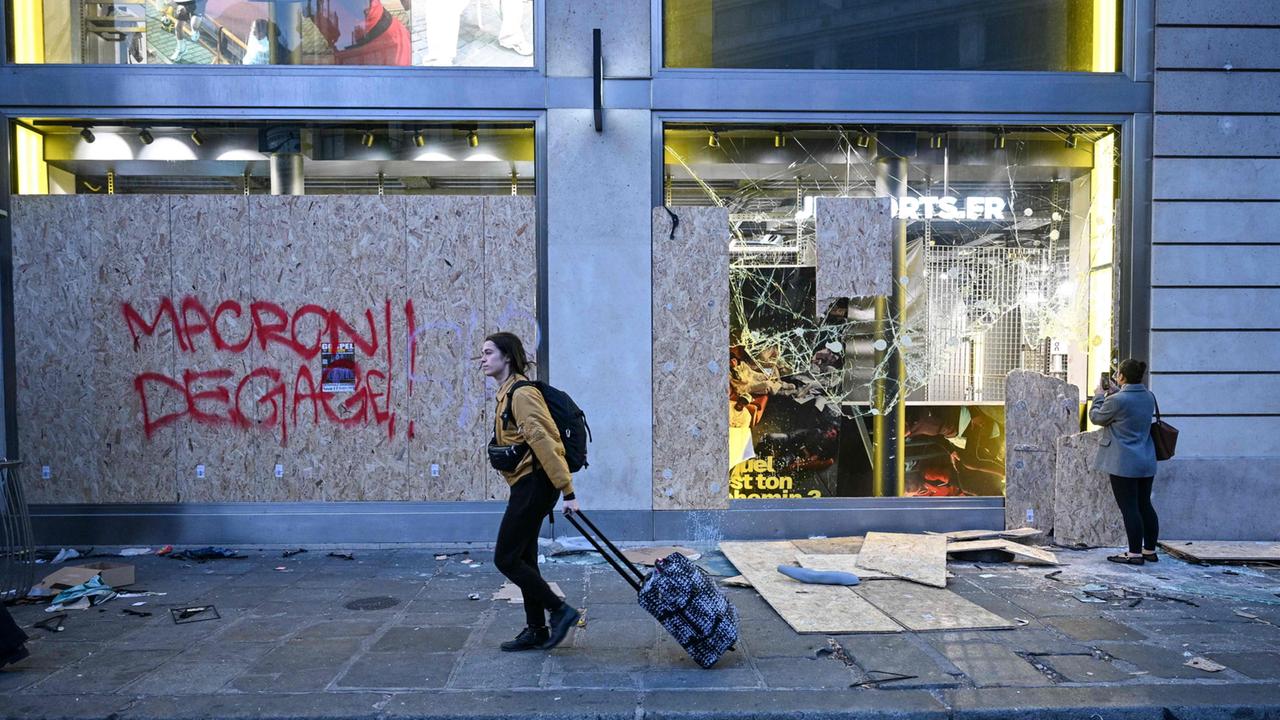
Many people in France have reacted to the violence during the protests with shock and bewilderment. The political camps are vying for control of the narrative – and blaming each other for the escalation. By Carolin Dylla Not far from the Place de la République, local residents are scraping a black mass off the road, in which the remains of an e-bike can still be made out. They are clearing away the traces of destruction as best they can. Nicolas stares in disbelief at his favourite café: set alight and burnt out. He condemns the violence, but supports the social protests. The media only talk about the violence now, he says. “And what has happened is very bad.” The fact that people have been demonstrating peacefully in many cities is no longer an issue: “Demonstrations where young people are fighting for their rights, or where people who have been struggling enormously for the past ten years because of Emmanuel Macron’s policies.” For him, this is “a symbol of a society that is in a bad way and is suffering”, Nicolas continues. Macron wants to crack down hard on rioters. French President Emmanuel Macron spoke out yesterday evening in a televised address. He was more restrained than one might expect from him. But he was clear when it came to assigning responsibility: “Rioters from far-left groups – together with criminals – have perpetrated unbridled violence in our cities. How could French people do this to France? Nothing can justify, explain or excuse this,” said Macron. He promised to take tough legal action against rioters. He made no specific concessions to the young people who have been taking to the streets for weeks to demand better learning conditions, but held out the prospect of greater involvement in decision-making. Prime Minister Sébastien Lecornu is to bring student representatives, trade unions and employers’ organisations together shortly to work on improvements. With a view to the upcoming presidential election in spring 2027, Macron called for calm and respect. He warned against taking the election campaign to the streets. “Those who would have you believe that it is urgently necessary to demonstrate and cause unrest have only one aim: to hijack the debate and harm the Republic,” he said, addressing the French public. Are the political extremes benefiting? This refers primarily to the far-left party LFI, which Macron and the government repeatedly accuse of fuelling protests and even violence in order to gain political capital from them. LFI leader Jean-Luc Mélenchon, for his part, blames the government for the escalation. In particular, he condemns the police’s tactics. “We have a choice between a people and its youth, who are in the throes of a deep crisis – moral, psychological and economic – and a government that always relies on the same strategy: namely, to stand by and watch as the situation worsens, only to then resort to indiscriminate violence and instil fear in everyone,” said Mélenchon on the LCI channel. A few hours before Macron’s address, Marine Le Pen had released a video message – full of presidential symbolism, filmed in front of a bookshelf with the French flag in the background. The country is caught between violence and powerlessness, according to the presidential candidate of the far-right Rassemblement National. On the one hand, there are “forces of destruction that trivialise violence, target police officers, institutions and representatives of the state, and treat them as enemies who must be crushed”, said Le Pen. On the other hand, she said, there is “Macron’s power elite: exhausted, disoriented and now only capable of commenting on their own powerlessness and decline”. An election campaign without nuance Following the escalation of violence, the political camps are blaming each other. They are fighting over interpretations, the right to define the narrative and the dominant narrative. The tone of the political debate leaves little room for nuance. But it is likely to shape the coming months in the run-up to the presidential election.
Source: tagesschau ›


Comments (0)
No comments yet.