Referendum in Alberta: A result, but no end to the discussion
The inhabitants of Alberta clearly decide to remain in Canada. But the referendum also focused on migration issues.
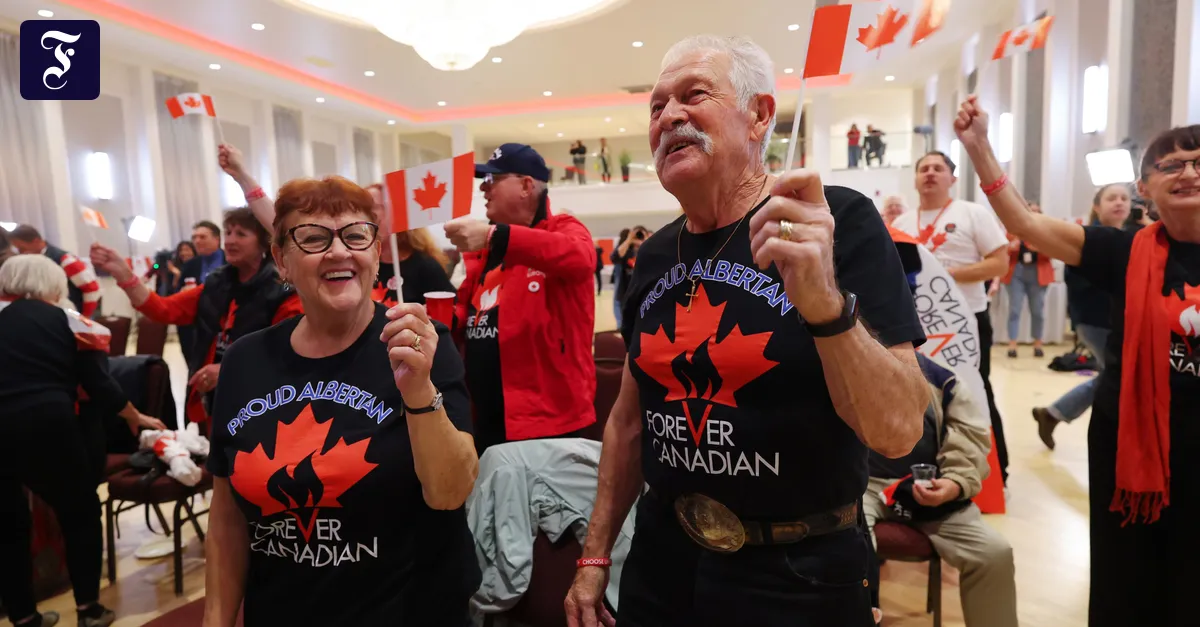
Mark Carney was relieved. “Tonight’s outcome on the crucial issue of secession means that the inhabitants of Alberta and all Canadians will move forward together with new impetus and lofty goals,” the Canadian Prime Minister said Monday evening. He sent out his speech shortly after Canadian media had consistently predicted that supporters of Alberta’s remaining in Canada had won a corresponding referendum. According to the results, the supporters of a united Canada could count on a clear victory of more than 70 percent. This is likely to confirm the opinion polls of the past year and a half, which had seen the approval for a detachment from Canada between 20 and 30 percent. Carney promised in the announcement that Canada would now “unleash its full potential as a global energy superpower, with Alberta at its heart.” Canada is so much more than the sum of its parts. “Now we have the opportunity to take all that was given to us as Canadians – and we were given the greatest country in the world – and make our country better for all of us.” Also constitutional changes on the note with the result of Monday, the residents of Alberta have decided to remain part of Canada. The question was whether the government should hold another, this time legally binding, referendum in Edmonton on secession and the establishment of its own state. That will not happen now. Although the question of independence has dominated the debate in recent months, it was not the real reason for the referendum. Rather, Alberta Prime Minister Danielle Smith wanted to ask voters nine questions in order to invoke the will of the voters in the implementation of her policy goals, even though she had won the previous election in 2023. The first five questions were mainly about migration. Thus, the government should work to take greater control over immigration; social programmes are limited to residents with valid residence permits and limited in time for non-citizens; a fee will be charged to non-citizens if they avail themselves of the social systems, and an identification requirement for voting will be introduced. The other four questions revolved around constitutional changes that Edmonton should bring in Ottawa. “We should leave it behind” According to preliminary results, Smith was able to count on voter approval on migration issues. In the constitutional issues, there was a race too close to be able to determine a result. These very questions are aimed at projects that Alberta cannot implement alone. For changes to the Canadian constitution, Smith would have to get support from other provinces, especially the populous Ontario or Quebec. However, this is unlikely. Smith had added the tenth question to pacify the separatist wing of her United Conservative Party (UCP). Experts point out that there is a real possibility that the separatists could try to take over the UCP, force Smith out of office and replace him with one of their own. A major driver of discontent was also the unpopularity of liberal Prime Minister Justin Trudeau in structurally conservative Alberta. Monte Solberg, who was formerly a minister in Ottawa under Conservative Prime Minister Stephen Harper, told the F.A.Z. that Trudeau was “too green and too woke” for Alberta residents. He also actively prevented Alberta from exploiting his oil wealth, despite the fact that the Canadian economy was not doing well at the time. But, says Solberg, “Trudeau is now Katy Perry’s problem, he has left it behind.” We should do that too. As for the future, Solberg is sober. The separatist movement will not disappear, he says. It needed the greatest possible success of the unit supporters in order to cool down their enthusiasm a little and get them “back in the box”. A result of more than 70 percent against independence would be good. One of the leaders of the separatist movement, Keith Wilson of the group “Let Alberta decide”, had said before the vote that he was not really for a secession from Canada, but wanted to send “Ottawa a message”. He was above all concerned with having an “adult discussion” about strengthening Alberta in the Confederation. After the first results, he said in Calgary: “Tonight an election campaign is coming to an end, but the discussion about the future of Alberta in Canada and our place and role in Canada will continue.”
Source: FAZ ›

Comments (0)
No comments yet.