The film "Tenzing": This time Hillary on Mount Everest is the companion
In 1953, Tenzing Norgay was only Hillary’s companion to the Daily Mail, but he had already been on Everest six times. Jennifer Peedom’s film shows him as an outsider between British conquerors and skeptical Sherpas.
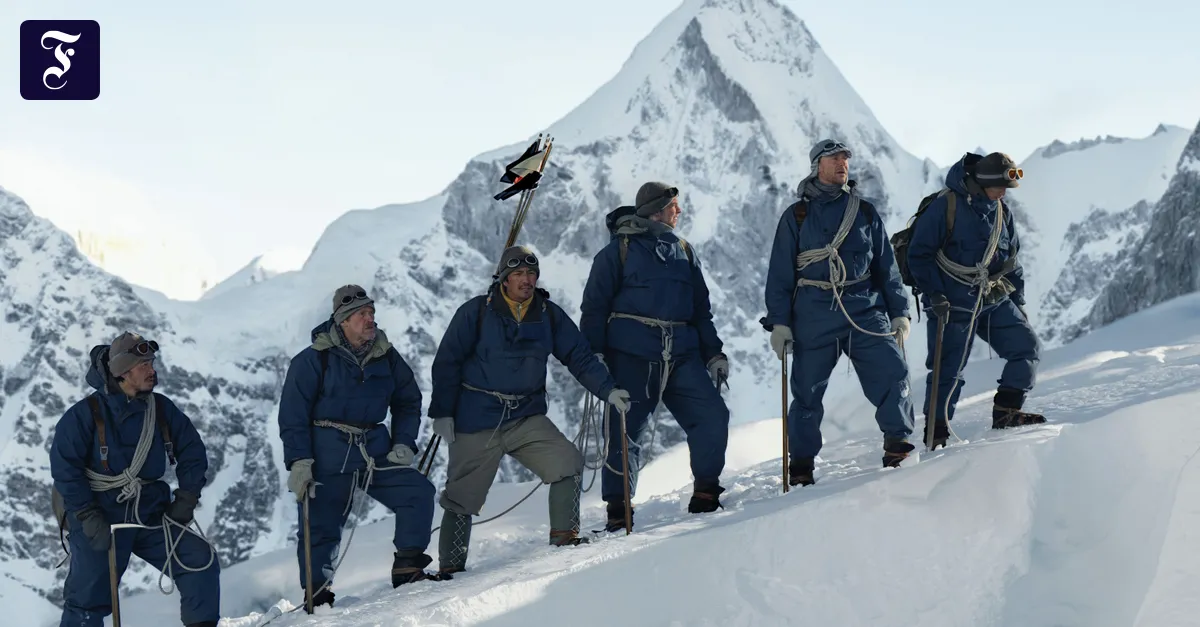
The opulent adventure drama “Tenzing” describes the first ascent of Mount Everest from the perspective of Nepali-Indian mountaineer Tenzing Norgay for the first time. It’s a little wonder that this story is only now being told – albeit by a western director, Australian Jennifer Peedom. She has been connected to the Sherpas community for more than twenty years and enjoys trust there, among other things, thanks to her 2014 documentary “Sherpa”, which envisages the increasingly commercialized Everest expeditions from the point of view of the Sherpas and still runs in the tea houses of Kathmandu. Tenzing’s son Norbu herself asked her to stage his father’s story. Tenzing Norgay belonged to the British expedition led by John Hunt, which in 1953 sought the first ascent of the highest mountain in the world. On May 29, Tenzing and New Zealand mountaineer Edmund Hillary reached Everest summit in time for the coronation of Queen Elizabeth II. “Everest is conquered,” the Daily Mail headlined with a piece about “the man who made it.” Tenzing appeared in the reporting only as his “companion”. Tenzing had more Everest experience than anyone else in Peedom’s film, however, superstar Tom Hiddleston as Edmund Hillary with remarkable restraint leaves the stage to Tibetan actor Genden Phuntsok; He wears the film with his warm smile and unwavering straightforwardness effortlessly. Tenzing had far more Everest experience than anyone on Hunt’s team. He had already been on the mountain six times, including with the Swiss expedition, which had made it to 250 meters below the summit the year before. And yet Tenzing had to fight hard to rank as a full-fledged expedition member and not just a carrier. Peedom’s film goes beyond the mere exhibition of colonial lord racism, which a less curious director might have turned into a linchpin. The great charm of “Tenzing” is that it contrasts the intimate connection of the Sherpas to the mountain world with the British conqueror attitude. “They see the mountain as an enemy,” says Tenzing of the British, who shamelessly perceive the summit, named after the surveyor Sir George Everest, as “their” mountain. “We see ourselves in him.” For the Sherpas, the mountain they call Chomolungma is animated, a deity that must be respected so as not to arouse their unwillingness. It is not the “conquering” of the mountain that is in the foreground, but a rendezvous with the Mother Goddess, in whose womb it is necessary to climb to meet her in all her sublimeness. Numerous retrospectives reveal Tenzing’s childhood and adolescence, which are shaped by Everest in a completely different way than the world of Western climbers. Already as a young boy yak-hunting, he gazes at the majestic mountain, and in a beautiful scene he tries on the boots of George Mallory, who died in a first ascent attempt in 1924. The film does not shy away from complications. Tenzing himself is an outsider. He belongs to a lower caste than his wife, and he is of a different ethnic origin than the Sherpas; They are indignant that they must accept him as a leader. His expedition rank also annoys them. “He thinks he is one of them,” etched Pasang (Tenzin Jigmey), who hardly hides his skepticism towards the British and Norgay. “We get paid to wear them, and they can act as heroes.” Visually, the film, which was shot partly on Mount Everest, partly in the Alps of New Zealand, is as intoxicating as Peedom’s mountainous ode “Mountain” from 2017, once again pays homage to the mountains with gorgeous visual force. In 2006, Peedom was in Everest Camp four at 8,400 meters as part of a Discovery Channel documentary, and she makes no mistake about the dangers and hardships of the expedition. The effort to advance in the thin air eight kilometres above sea level seems as physically perceptible as the clanging cold and the cutting wind at an altitude where humans can survive only briefly. A crowning moment of “Tenzing” is of course the summit storm. But there are other highlights. One of them is a scene (at least half-guaranteed) in which Peedom amuses the heart of her story: The Sherpas are gathered on the site of the British Embassy in Kathmandu and reprimanded for urinating into the bushes of the sprawling garden. But the translation of Tenzing Norgay undermines the censure of expedition leader John Hunt (Willem Dafoe) – the British apologized for the rudeness of letting the men sleep in the stables, Tenzing tells them; They vowed to treat the Sherpas with more respect in the future. Tenzing is on Apple TV.
Source: FAZ ›



Comments (0)
No comments yet.