Stonehenge in Munich: The Day the Bell Cup People Came
Why Stonehenge? An exhibition worth seeing in the State Archaeological Collection presents the results of a research project on the strange monument.
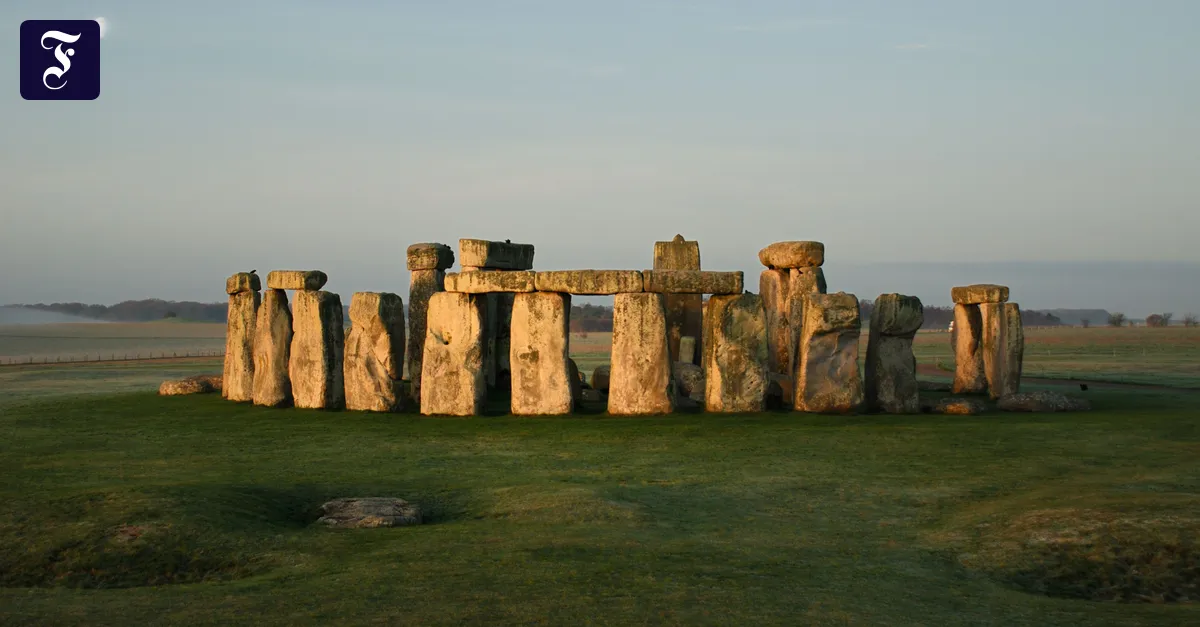
Stonehenge was once built by giants in Ireland. Then came the wizard Merlin, dismantled the stones and had them shipped to Britain, where he rebuilt them on the plain of Salisbury. Geoffrey of Monmouth, a Welsh clergyman of the early twelfth century, to whom we owe much of the legend of King Arthur. Now Geoffrey’s story is not the only absurd idea of how the famous stone circle came about in the southern English county of Wiltshire, just remember Erich von Daniken, who strove aliens in a 1968 publication. But what to make of this: Stonehenge was once built in the southwest of Wales, 220 kilometres as the crow flies from its current position, but then most of the rock blocks built there, each weighing about two tons, were transported by Stone Age people to Wiltshire, where they provided the original equipment of Stonehenge as so-called Bluestones. A few centuries later, Stone Age people of the same group erected five gate-like formations of rock cubes, the so-called triliths, and surrounded them with a circle of thirty pillars and as many architraves. These cuboids, the so-called Sarsen, weigh on average 25 tons and were transported from 25 kilometers away. This does not sound much more believable than the stories of Geoffrey or Daniken. A landscape full of monuments But so it was, says science. At best, it is controversial whether the blue stones in Stonehenge were actually already used in Wales in a stone circle or were only broken there. But who were the people who did that? What did they intend with the first circle of blue stones around 3000 BC, what about the gigantic expansion with the Sarsen about 500 years later? And how did it go on until the plant was completely abandoned again a thousand years later? “Stonehenge is known to everyone, but no one knows anything about it,” says the archaeologist Heiner Schwarzberg, coordinator of the exhibition in the Archaeological State Collection in Munich, which offers something that is able to close this knowledge gap a bit, including about six hundred finds, of which only a minority comes from the site of the Steinkreisanlage itself. Because Stonehenge can no longer be talked about in isolation today. The complex is part of an entire ritual landscape with hundreds of soil monuments, some of them significantly older than Stonehenge. Between 2003 and 2009, the Stonehenge Riverside Project examined the relationship between the famous building and its surroundings. It was initiated and directed by Michael Parker Pearson, who now teaches at University College London. Parker Pearson is also the curator of this exhibition, which was already conceived in 2018 and has been expanded for its station in Munich with interesting continental European references and brought up to the current state of science. Stone the dead, wood the living Parker Pearson for his project proceeded from a hypothesis. According to her, the Stones of Stonehenge stand for an “empire of the dead” and served at least in the first two of the five phases of the monument, which can be distinguished archaeologically, burial and ancestor worship. Opposite it is a wooden “empire of the living”, which had its center three kilometers further east: in the settlement of Durrington Walls and a neighboring complex called Woodhenge. In fact, the Riverside Project encountered a large number of animal bones here, apparently remnants of extensive mowers, while burials are missing. On the site of Stonehenge, it is the other way round: no trace of living mice or Neolithic everyday life, but the fire burials characteristic of the period before 2500 BC. The juxtaposition of stone and wood is also a structural principle of the exhibition. In the first of the three skillfully interconnected halls, visitors actually encounter a lot of stone, but also the typical tool of the builders of Stonehenge. The second hall, where finds from Durrington Walls predominate, is the largest of the three, and it themes the perhaps no more than 40 years in which this settlement was built around 2500 BC. It was inhabited around, while in Stonehenge the Sarsen were set up. There is also a re-enactment video, whose visual minimalism and originality stand out pleasantly from what has become common in exhibitions on prehistoric topics: In a monologue, a neolithically dressed actress gives thoughts on how they might have been made by those involved in the construction of the Sarsen plant. The bell cups or the end of the Stone Age The third hall finally themed Stonehenge after a profound upheaval: Around 2450 BC, only decades after the completion of the Sarsen circle, the culture of its builders disappeared from the scene. For from the European mainland another culture had spread to England and the population ancestral there had replaced or absorbed within a few generations. She already knew the processing of metal and is named after the bell-shaped cups that these people put in the graves of their dead. With the new arrivals, Stonehenge became part of a culture that flourished in various regions of Western Europe – the exhibition shows exemplarily finds from a bell-cup tomb near Augsburg and presents the bell-cup-time circular complex of Pömmelte near Magdeburg, which had similar dimensions to Stonehenge, but with structures made of wood. In Stonehenge itself, the bell-cup people must have been at first at a loss to the stone monument. “They found Stonehenge, but did not know what it was for,” says Heiner Schwarzberg. They lifted pits in the plant..
Source: FAZ ›




Comments (0)
No comments yet.