Elfriede Jelinek 80: The fury wind of reality
From the bitter struggle against power structures and gender relations to the sarcastic lust for the comic language game: Nobel Prize winner Elfriede Jelinek on the 80th.
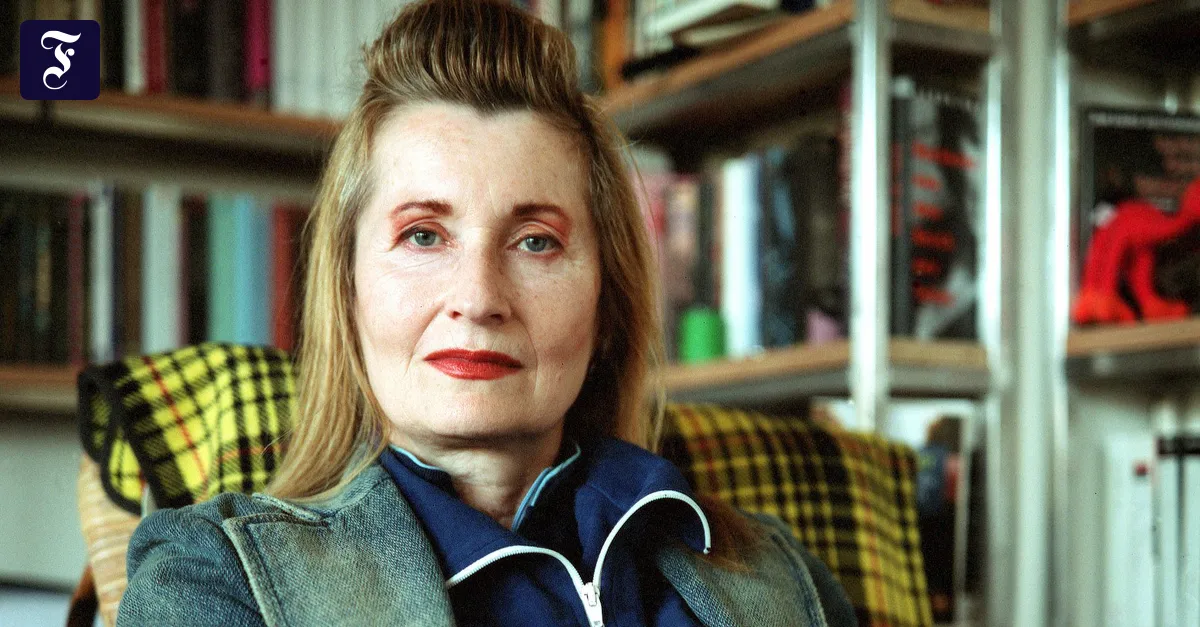
Language bites the hand that forces it on paper. But she also lets this hand crawl her fur and throws herself on the floor before her, obedient, loving and unpredictable at the same time. In her Nobel Prize speech titled “Away”, Elfriede Jelinek described language as a headstrong being, a dog who behaves dogishly, so lets herself be domesticated and performs tricks, but never forgets that he has his own will and sets his own priorities. At such moments, he grinds his wife on the line behind him. Language is the material of this author, it is her tool and her medium. Above all, however, language is the place where reality and the writer meet, it is the utopian non-place that is everywhere and nowhere at the same time and where Elfriede Jelinek spends most of her life. It is not a space without domination, but one in which the relations of domination are in constant motion, so that one could almost consider them changeable. World-class provincial author Anger and despair in the face of the family structures and gender relations experienced as unchangeable belong to the core of this extensive work. The roaring of her female characters, who try to defend themselves against the male-dominated rituals in culture and sexuality in a combative, but ultimately hopeless and therefore often auto-aggressive way, began in 1977 with the play "What happened after Nora had left her husband" ("The woman is what does not speak and of which one cannot speak"), followed by the 1982 premiere "Musical tragedy" around the pianist "Clara S". The pursuit of female self-determination by the title character, who oscillates between lust for submission and arrogance, is described here as just as naive and hopeless as in the case of Nora in Jelinek’s Ibsen continuation. After all, according to the author herself in retrospect of her piano-playing main character Erika Kohut, "she ventures to discover more in her own body than the man's territory." To the radical, sometimes disturbingly bitter revolt against power relations between the sexes came a bitingly sarcastic criticism of the conditions in her home country, which she repeatedly accused of suppressing the Nazi past, which does not change the fact that she sees herself as a kind of Austrian provincial author who “works in a certain way with a certain language”. The fact that it comes from the literary tradition of the Vienna Group, which focuses more on language, sound and loudness than on content, is hardly understood in Germany, she complained several years ago. Since the Nobel Prize, her work has been playful. Despite her love of language and play, she has often already made clear with the titles of her essays and books what she was up to – from “going to school is like going to death” and “I beat with the axe three, so to speak” to the mortal sin novels “Gier” and “Envy” to the plays “Ulrike Maria Stuart” and “Rechnitz (The Choke Angel)”. The poetic methods used are often addressed in the texts, but are rarely presented as succinctly and transparently as in the preliminary remarks on her play “Bambiland”, which was premiered by Christoph Schlingensief at the Burgtheater in 2003, with which she referred to her sources, namely Aeschylus and Nietzsche. The rest is not mine either. He is from bad parents. He is from the media. Over almost six decades, Elfriede Jelinek has created a work that spans virtually all literary genres, from radio plays to essays, novels and plays to translations that she herself has described as low-paid breadwork. In addition to boulevard comedies by Feydeau and Labiche, Elfriede Jelinek has also translated Thomas Pynchon’s “The Ends of the Parabola”. The fact that she was awarded the Nobel Prize for Literature in 2004, but Pynchon did not receive the award, she described in an interview with the Frankfurter Allgemeine Zeitung as a joke: “This is against the laws of nature.” The financial independence, but perhaps also the worldwide recognition associated with the Nobel Prize, was also noticeable in the literary work: it became freer, more carefree, more playful, without the will to ridicule, scorn and accusation had waned. The wrath of reality that Jelinek spoke of in 2004 remained perceptible. Criticism of institutions, authorities, repression and the mechanisms of oppression did not subside, but the always existing penchant for comedy, the lust for wit and kalauer, became more apparent. Elfriede Jelinek has survived hostilities and scandals, twice pronounced and lifted a performance ban on her plays in Austria, coped with the shock of the Nobel Prize (which she did not accept personally) and announced her farewell to the printed book in 2008. On the Internet, she thought she had found the appropriate place of work and publication: autonomy and privacy in its most public form imaginable. The fact that she abandoned the principle of mastery of work as an author was part of her development as a theatre author who writes plays that are organized as text surfaces, as a sequence of monological passages that stack up literary, philosophical and banal things, associative drama without allocation of persons, which Aeschylus or Schiller uses just as much as the “Kronen-Zeitung” and the fund of proverbial idioms that she uses like old bedspeople about the long..
Source: FAZ ›




Comments (0)
No comments yet.