Entertainer without a car: How Harald Schmidt fell into reason
No more Jaguar for Harald Schmidt: The entertainer gave his car to a hobbyist and attached his awakening experience to the big bell. Be warned of false attachment!
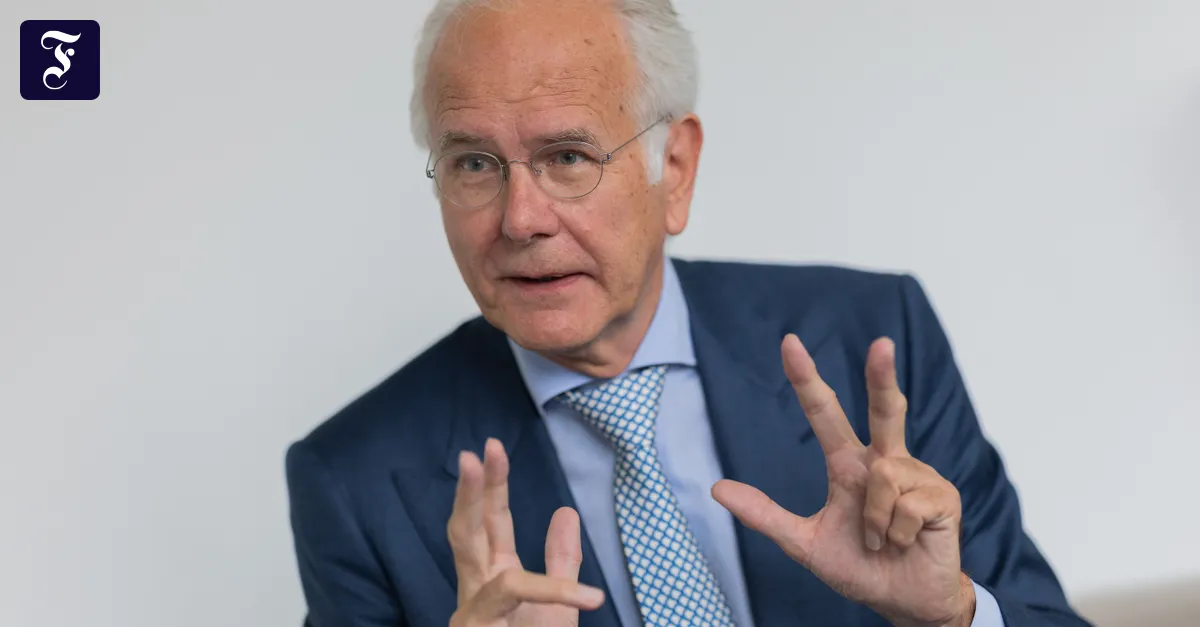
The German Press Agency in Cologne informs Harald Schmidt that he had given his Jaguar to a car maker. Regardless of what the agency-capable news value may be about this announcement – the colleagues at dpa Cologne are familiar with the business of classifying news – and therefore quite independently and without wanting to dig deeper here, the incident is nevertheless illuminating for the generalizable question of when, under which circumstances, people have come to their senses. Let’s briefly recap the ratio of Schmidt to repel his eight-cylinder combustion engine, to which he had previously held as his “dream”. The narrated argument is: “I gave it to a hobbyist, because he could no longer get through the TÜV.” I would have financed it again, but now the Zipperlein started. Old-timer owners know what Zipperlein is talking about: An orgy of wear has set in, in which one part after another has become in need of repair or has to be replaced directly, the whole often creeping, without admitting the ruinous process as a continuum. At this point, the unwavering ones called “lovers” continue on their way to unreasonableness, recording horrendous investments as a joy of life. But the Jaguar was obviously not so libidinously occupied for its owner, with Schmidt the fiscal calculation prevailed. Looking at the next patinacarre? Where does it go for him now? Is the next patinacarre from the luxury segment already in view? Schmidt: “I don’t need a car anymore, I don’t have a car anymore.” He can do without private cars. He has always travelled a lot by train, inner-city he uses bus and tram. In other words: Schmidt, looking at the next TÜV, opened his eyes to a bottomless cask, entering the realm of reason as a realm of freedom from false attachment. Resonance theorist Hartmut Rosa points out that in order to follow it, reason is dependent on energetic readiness, which in turn unfold in peculiarly subjectless ways. It is less about an action than something that happens between active and passive, as in the case of falling in love. Schmidt fell into reason, as someone says: He fell in love. Insight, if pink is understood correctly, turns out to be a phenomenon of circulating social energy that makes the entertainer, now wise forever, say: It is enough. Someone does not want to enter the apocalypse of car history as a lover, and this energetic moment is on: If someone like Harald Schmidt, who has the bow out in everything, no longer drives a car – why don’t I also want to become reasonable?
Source: FAZ ›



Comments (0)
No comments yet.