EU Commission: Security at the heart of the new Arctic strategy
The new Arctic strategy is all about the security situation and geostrategic competition. The EU wants to defend its interests.
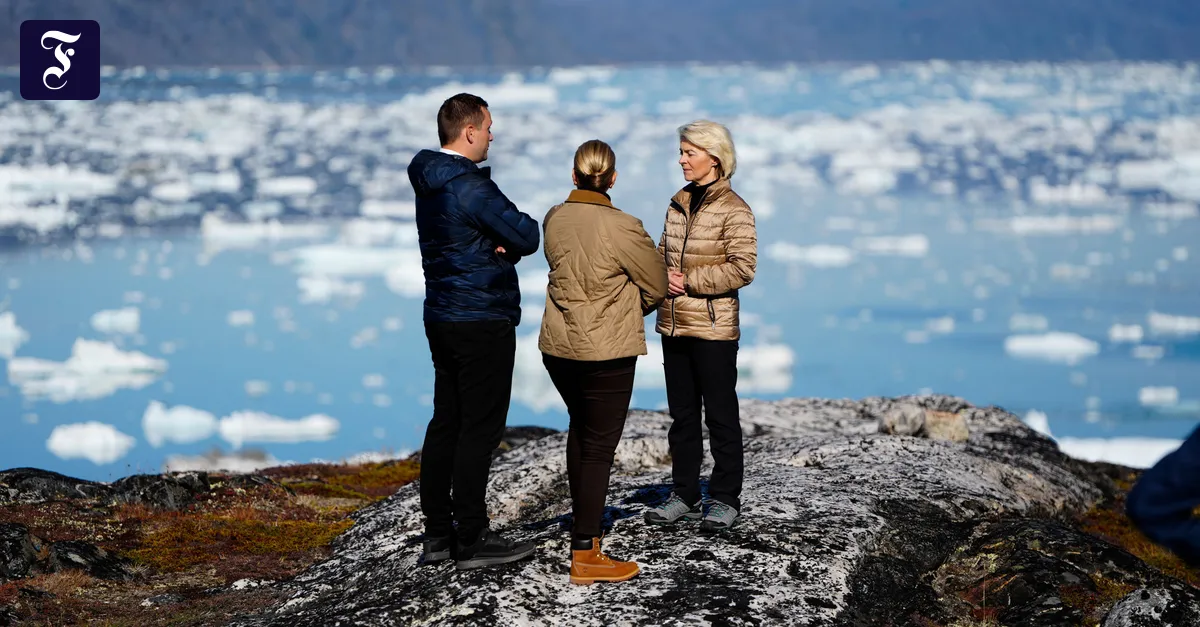
The Russian war of aggression against Ukraine “has fundamentally changed the security situation in the Arctic and in the EU as a whole”. This is the case in the new Arctic Strategy, which the EU Commission and the High Representative Kaja Kallas presented on Tuesday. That is now the starting point for all considerations. In the previous strategy, which is five years old, there was already talk of “geopolitical competition and possible tensions”. However, Russia still appeared as a partner in the so-called Northern Dimension, with whom it wanted to work more closely. In addition, the previous strategy revolved around climate change as the “most comprehensive threat” to the Arctic. He is also now again prominently mentioned, with the indication that the Arctic is warming four times faster than the Earth on a global average. The EU wants to preserve and protect this unique ecosystem as much as possible. But she is now much more prepared for the fact that climate change is fueling geopolitical competition – and that she herself has to defend her interests. This ranges from the exploitation of new raw materials to military infrastructure to the protection of submarine cables. An example of the new realism is the handling of fossil fuels. On the one hand, it should remain that “oil, coal and gas must remain in the ground”, as they say. There is simply no need to promote them in the Arctic, explained an EU official. This is a signal to both the US and Norway, which wants to clear areas in the ice-free Barents Sea for exploration. On the other hand, the 2021 target of working towards a multilateral moratorium on the promotion of fossil fuels is no longer in the new strategy. It has become much harder to enforce such a thing, said the official. On icebreakers, the Commission remains vague The exploitation of other, rare raw materials, on the other hand, is expressly desired by the EU Commission and financially supported. These include mines for mining molybdenum in Greenland, copper and other precious metals in Finland and Norway, and rare earths in Sweden. “The EU will work closely with Canada, Greenland, Norway and the United States through strategic partnerships in the field of raw materials to unlock further opportunities for sustainable raw materials,” the strategy says. However, it only wants to develop resources in the deep sea when ecological risks can be excluded. The strategy remains strikingly vague when it comes to icebreakers. Earlier this year, Commission President Ursula von der Leyen had brought a European icebreaker fleet into discussion and suggested that it could be financed from the defence item in the next financial framework from 2028. This was a particular concern for Finland, which manufactures such ships and also supplies them to the United States. Now the Commission wants to first identify the needs and then “examine possibilities for pooling financial and technological resources within the northern neighbourhood”. This sounds as if these states should procure ships together, without a financial injection from Brussels. This also reflects a certain realism: after all, the appropriations for defence have already been cut by a third in the budget negotiations. From the current budget, the Union spends EUR 260 million on ten Arctic-related defence projects. These include the development of an aircraft that can withstand extreme environmental conditions, textiles adapted to extreme conditions and extensive sensors covering the Arctic. The Commission now also sees the Arctic as a region where it wants to improve military mobility. Ports, airports and their connections to the hinterland should be planned as a “logistics system that is operational in adverse weather conditions,” the text says. Underwater cables are to be protected jointly Planned is the construction of a center for maritime security in the Arctic, on the model of a pilot project in the Baltic Sea. Member States should exchange information on illegal fishing as well as on shadow fleet vessels and dangers to submarine cables. These should also be repaired faster. This is particularly important because the Commission wants to improve the networking of the region. Earlier this year, a new electricity connection between Finland and Sweden was inaugurated, which is to be expanded. The Commission is also working on a concept for a submarine cable to connect Europe via Greenland and Canada with Japan and South Korea. It also wants to connect Greenland to the European Union via an independent and safe submarine cable. Three EU countries are located north of the Arctic Circle: Finland, Sweden and Greenland, part of the Kingdom of Denmark. A total of 500,000 EU citizens live in these regions. Norway and Iceland participate in the internal market. The EU wants to expand its relations with Canada. The conflict with the US over Greenland has eased. “We want to work more closely with them,” said Commission President Ursula von der Leyen on Tuesday. For a peaceful, stable and resilient Arctic. For a prosperous and economically safe Arctic. In short: for an Arctic that benefits its people. This referred to the Western partners – but not to Russia.
Source: FAZ ›
Comments (0)
No comments yet.