Expert on film "Whalefall": Can you survive in the stomach of a sperm whale?
Swallowed and trapped in the belly of a sperm whale – with only little breathing air in the diving bottle. How real is this claustrophobic plot? Lisa Klemens from the German Maritime Museum has already performed innumerable whales and knows the differences between reality and cinema art.
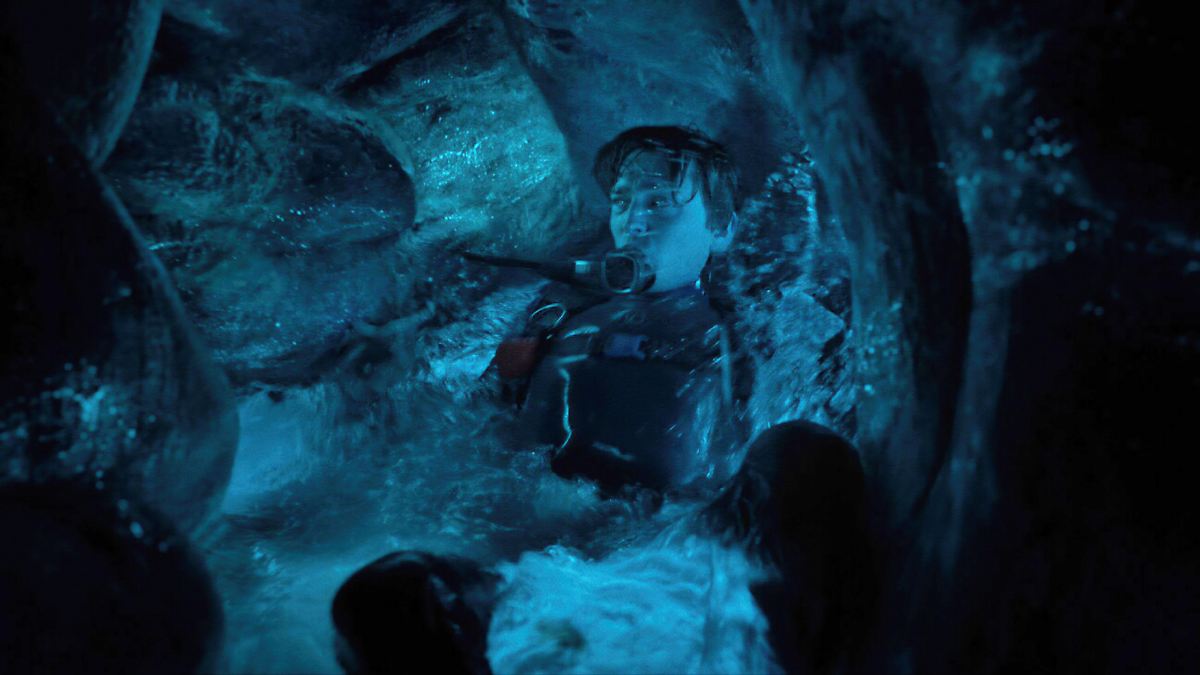
Swallowed and trapped in the belly of a sperm whale - with only little breathing air in the immersion bottle. How real is this claustrophobic plot? Lisa Klemens from the German Maritime Museum has already performed innumerable whales and knows the differences between reality and cinema art.
The film: "Whalefall" is based on the novel of the same name by Pulitzer Prize winner Daniel Kraus and is, according to the publisher, "a scientifically accurate thriller set in an absurdly unlikely environment". He tells of the young Jay Gardiner (in the film: Austin Abrams) who searches for the remains of his drowned father off the Pacific coast of California. While diving, he is accidentally swallowed by a sperm whale, along with a giant squid, and desperately tries to free himself from his stomach. Director Brian Duffield hired Wētā Workshop from New Zealand for special and visual effects and visual artist Guillaume Rocheron, who has won two Oscars (for "Life of Pi" by Ang Lee and "1917" by Sam Mendes).
The whale expert: Marine biologist Lisa Klemens from the German Sea Museum Stralsund has already obduced countless whales, because she writes her doctoral thesis on the digestive tract of toothed whales. She has also examined the stomach of a sperm whale that washed dead in the Canary Islands. So the Hollywood movie backdrop is very familiar to her in real life – just like the smell of whaleries. For the reality check of the scenes under water she watched the trailers and the Disney press material before the movie release.
Mrs Klemens, you are doing your doctorate on gastric anatomy and food analysis of toothed whales. Have you ever discovered a human in the belly of a whale?
Lisa Klemens: Never before - I only know this from the biblical story of the prophet Jonah and Pinocchio! In any case, it has never been scientifically documented that a human has landed in the stomach of a wild whale. Not even a human body part.
The author of the book, Daniel Kraus, said that the video of a kayaker who was accidentally "swallowed" by a humpback whale inspired his story.
I have seen such a video and can explain what probably happened: Humpback whales have refined hunting strategies for herring fish. They encase the swarm in the team in a so-called bladder ring. The kayaker is probably paddled in and a whale, who wanted to grab the herring on the water surface from below, caught him briefly - but certainly not swallowed. Whales are very smart animals and the mucous membranes in their mouths are very sensitive. They would immediately notice, iiih, this is unwanted bycatch, and spit it out again. It was the same with the kayaker.
Let’s dive into the movie scene off the coast of Monterey, where Jay meets the sperm whale hunting a giant squid. So far realistic?
What we're seeing is a kelp forest -- in such an ecosystem of large brown algae, sperm whales don't normally swim around, they would just get caught in it. They live far away from the coasts in the open sea, where they can dive very deep. The giant squid also lives in the dark deep sea, well below 300 meters. Only its larvae can be found near the sea surface. A diver, on the other hand, can never enter his habitat with the equipment Jay has in the film. This requires a diving robot.
Okay, so this setting is rather fairytale. But basically do sperm whales hunt and eat giant squid?
Absolutely! Their diet consists mainly of cephalopods, i.e. squid and squid. And when hunting, they can get very fast.
They orient themselves with echosonar, which is the click you hear in the film.
Whales can actively choose what kind of clicking sound they send out - whether audible to humans or not. When their echosonar bounces against something, it is sent back and they receive these signals in their lower jaw. This insanely sensitive hollow body passes it on to the auditory structure.
In any case, he perceives the world completely differently than we humans! He looks bad, but his sonar is so sensitive that he "hears" every little object in the water. If it is not food or a fellow species, he would immediately turn when swimming - and it would never come to a collision with a diver like in the film. By the way, my colleague, our dive chief Henning May, said that Jay moves in this scene like a fall on land. Underwater, you do not hit the ground several times after a collision.
I suspect this scene was digitally recreated. How do you like the real protagonist: the sperm whale?
Very good from the outside. The skin with the scars looks really natural.
Mainly from fights with other males - and from giant squid who resist being eaten. Their beak is made of chitin and very sharp. The whale mandible is also top: narrow, almost white, with up to 50 large, pointed teeth and wide gaps in between; One of them can be 20 centimeters long and a kilo heavy! They do not use their teeth for biting, but to hold the soft, glib cephalopods. The upper jaw is toothless. If a sperm whale closes its jaws, the prey can no longer escape.
Our diver Jay somehow gets involved in the tentacles of the squid, is dragged into the throat of the sperm whale - and then swallowed.
Theoretically, a man could fit into the mouth of a sperm whale in size and possibly even slip through the esophagus; The whales are up to 18 meters long, the film poster shows the size ratios realistically. It's just never been observed in nature. And there is another problem: Jay also has fins and a compressed air bottle with him. This hard..
Source: n-tv ›




Comments (0)
No comments yet.