Vehicle industry: Hungary's car miracle remains a bet on future battery cells
BMW is already rolling the electric iX3 off the assembly line in Debrecen. CATL lags behind with cell production – and reveals the risk of the Hungarian bet.
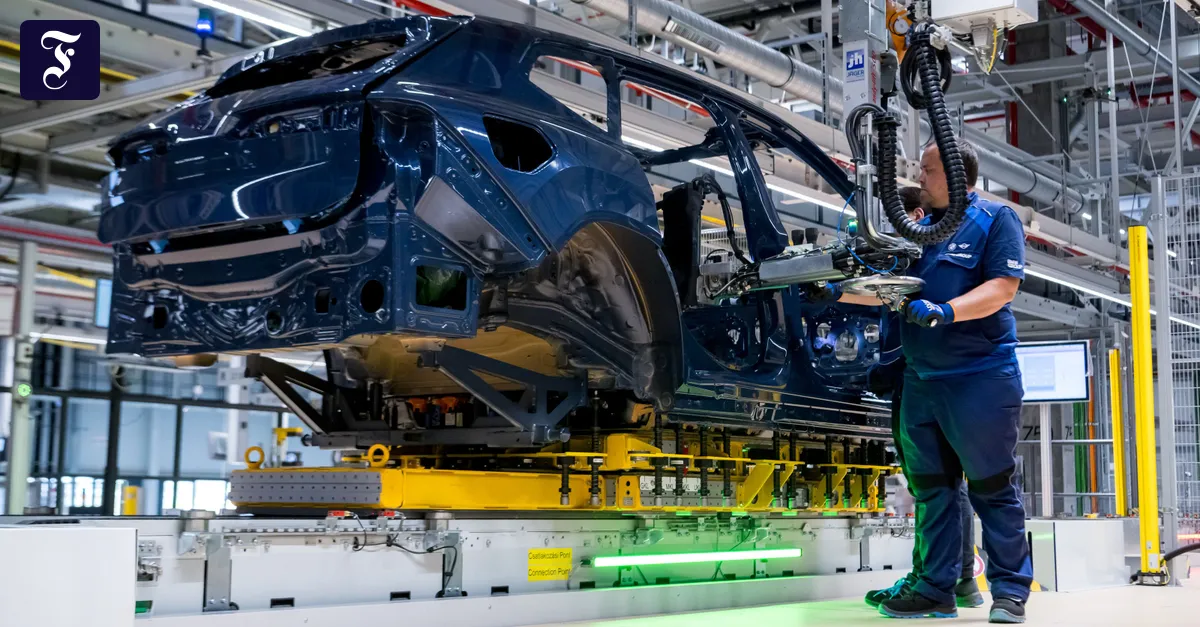
In Debrecen, the European vehicle industry shows its future prospects. BMW is building the electric iX3 in Hungary’s second largest city, while Chinese battery manufacturer CATL is commissioning its cell factory. German vehicle technology and Chinese battery technology want to form an industrial center that brings Hungary additional prosperity. Only the two sides of this partnership are running at different speeds so far: While BMW is ramping up its vehicle production, CATL’s cell production is only in trial operation. The supposed automotive miracle is therefore a bet on future utilized factories. Europe’s producers are putting cost pressure, Chinese competition and a change in technology. Nevertheless, they are expanding their Hungarian locations. This is no proof that Hungary would be spared from the European sales crisis. Rather, the crisis is shifting investments within European production networks: those who have to save are looking for cheaper plants. For individual Hungarian locations, this can lead to growth without the European car market growing strongly overall. Low labour costs and taxes The production figures show how closely both developments are linked. According to the foreign trade agency Germany Trade & Invest (GTAI), the production value of Hungarian vehicles and vehicle parts fell by almost ten percent in 2024 and by a further 5.3 percent in 2025. Production of cars shrank from 507,222 to 411,776 vehicles within two years. Between January and June a recovery followed: vehicles and parts together increased in value by 3.7 percent, vehicles alone by 9.7 percent. However, this does not lead to an upswing in the entire industry. Hungary’s advantage is not only low wages. German premium manufacturers such as Audi, Mercedes-Benz and BMW have also built up supply relationships and an employee base of specialists in Hungary for decades. New investors therefore find more than cheap land. In addition, there are labour costs of an average of 15.20 euros per hour in 2025, the third lowest value in the EU according to Eurostat data, and a nominal corporate tax rate of nine percent. Manufacturers distribute production around BMW’s Debrecen plant, initially designed for 150,000 vehicles per year. Serial production began at the end of 2025 and now works in three shifts. Mercedes-Benz has completed an expansion in Kecskemét for around one billion euros. The maximum capacity is expected to almost triple, to up to 400,000 vehicles per year. Last year, Mercedes produced only more than 100,000 cars there in 2025, but now the new models GLB and the new C-Class should provide for utilization. Mercedes keeps the parallel production of combustion engines, hybrids and electric cars open. This flexibility limits the risk of unilateral demand development. In turn, Audi produced a total of 200,756 vehicles and almost 265,000 electric drives in Győr last year, about three quarters more than in the previous year. Hungary’s rise thus consists not only of new factories, but also of the redistribution of models and processes within existing corporations. Chinese suppliers control a crucial part of this division of labor. Without competitive battery cells, the electrical strategy of German manufacturers cannot be implemented. CATL and EVE Power will bring this key component closer to European assembly plants. This shortens transport routes and facilitates coordination with customers. However, European manufacturing does not yet mean European technical independence: processes, corporate decisions and, initially, numerous precursors remain Chinese. CATL’s Debrecener project is particularly large with announced investments of 7.34 billion euros and a long-term capacity of 100 gigawatt hours of batteries: 1.25 million car batteries of 80 kWh are then behind it. So far, however, only the first cell factory has been completed, which company representatives described at the beginning of October with around 40 gigawatt hours. The further expansion stages are not secured. Already in 2025, preparations for the second stage were suspended. Their continuation is now being negotiated with the new liberal conservative government. Delayed production in battery production Above all, a distinction must be made between cell production and module assembly. CATL has been assembling battery modules in Debrecen since autumn 2024. By September, according to the company, a good half a million pieces were produced. Imported cells can be processed. Only in September began the test operation on two lines in the new cell building. The plants and processes are to be set, optimized and validated. A reliably proven start of regular cell mass production does not yet exist. At EVE Power, caution is also needed against anticipated success stories. The GTAI project overview from September 2025 indicated that the Debrecen plant would be completed by 2027 and that cells would be supplied for BMW’s sixth generation eDrive. A confirmed regular series operation is not documented in the evaluated sources. Sunvoda’s plant in Nyíregyháza near the border with Ukraine was still in an early phase of construction, according to a September report. The frequently mentioned approximately 200 gigawatt hours of Hungarian cell capacity thus mix announced and implemented plants. The already established cell production is also carried by South Korean companies: Samsung SDI in Göd and SK On with Hungarian locations, including Komárom and Iváncsa. These plants produce but were also affected by weak demand and throttling. The Hungarian news portal G7 reported in early October, citing Korean..
Source: FAZ ›



Comments (0)
No comments yet.