Frankfurt anthology: Guntram Vesper: “Inheritance”
What do the old bed frame of a small farmer and Georg Büchner have to do with each other? This poem is committed to literature from a plebeian perspective and the message of the “Hessian Landboten”.
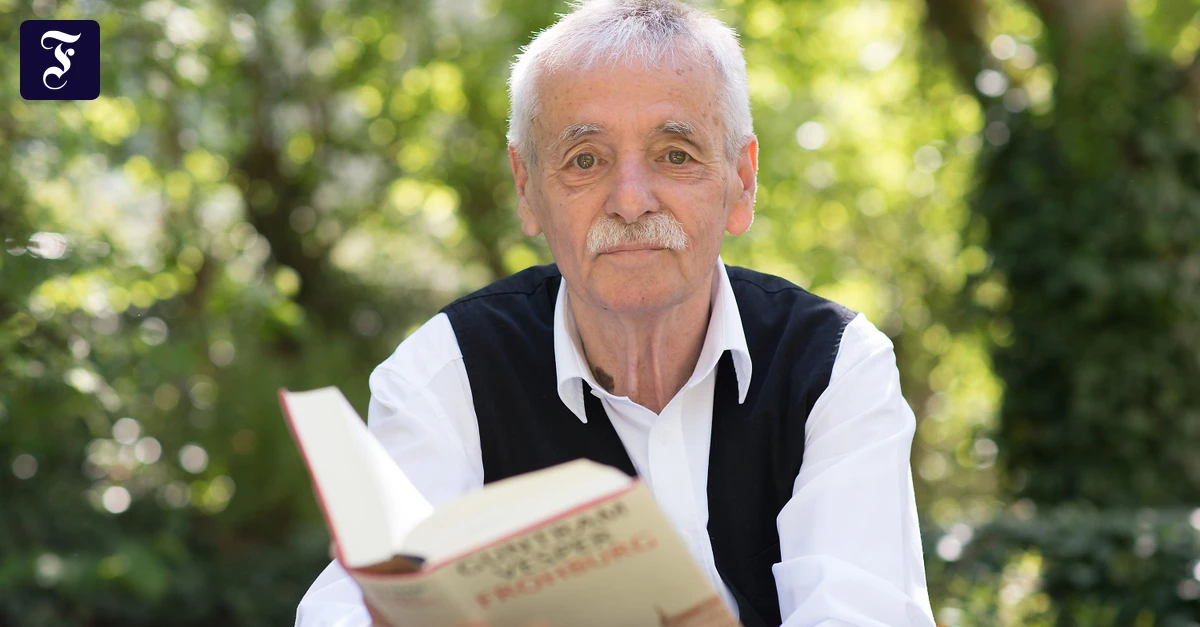
What do the old bed frame of a small farmer and Georg Büchner have to do with each other? This poem is committed to literature from a plebeian perspective and the message of the “Hessian Landboten”.
“I wrote the poem during my last Friedberger year, in April 1966 it was printed by the Frankfurter Rundschau,” says Guntram Vesper about the poem “Inheritance”. In his essay “Oberhessen”, most recently published in the volume “Lichtspiele”, he comments on the origin of verses and verses. Vesper, who was born in 1941 in the Saxon city of Frohburg, came to the West with his family in 1957. Until 1963 he went to a boarding school in Friedberg, where he met his later wife Heidrun. This in turn came from the nearby village of Steinheim, to which he alludes in the poem.
In his novel “Frohburg”, published in 2016, he describes the “low bedroom of the in-laws with the two windows to the right of me and with the marriage beds to the left, the usual chamber of the small farmers in the area between Wetterau and Vogelsberg, meant by Weidig and Büchner in the Hessian Landboten, pay taxes, levies out, recruits and spend their lives in the earth, on the towel baggers”. In his poem Vesper goes back to the time of 1834, when the forbidden pamphlet was distributed in the Hessian villages. With the expression “winter morning” he probably refers to the second, revised version, which circulated in November of the same year. The theologian Friedrich Ludwig Weidig, who together with Georg Büchner wrote the “Hessische Landboten”, was arrested on the basis of the illegal pamphlet and imprisoned in Friedberg. Perhaps Vesper was also aware of this detail when he wrote his text, which he again published in 1990 in the collection “I heard the name Jessenin” with early poems.
See F.A.Z. articles more often in your search results
In the essay “Oberhessen” he explains the title “inheritance”. In his parents’ house in Reiskirchen near Gießen, he discovered “an old high-legged bed frame” in the attic, which he restored and set up in his room; “As in a high-board ship, I lay in it, much higher above the ground and much closer to the ceiling than in the flat refugee bed I had had before, I was so sealed off, secured, when I read Danton’s death and on the same evening with approximately the same intensity, but faster pace also G-man Jerry Cotton,” writes Vesper, who died in 2020 in Göttingen. The poem “Inheritance” is thus inspired by the spirit of the place, the Genius Loci.
The idea that the stripped-off bed belonged to a small farmer in Steinheim, who burned the pamphlet full of fear, which called for resistance against the rulers in the Grand Duchy of Hesse-Darmstadt, triggered the writing impulse, combined with the memory of the bedroom of the in-laws. The fear of persecution and punishment by the authorities was widespread among the Hessian rural population after the “Bloodbath of Södel” on 1 October 1803. The protest of the locals, aimed at improving their political and economic situation, was violently suppressed by the soldiers of the government at that time. Vesper’s poem becomes an experienced story, an identification with ancestors. But it is also about the spiritual legacy of Büchner and Weidig. The “land messenger” is still a relevant reading, because the situation of ordinary people is at the center, over whose heads is decided. For Vesper, the task of literature is the plebeian perspective, the view from below. History becomes experienceable and vivid through the description of people who are directly exposed to the pressure of social conditions, who have to establish themselves professionally and privately under changing forms of rule.
“Inheritance” is a prophecy. Vesper recapitulates an event in 1834 and describes its aftermath for the lyrical self. The writer breaks the sober and comprehensible sentences into verses and verses. The fact that a poem emerges from this small narrative is due to the accentuation at the end of the text, in which the double meaning of the expression “inheritance” becomes recognizable. The “four boards” refer to the material property that is in the “possession” of the lyrical self. Connected to the bed from the early 19th. But the century is the spiritual tradition that emanates from the “Hessian Landboten”. Vesper transfers the hopes of freedom, democracy and social advancement that developed in the pre-March period to his own world, to the first decades after the end of the Second World War.
Eighteen hundred thirty-four in the Hessian village of Steinheim
in the winter morning rush to burn the candle to the stovepaper.
The pamphlet that hung on the fence hesitantly the housewife of the cracked clay wall overnight next to the dormitory of the family
four boards, today in my possession, a place for the Landboten reading still.
Guntram Vesper: ‘Deepland Bay’. The poems. With an afterword by Michael Krüger. Schöffling & Co., Frankfurt am Main 2018. 536 S, born, 32,– €.
Respected reporter Christiane Amanpour leaves CNN. And she's not the only one. Tech expert Kara Swisher finds clear words for the new owners, Trump friends Ellison.
With “Trainspotting” and “Slumdog Millionaire” he celebrated world success. He staged the Queen and yet rejected the monarchy. Star director Danny Boyle turns seventy.
For online surveys, the highest caution is required. Methodologists and the CDU-affiliated Adenauer Foundation point this out. Nevertheless, the CDU invited the click demoscopes of Civey to their crisis meeting.
Source: FAZ ›



Comments (0)
No comments yet.