Huang zu Merz: “Give Germany a chance!”
The start of the German government’s investment summit will be a demonstration of the strength of the AI industry with Nvidia CEO Jensen Huang as its uncrowned king.
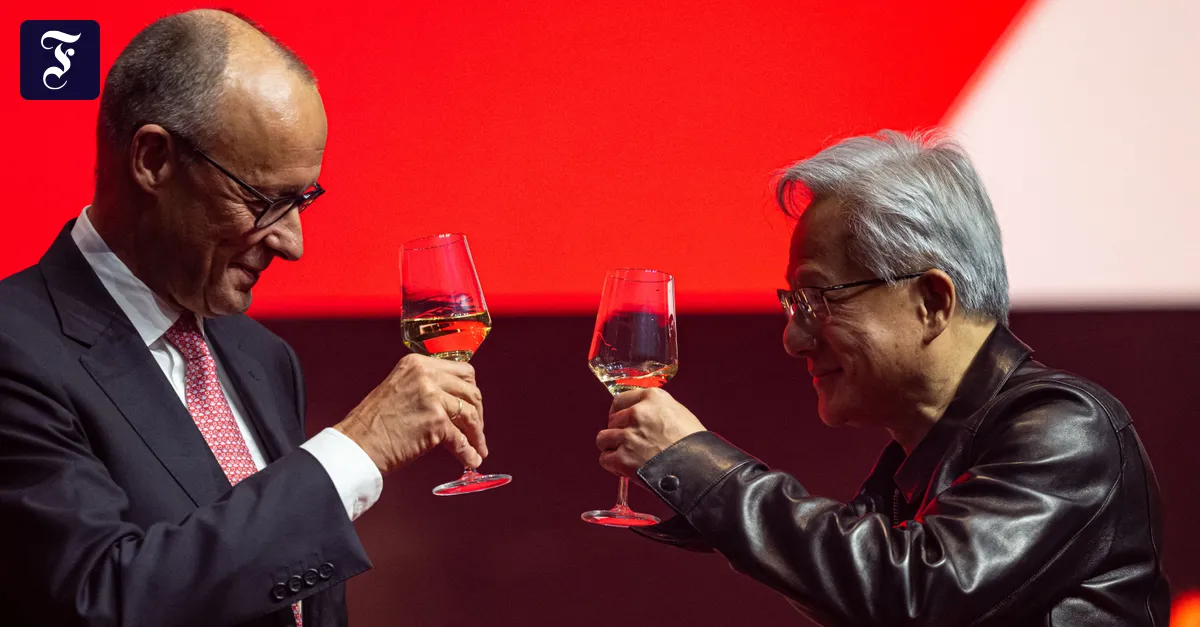
Nvidia boss Jensen Huang has called on Chancellor Friedrich Merz (CDU) to release the political brakes that have blocked Germany’s economy for years. If the country does not succeed in linking its traditional competences, especially in manufacturing, with the current AI revolution, the industry will first lose its connection and then its traditional markets. "Give Germany a chance," Huang told the Chancellor on an open stage in front of around 500 guests in the face. Merz had opened with a conversation with the Nvidia founder on Monday evening, the two-day investment summit of the Federal government in Berlin. Germany is “in a position of strength,” said the Chancellor at the opening of the event, in which Vice Chancellor Lars Klingbeil (SPD), Minister of Economic Affairs Katherina Reiche (CDU) and other government representatives until Tuesday afternoon for the favor of more than 200 investors. The most important guest of the event is Nvidia boss Huang. The company he co-founded in the early 1990s is currently valued on the stock exchange with a market value of the equivalent of 4500 billion euros. This corresponds approximately to the annual economic output of the Federal Republic. Nvidia designs computer chips to develop artificial intelligence (AI) systems. It has an almost monopoly position on the market in this area. In order to consolidate and expand this position, Huang has been building a close-knit global network of alliances, participations and partnerships for about three years. In January he was in China, in May in Taiwan, in autumn now Europe is on his agenda. After London, Paris and Stockholm he arrived in Berlin, where Chancellor Merz received him with open arms. The balance of power at the summit kick-off with the Nvidia boss was clearly distributed: “There will be nothing to regulate if the AI industry is not successful here,” said Huang in response to the explicit request of the Chancellor to give him advice for the regulation of the AI industry and the handling of the Brussels bureaucracy behind the strict European regulations. Even the founder of Nvidia had to fit. Just in time for the start of the first “Invest in Germany” summit, the Federal Government and Nvidia now agreed on closer cooperation to promote the industrial use of artificial intelligence in Germany. The aim of the cooperation is to accelerate the digital transformation of German industry, especially SMEs, and to secure the country’s technological sovereignty. “Nothing would please me more than seeing all of Nvidia’s investments in Germany turn into gold,” Huang said. The company currently has a thousand employees in Germany and a large branch in Berlin. In addition, the company has a long history with local partners. In 2000, Nvidia had a cooperation with the German PC game developer Crytek. Through the cooperation with the Coburg company, the Americans opened the doors and gates to the German car industry. Five years later, we started the first project with Audi. First, it was about infotainment in the car. Today we are talking about the development of self-driving cars, Huang said. The cooperation with Audi was followed by the cooperation with Mercedes. The latter attracted millions in young promising companies such as Agile Robotics, the automation specialist n8n or the AI developer Black Forrest Labs. Nvidia is now one of the largest venture capitalists in Germany. “And we will not stop here,” Huang said. London, Paris and Berlin Before Berlin, Huang was already on the road in London and Paris. On the one hand, he drummed publicly for the widespread use of AI technologies and the expansion of the corresponding infrastructures. On the other hand, he wants to sell his chip systems in Europe. They are considered the heart chambers of the major data centers. In addition, on the sidelines of Huang’s appearances, Nvidia’s investment team made several investments in promising European start-ups. This includes Dotclip, a company that develops technology for healthcare. Or Entalpic, which is working on novel materials for semiconductor manufacturing. Or Genesis AI, which builds robots. All in all, the share purchases should have a volume of around two billion dollars. Nvidia had already invested almost ten billion dollars in Europe in its local AI network last year. France, in particular, was at the center of the activities of the Americans. There, Nvidia participated in several young companies. This included the quantum start-up Alice&Bob and Gradium, a spin-off of the Paris AI research laboratory Kyutai. Nvidia also acquired shares in Scintil Photonics, a Grenoble-based company specializing in optical connectivity solutions. Nvidia is involved in around 250 young companies across all areas of high technology worldwide. Thanks to its AI chips, bubbly profits and full order books, Nvidia was able to tie up a tight-knit network of stakes that even dwarfed the multi-billion-dollar shopping sprees of a corporation like Google during the peak phase of the Internet twenty years ago. Within four years, the Group has built up an investment portfolio of around 50 billion dollars. In this way, the company wants to build a predominance in the AI industry far beyond chips. Since large acquisitions can quickly fail at the antitrust authorities, Nvidia aims for medium-sized participation.
Source: FAZ ›



Comments (0)
No comments yet.