Indonesian President Prabowo marks 2 years in office with economic gains, but challenges loom
As Indonesian President Prabowo Subianto enters his third year in office, observers say the challenge will be to translate his ambitious promises into tangible results while balancing public expectations with economic and political stability.
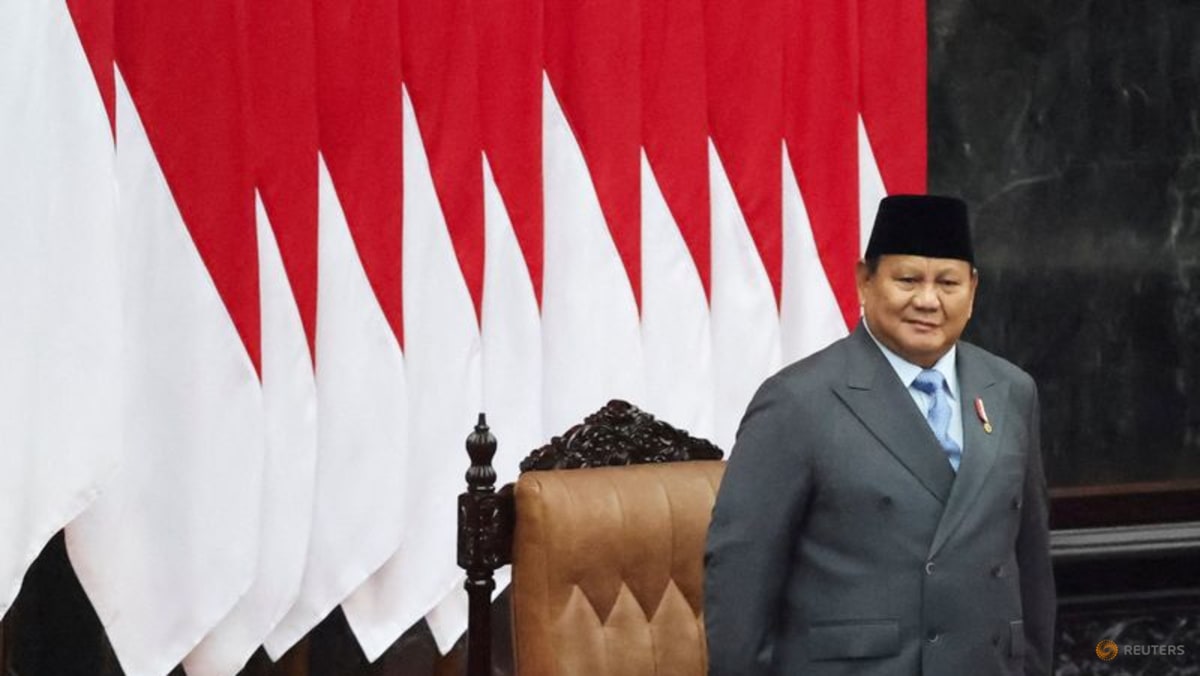
As Indonesian President Prabowo Subianto enters his third year in office, observers say the challenge will be to translate his ambitious promises into tangible results while balancing public expectations with economic and political stability.
DEPOK, Indonesia: Indonesian President Prabowo Subianto marked two years in office on Tuesday (Oct 20), with his administration touting progress on food security and energy independence, even as questions mount over the sustainability of his ambitious social welfare programmes.
Since taking office in October 2024, Mr Prabowo has made sweeping promises to improve the lives of ordinary Indonesians, with his administration highlighting rice self-sufficiency, progress towards greater energy independence and stronger-than-expected economic growth as key achievements.
But as he enters his third year in office, the former military general faces mounting pressure to deliver lasting benefits without undermining Indonesia's fiscal stability.
Political manoeuvring is also expected to intensify ahead of the 2029 general election, potentially testing the durability of his broad ruling coalition.
Among the latest proposals being considered by the government is the abolition of tuition fees at state universities nationwide.
Last month, Mr Prabowo instructed the Ministry of Higher Education, Science and Technology to develop a framework for providing free education at public universities.
Some students believe greater access to higher education deserves greater priority in the national budget.
“Spending on other programmes … such as the president’s flagship free meals programme … is much higher. I believe education should also be a priority when it comes to how our government spends its revenue,” said Isyana Balqis, an undergraduate at the University of Indonesia.
Her fellow schoolmate Amanda Putri Dimas said: “I have to work while studying to cover my tuition and other expenses. If Indonesia truly wants to achieve its Golden Indonesia vision, this should have been planned from the very beginning. I hope this plan will actually become a reality.”
The Golden Indonesia 2045 vision aims to transform the country into an advanced economy by the centenary of its independence, with education seen as key to developing a more skilled workforce.
However, the proposal comes with a substantial price tag.
The government estimates that eliminating tuition fees for nearly 3 million undergraduate and diploma students at state universities would require an additional 93 trillion rupiah (US$5 billion) annually, roughly US$1,850 per student.
While the plan has generated optimism, it has also prompted questions about how the government intends to finance another major spending commitment.
At the centre of Mr Prabowo's welfare agenda is his flagship free nutritious meals programme, aimed at combating stunting and malnutrition among children.
Despite food poisoning incidents that have raised concerns over food safety and oversight, the initiative has expanded rapidly to reach more than 57 million beneficiaries nationwide, including schoolchildren, toddlers, breastfeeding mothers and pregnant women.
At least US$15 billion has been earmarked for the initiative in next year's state budget, underscoring the significant financial resources required to sustain it and intensifying scrutiny of the government's spending priorities as it simultaneously pursues other costly programmes.
Indonesia’s parliament in September approved Mr Prabowo’s 2027 budget, with spending projected at over US$228 billion.
The growing expenditure has also revived debate over Indonesia's long-standing fiscal rules.
The country's annual budget deficit is capped at 3 per cent of gross domestic product, a restriction intended to maintain fiscal discipline and reassure investors.
Some lawmakers have called for a review of that ceiling to give the government greater flexibility to spend.
However, critics warn that relaxing the limit could weaken confidence in Indonesia's fiscal management.
“That's very risky because it implies that the government will do anything to raise funds for these priority programmes or projects,” said Bhima Yudhistira Adhinegara, executive director of the Centre of Economic and Law Studies (CELIOS), a Jakarta-based public policy institution.
“The consequence is that investors and creditors may start to view Indonesia as being a little reckless.”
Last Friday (16 Oct), Indonesian stocks suffered their steepest one-day fall in nearly three decades, after index provider MSCI raised the prospect of stripping the country of its “emerging market” status.
Despite concerns over government spending, Indonesia's economy has shown resilience.
The economy expanded by 5.45 per cent in the first half of 2026, exceeding economists' expectations and prompting the International Monetary Fund (IMF) to raise its full-year growth forecast.
However, a significant portion of that expansion has been driven by public expenditure, raising questions about whether the momentum can be sustained.
Government spending rose 15.97 per cent in the second quarter, following an even sharper increase of 21.81 per cent in Q1.
Analysts say that while higher public spending can stimulate economic activity in the short term, sustained growth will also require stronger private investment, job creation and productivity gains.
That is particularly important for Mr Prabowo, who has set an ambitious target of accelerating Indonesia's economic growth to 8 per cent annually.
Last month, Mr Prabowo appointed Mr Suahasil Nazara as finance minister, placing him at the centre of efforts to balance the administration's spending ambitions with fiscal discipline.
Mr Suahasil has pledged to maintain the budget deficit below the statutory ceiling of 3 per cent of GDP, signalling continuity in the government's commitment to fiscal prudence.
However, the pressure to finance expensive welfare ini…
Source: Channel NewsAsia ›



Comments (0)
No comments yet.