Inflation Food RI is in. 3, Filipino and India are the worst!
Indonesian inflation in August 2026 recorded 3.19%, lower than any other country. However, food inflation is at 3.86%, indicating high price pressure.
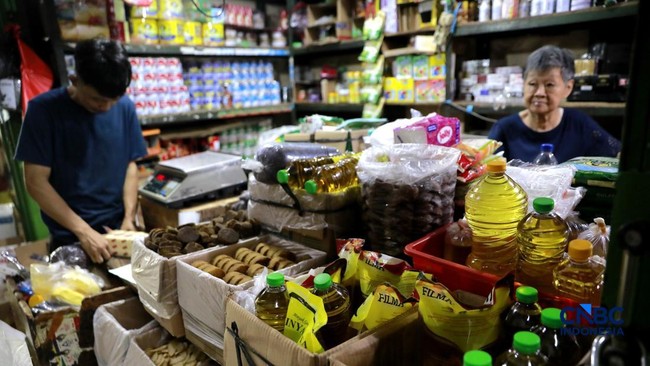
Jakarta, CNBC Indonesia - inflation pressure due to rising prices of energy and food not only faces Indonesia, but also a number of developing countries. Although Indonesian general inflation is relatively lower than some countries, food prices in the Fatherland are still high.
Based on the data of the Economic Investigation Institute (LPEM) FEB UI, Indonesia's annual general inflation in August 2026 recorded for 3.19% (year- year / yay). This number is lower than the Philippines by 6.15%, India 4.82%, and South Africa 4.17%.
However, Indonesian inflation is still higher than Thailand at 2.53% and Malaysia 1.93%.
The UI FEB LPEM explains, the escalation of conflict in the Middle East that holds crude oil prices at high levels, as well as the central bank policy of the United States (US), the Federal Reserve or the Fed, which still tend to be tight, is an external factor affecting inflation in these countries.
"Escalation conflicts in the Middle East which holds the price of crude oil at high levels and the direction the Fed's policy still tends to be an external factor relative to this group of nations," write LPEM FEB UI in his report, quoted Tuesday (20 / 10 / 2026).
Despite the relatively similar external pressure, the size and composition of inflation each country is different. It affects the structure of public consumption, the policy of subsidy energy, the conditions of food supply, as well as the targets of inflation each country.
The Philippines recorded the highest general inflation, especially due to a spike in rice prices that reached 19.4% yoy, as well as increased domestic transportation costs.
On the contrary, Malaysia records the lowest inflation in between six compared countries. The prices in the country are relatively limited and sourced from transportation, food, and housing groups.
Meanwhile, the Thai inflation is relatively low, although it began to increase as the rising price of fuel and food.
Behind the relatively controlled general inflation, the Indonesian food price pressure is actually higher than the countries.
The UI FEB LPEM recorded Indonesian food inflation at 3,86% yoy in August 2026. This number puts Indonesia in the third highest position, under India by 5.66% and the Philippines by 4.56%.
As for Thai food inflation recorded 2.99%, Malaysia 1.90%, and South Africa became the lowest, which is 0.86%.
"Regardless of the difference between each country's food-spending basket, the rate of this price increases is one relative indication that shows the going of food price pressure not only in Indonesia, but also some other developing countries," reveal the UI FEB LPEM.
In India, food inflation is particularly affected by a price spike in seasoning, such as ginger, garlic, and garlic. At the same time, a number of vegetables, including tomato and potato, are going down.
Meanwhile, South African food inflation is still very low and it's only rising thin after nine months.
The price of energy is different due to government policy
Interstate inflation pressure difference is also seen in energy groups. The Philippines records the highest energy inflation, which is 16.79% yoy, pushing up the fuel costs of transportation and utility charges.
South Africa followed by 7.35% energy inflation, among other things due to increased electrical rates. The state's energy regulator, NERSA, approves of the Eskom power rise of about 8.76% for customers to start on April 1, 2026 and 9.01% for local government customers starting July 1, 2026.
Instead, Thai energy prices have the annual deflation of 0.44%.
In Indonesia, energy inflation is 3.18% yoy. This number is relative to India by 3.10% and Malaysia by 3.26%.
The UI FEB LPEM reminds us that energy inflation comparisons cannot be used only to assess interstate inflation control performance. However, that comparison shows that the pressure of global oil prices relative uniforms can produce a different impact, depending on the energy price policies applied to each government, especially for electricity and fuel.
For Indonesia, the impact of rising the price of crude oil is relatively stifled because the government ensures the cost of BBM that is consumed by a lot of people, Pertalite and Botolar, does not rise until the end of 2026, as the UI FEB LPEM says.
Thus, even though Indonesia's general inflation is still at the medium level compared to the countries of comparison, food price pressure still needs to be looked at. The growth of food commodities and energy policy will be an important factor in determining the direction of domestic inflation.
Source: CNBC Indonesia ›



Comments (0)
No comments yet.