Integration: Merz calls fear of the stranger “ideologically infectious”
On the anniversary of the recruitment agreement with Turkey, Merz praises the diligence of the first generation of immigrants. The 65-year history also included “black chapters”.
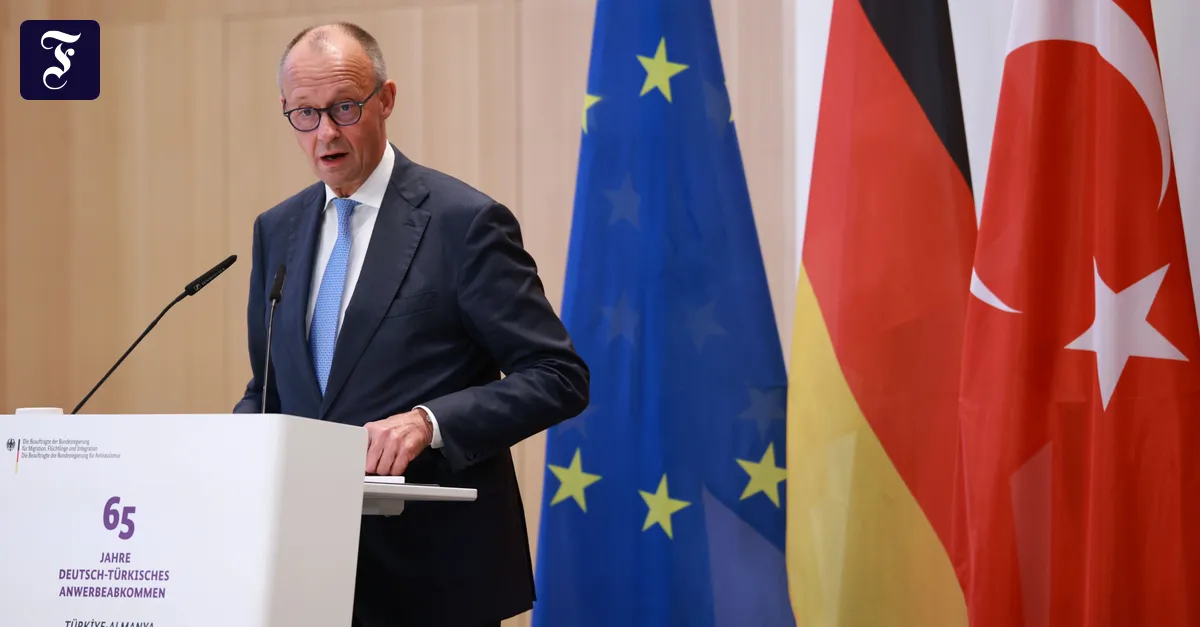
The fact that the German-Turkish recruitment agreement was signed 65 years ago is a cause for celebration for the German Government. Chancellor Friedrich Merz (CDU) spoke at a ceremony in Berlin of a “success story that began on 30 October 1961”. This should be secured, defended, but also continued. His critics, who perhaps associate him with remarks about “little pashas” or “this problem in the cityscape” may surprise, but new tones are not. Already in his first government statement in May last year, Merz had left no doubt that he sees Germany as an immigration country, and at the same time made clear his course against uncontrolled migration. He did not leave the migration turnover unmentioned this Tuesday. “We have to pay close attention to where an open and tolerant society is overwhelmed,” Merz said at the event, to which the Federal Government’s Integration Commissioner, Natalie Pawlik (SPD), had invited. At the same time, he reaffirmed that Germany and Europe are dependent on specialists from abroad. In his speech, Turkish Ambassador Gökhan Turan described Merz’s participation in the anniversary event to sign the agreement as a “meaningful gesture”. He recalled a famous quote from the writer Max Frisch: We called workers, and people came. This brings the 65 years of common history to the point. The recruitment agreement, which included only two sides and a model for an employment contract in the plant, initially provided for a two-year temporary posting of so-called guest workers from Turkey to Germany. It was intended to help meet the need for manpower and to strengthen Turkey, which joined NATO in 1952, economically. In 1964 the time limit was lifted, in 1973 a recruitment stop was imposed as a result of the oil crisis. But there was no turning back. Germany had become a country of immigration, even if it was long disputed – and the recruitment agreements with Turkey and other countries had a considerable share of it. Merz’s speech was thoughtful. At first, migrant workers did not live in the inner cities, but in simple accommodation outside. Working, sleeping, working, sleeping: that was the everyday life of the first generation. He spoke about the time of the economic miracle, when companies needed workers – and the growing poverty in Turkey at that time. Merz praises the “extraordinary diligence” of the first generation The Chancellor paid tribute to the life achievements of first-generation immigrants; They were among the listeners. This generation had “co-created substance in our country,” Merz said, “often with extraordinary diligence.” He also highlighted the importance of Turkish-born culture professionals, athletes and scientists, such as vaccine developer Özlem Türeci and Uğur Şahin. From the experiences of the past 65 years, Merz derived “success conditions” of successful integration. He spoke about colleagues and neighbors who had been curious about each other and had also worked together. Workplace, classroom, sports club, these are still the places of integration, said Merz, and at the same time highlighted the importance of state efforts towards integration. He also talked about the expectations of people coming to the country, about curiosity and respect for “our way of life”, the equality of women and men, the historical responsibility of the Shoah towards Jewish life. Finally, Merz addressed the prejudices that citizens with immigration history encountered. “Fear of the stranger is poison of any free society,” he said. Unfortunately, 65 years of history also included “black chapters” of terrible acts of violence. He named Mölln, Solingen, the NSU murders and Hanau. Social progress can also be lost again if it is not actively defended. He called the fear of the stranger “ideologically infectious”. He did not need to call the AfD by name when he responded to a “non-word” that he had actually not wanted to pronounce: “remigration”. Behind this is an attack on modern Germany, which has been built over the past 65 years. Integration Commissioner Natalie Pawlik also addressed the social situation. A lot has been achieved, but who really belongs, decide in everyday life. Even today, people in Germany are afraid because they have a different name, look different or have not started their family history in Germany. This fear is growing, Pawlik said, because something has shifted. “The next generation should no longer have to fight for their belonging, they should shape their own future.” Pawlik highlighted that today around 2.6 million people with Turkish immigration history lived in Germany. “That’s 2.6 million answers to questions no one asked in 1961,” she said. A temporary stay has become home for many. “Opportunities in our country must not depend on coincidences or luck,” she said. This is the promise of our country, and we must be measured against it.
Source: FAZ ›

Comments (0)
No comments yet.