Investor summit in Berlin: “I want your money”
Amazon invests, others withdraw: The investor summit was an event of the big numbers – and a reality check for the image of the supposedly so well organized Germans.
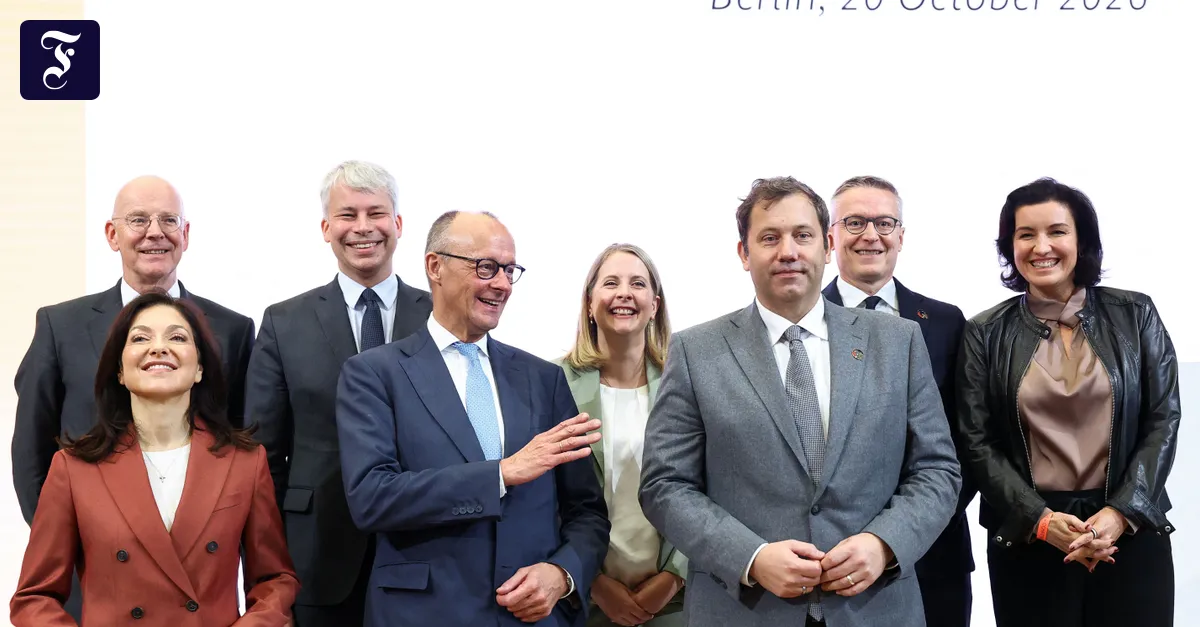
The start of the investor summit on Tuesday in Berlin was not the best advertisement for Germany as a location. In front of the former State Council building of the GDR, where the ESMT University of Applied Sciences is based today, long lines formed. The release of the accreditation tapes dragged on, as did the security controls. Many a CEO had to endure in the cold before Germany literally rolled out the red carpet. There was a “fast lane” only for the Federal Minister and the Chancellor. To the claim in the image video shown, “we like it ordered in Germany”, this scenery did not really fit. In the event hall with a view of the Berlin Palace, Vice-Chancellor Lars Klingbeil (SPD) put the message of the day best to the point: “I want your money,” said the Finance Minister to more than 200 investors who had accepted the invitation of the Federal Government to “Invest in Germany” in Berlin. On Monday evening, Federal Chancellor Friedrich Merz (CDU) opened the event with Jensen Huang, founder and CEO of the American semiconductor group Nvidia. “Germany is open to more business and ready for more growth,” Merz said. Federal Minister of Economic Affairs Katherina Reiche (CDU), whose house organized the summit in the lead, also strove for the confidence of investors. “We are working tirelessly to make Germany an even better location for the economy,” she said, promoting investments in energy infrastructure and the use of artificial intelligence (AI) in industry. Digital Minister Karsten Wildberger (CDU), Research Minister Dorothee Bär (CSU), Transport Minister Steffen Bilger (CDU) and Construction Minister Verena Hubertz (SPD) presented investment opportunities in high-tech, infrastructure and real estate. The “pitch” of Hubertz was particularly delicate in view of the ongoing debate about the socialization plans of the Left, Greens and SPD in Berlin. The Minister of construction promised, however, that the Federal government will secure the ownership of residential real estate with an investment protection law. In addition, she announced that she wanted to use the German State Fund to increase private investment in housing. Both projects are still in the works – like many other reform promises by the Federal Government. The Chancellor nevertheless sees Germany in a “position of strength”. The country is facing the largest modernization offensive in recent decades and wants to mobilize private capital, he said. From 800 billion euros in investment commitments, the Chancellery speaks with reference to the addition of the company-supported initiative “Made for Germany”. Reiche puts the volume of the largest investment projects for 2026 at just under 230 billion euros. Of these, almost 100 billion euros were attributable to foreign companies such as Amazon, Alphabet, Sanofi and Tesla. More precisely, the Ministry did not want to break down the sums on request. The official statistics of the Bundesbank paint a different picture. Foreign direct investment in Germany fell from EUR 79 billion to EUR 43 billion in the first eight months. According to Germany Trade and Invest, the foreign capital flowing into resettlements has also halved and last year stood at just under twelve billion euros. According to Allianz Research, Germany has a large investment gap of 730 billion euros compared to the United States between 2019 and 2025. Compared to the rest of the euro area, 390 billion euros were underinvested over this period. The “Made for Germany” initiative puts the investment requirement at four trillion euros by 2035. The picture of the aspiring Germans “Germans go to sleep early and get up before sunrise,” Merz said about the advantages of the location. “On holiday we are the first on the beach and put out our towels before breakfast.” During the opening event on Monday evening, Nvidia chief Jensen Huang called on the Federal government, however, to increase the pace. “Go to work,” Huang said in conversation with the Chancellor. When asked by Merz how Europe should regulate the AI industry, he replied: “Give Germany a chance.” Huang-co-founded company Nvidia, which drives the AI race in the world with its chips, puts it on the stock market on a market capitalization that corresponds to the economic performance of Germany. On the sidelines of the summit, Huang agreed with the Federal Government to cooperate to advance industrial applications of AI in Germany. Details of the plans remained open. The largest concrete investment commitment at the investor summit was announced by Amazon. The American technology and trading group wants to invest around 16 billion euros in Germany next year. Among other things, the money will go to the expansion of data centers and the modernization of logistics sites, as the company announced. In logistics alone, around 3000 additional jobs are currently being set up. In addition, more than a dozen own productions in Germany for the streaming service Amazon Prime are planned. The French pharmaceutical company Sanofi had already confirmed on Monday his plans for a two billion euros expensive insulin plant in Frankfurt. In September, the EU Commission gave the green light for 400 million euros in state aid granted by the federal government, the state of Hessen and the city of Frankfurt. Sanofi had already announced the plans in 2024. Other pharmaceutical companies such as the US group Eli Lilly have scaled back their investment plans for Germany. The German head of the Swiss pharmaceutical group Roche, Daniel Steiners,..
Source: FAZ ›

Comments (0)
No comments yet.