Listen out for Lanny: can Max Porter’s mythic tale of a mulch-guzzler really be heard in this woodland?
Every sun-dappled object is an instrument as composer Dom Coyote and sound designers Elena Peña and Dave Price conjure trip-hop-inspired rhythms in the Mendips for a new stage adaptationThe woodland is stuck to our skin. Sound designers Elena Peña and Dave Price are hunched next to me, burying a microphone into mossy ground. Composer Dom Coyote is listening on headphones, crunching out a rhythm with his boot before shucking his shoes for a subtler sound. “It’s got to be socks off, Dom,” says Price. Coyote obliges, the balls of his feet soon covered in dead conifer needles. “Do you wi...
Every sun-dappled object is an instrument as composer Dom Coyote and sound designers Elena Peña and Dave Price conjure trip-hop-inspired rhythms in the Mendips for a new stage adaptation
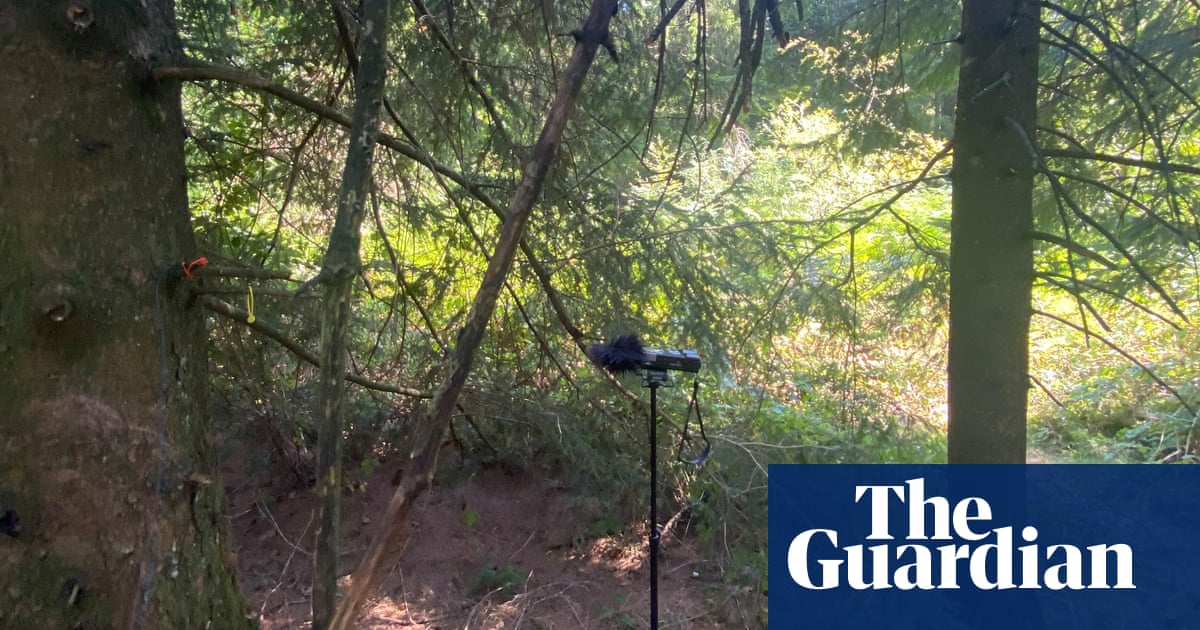
The woodland is stuck to our skin. Sound designers Elena Peña and Dave Price are hunched next to me, burying a microphone into mossy ground. Composer Dom Coyote is listening on headphones, crunching out a rhythm with his boot before shucking his shoes for a subtler sound. “It’s got to be socks off, Dom,” says Price. Coyote obliges, the balls of his feet soon covered in dead conifer needles. “Do you wish you’d had a pedicure now?” Peña asks.
It’s a short drive from Bristol to this patch on the Mendip Hills, where pine cones and rowan berries scatter at the entrance to the trees. We’re on the hunt for sounds to orchestrate a staging of Max Porter’s novel Lanny. The adaptation by Somerset-based Bea Roberts moves the spectral story of a lost boy and a mulch-guzzling creature from commuting-distance-to-London to commuting-distance-to-Bristol, with director Nancy Medina wanting the show’s sound to exist within the city’s historical music scene. “A kind of trip-hop world,” says Coyote, who is exploring this idea by replacing electronic beats with those of the natural world. “So we need to go and play the forest.” Every sun-dappled object becomes an instrument. Up on his feet, Price tests out a rhythm on a deep-timbred trunk. He points to the tree. “Any notes for the snare drum department?”
Lanny is a story that lends itself to the ear. On the page, which uses experimental typography, Porter’s text curls as Dead Papa Toothwort – an ancient creature who is myth, fable, scapegoat and threat – inhales the sounds of the village. “Music is so part of the book,” says Coyote, who describes the novel as like a spell. “You can already hear this village voice, where Dead Papa Toothwort is almost feeding off the language and culture and thoughts.” The team shake and rustle the trees, listening for sounds to bring the audience into Dead Papa Toothwort’s mystical world. Coyote’s aim is for the audience to ask: “Is the world making music, or am I just making sense of it?” As he and Peña are changing a microphone’s settings, Price appears with a blackberry plucked for each of us. “To enter the other realm,” he smiles.
The human world is hard to escape. They worry the road is too close. A little further in, we come to a contained ring of spruce trees, where Peña places a stethoscope-like contact mic – so called because they only record what they’re in contact with – against a trunk. Every angle she taps and twists gives a different quality of sound. “Infinity,” she whispers. One tree sounds remarkably like bongos. “Too cheery,” Coyote frowns. Lanny is a tale of warning: a boy is lost, a village turns against itself and a family is torn apart. “When we do our job well, people don’t notice it,” says Coyote. “But it’s drawing you in, sharpening the lens.” He hopes this show’s music will “give the audience wonder”, he says, “to counteract the absolute tragedy of the tale”.
A folk song laces through Roberts’ adaptation, which Coyote has put to the tune of Sumer Is Icumen In. “Dead Papa Toothwort is living outside of our human arrow of time,” he says. “He’s in the past, present and future.” Coyote is hoping to capture the natural, folkloric feel, which runs stream-like through Porter’s story, within his compositions. “I’m not particularly interested in a trained voice,” he says. “I like rawness. Rough magic.”
Coyote never officially studied music. Instead, he learned guitar and acted, made anarchic music with Kneehigh in Cornwall, then continued doing theatre. Cracking open his laptop, he gives us a taste of his work-in-progress, made from recording sounds at home, in his garden and using the rattles of his child’s toys. “I used to feel very self-conscious about the fact that I couldn’t read music,” he says, “but now I see people want something more. For it to be led by ear. To feel really human.”
Tilting back his head, Coyote begins to sing. It’s a song about a mother calling to her lost son, which the composer has been teaching to the cast in a round. Peña and Price start tapping and crunching out rhythms in the leaves. Even in this rough form, the raw folk song and cathedral-like synths from his laptop sound like the breath of the woodland. The treetops seem to sing it back and pass it on, starting a round of their own. “It’s a temple,” Coyote says, “isn’t it?” Now their job is to bottle this rough magic and bring it back inside.
Source: The Guardian ›

Comments (0)
No comments yet.