Tax estimate: little hope for comprehensive reduction of electricity tax
The economic outlook has brightened somewhat. This should put more money into the state's coffers. But that does not mean that the government has room for new relief.
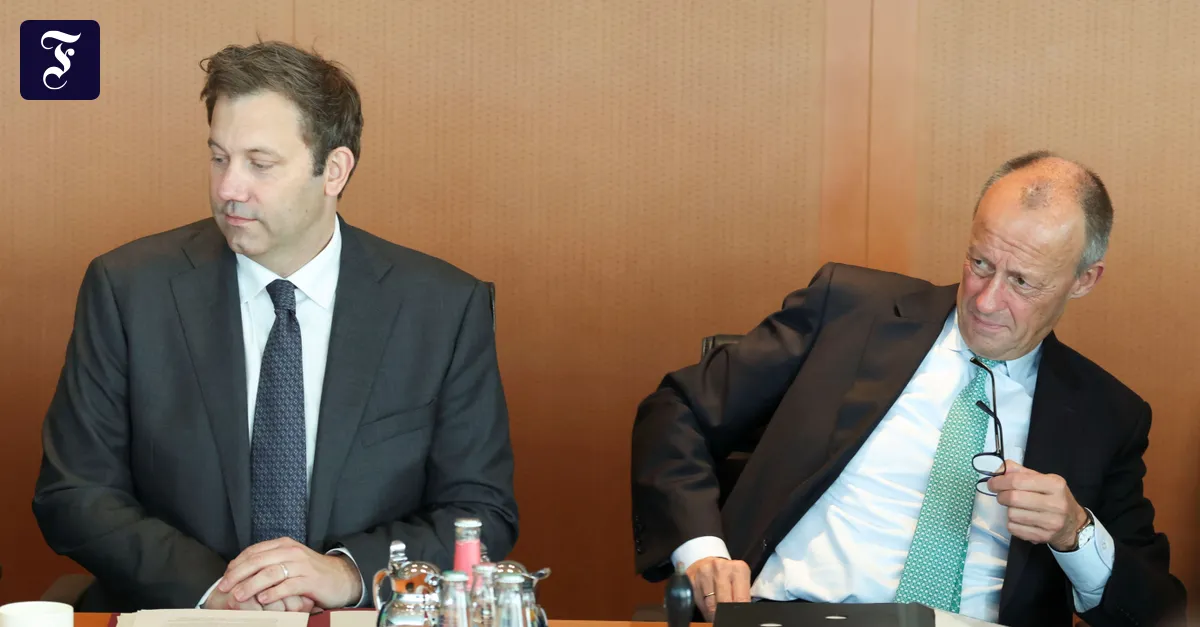
Now they count again, the tax estimators. Unlike in the spring, the prospects are now better and not worse. This leads to a better prediction. But are the foreseeable additional revenues enough to reduce the electricity tax for everyone, as Chancellor Friedrich Merz (CDU) has put it in the prospect? It is not only financial scientists who are skeptical. Two weeks ago, Merz said after an exam of the CDU presidency, room for manoeuvre in the budget should be used to reduce the electricity tax for all to the European minimum, as the coalition had originally promised. At that time, it was initially only diminished for certain companies, which was heavily criticized. There could be room for manoeuvre for discharge if growth solidifies and stabilizes, said the Chancellor, who referred to the improved growth forecast. One percent growth corresponds to about ten billion euros higher tax revenues in Germany. Of that, five billion came from the federal government. “That’s exactly the one percent growth that gives us this leeway.” Can the federal government afford to forego revenue? But is that true? In a double sense, one may ask. Firstly, does the stronger growth of the economy ensure that the billions flow into the federal coffers, which would cost such a relief of citizens and smaller companies? Secondly, given its difficult budgetary situation, can the federal government afford to forego such additional income? This Thursday, the working group tax estimate publishes the result of its three-day consultations in Saarbrücken. Since the members calculate locally and discuss each individual tax, the new estimate cannot be exactly predicted. But there are indications. And a formula of thumb. The starting point is the current emergence. In August, tax revenues increased by 1.7 percent. This is not a particularly high value, but still better than in the entire first eight months of the year. The increase is 0.9 percent. The estimators will still receive and take into account the figures of the big tax month of September. But all in all, this launch pad for the tax revenues of the next few years should not be too steep. A rule of thumb for tax estimation is better with the growth prospects. One percent more nominal growth (including price effects) increases gross domestic product by around 46 billion euros. The tax rate is about 22 percent. So you would come to the Chancellor's over-revenue of 10 billion euros. The federal government’s spring projection contained a nominal increase of 2.8 percent this year and 3.8 percent next year, in the autumn this turned into 4 and 4.3 percent. The difference and thus the foreseeable increase in volume would thus be greater this year than next year. As won, so wrecked, so could be the motto for the Bund next year. According to the rule of thumb, 0.5 percent more growth would be a tax increase of five billion euros, of which about half would be attributable to the federal government. An improved economic situation simultaneously reduces the economic component in the debt rule. According to F.A.Z. information, the Federal Ministry of Finance expects this effect to reduce the maximum permitted borrowing by 2.5 billion euros. All in all, this would not, for a change, aggravate the situation. But new scope would not be gained, not even for a lower electricity tax. Tax estimator Boysen-Hogrefe sees “not to some extent” leeway That is not enough, any government would be wise to look not only to the next year, if it plans a project that permanently withdraws funds from the Federal government. Its financial planning is already more than tense. The independent advisory board of the Stability Council has just warned that Germany’s deficit will regularly violate the European control limit of three percent in the coming years. The federal government considers extensive savings, although it is far from clear how this should happen. In this way, he identifies the need for action and works with very high global shortfalls (unspecified savings targets). Both add up to 150 billion euros for the years 2028 to 2030. The financial scientist and tax estimator Jens Boysen-Hogrefe therefore thinks nothing of the debate that Merz has initiated. “I do not see any scope for a reduction in the electricity tax,” said the Kiel economist of the F.A.Z. He referred to the municipal deficit of around 30 billion euros per year. Even if the federal states are responsible for this first, the federal government is also required to participate in a solution to this problem. In addition, the health insurance companies waited in vain for adequate coverage of the non-insurance benefits, instead they received loans from the federal government. Also in the own parliamentary group, there are concerns, as far as the research promise of the CDU presidency, but still to lower the electricity tax for all. “Even if it would be desirable, the financing question arises,” it is said cautiously in circles of budget politicians. There you can see how difficult it is to organize parliamentary majorities for the new taxes on sugary drinks, plastic packaging and crypto profits. Or for an income tax reform that hardly deserves the name so far. The coalition needs the new taxes in order to be able to draw up a constitutional budget. Due to the tense financial situation, it has also not yet been possible to postpone the income tax rate so that the cold progression is compensated for everyone. Without correction, inflation creates hidden additional burdens.
Source: FAZ ›



Comments (0)
No comments yet.