Dealing with the past: Northern Ireland is far from reconciled
In Northern Ireland, the rifts between Catholics and Protestants are still deep nearly three decades after the end of the civil war. A new law to deal with the violence should now help.
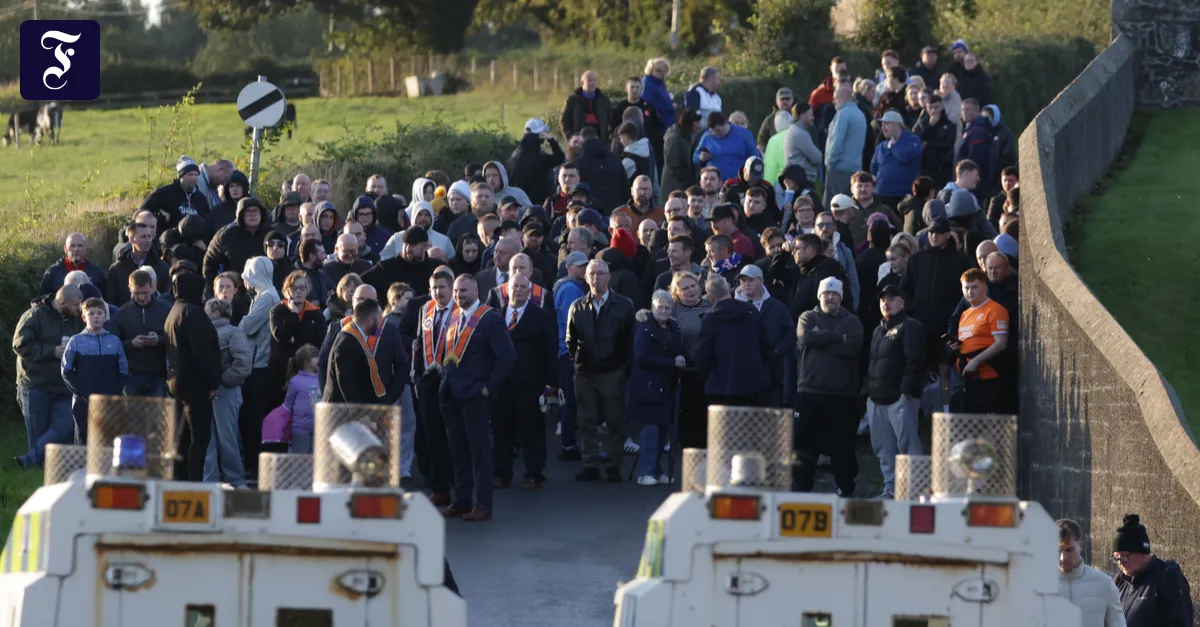
In Northern Ireland, irreconcilability is still rooted deeper than sowing understanding and prosperity. Nearly three decades after the Good Friday Agreement, which largely put an end to the violence of terror in the spring of 1998, the Protestant Unionists, who feel at home in the United Kingdom of Great Britain and Northern Ireland, and the Catholic nationalists, who want to see the Irish island united in one state, continue to mark their identities in sharp delineation. Two events this autumn demonstrate that the hope has so far been that the formal peace agreement will pave the way for a practiced normality. On the one hand, a few weeks ago, images were renewed that were topical in the hot times of the “Troubles”, the Northern Irish civil war. The march of the Orange Lodge men in Portadown – a symbolic parade of unionist Protestants – through the Catholic-nationalist neighborhood on Garvaghy Road was one of the fuses that exploded the violence in the acute period of conflict. 3,500 people died during the civil war For decades, the march has since been banned by an independent “moving commission” – established as part of the peace agreement – on the grounds that the danger is too great that old conflicts will be rekindled. This year, the commission allowed the Orange Lodge to move – and the old hostilities were immediately renewed, in the form of a roadblock by Catholic nationalists. On the other hand, a current draft law, which aims to point the way to reconciliation by clarifying previously unexplained decades-old bloody acts, shows how difficult it is still to open the barriers of hatred and fear. Among the perpetrators who killed more than 3,500 people in the decades of the civil war in Ulster were not only the Irish Republican (IRA) terrorist fighters and the paramilitary militia fighters of the Protestant Unionists, but also soldiers of the regular British army. Especially to protect these soldiers, the last Conservative government had put in place a legal regulation three years ago, which should largely cap the legal investigation of the old crimes. It prevents new criminal investigations into killings or other capital crimes committed at the time and guarantees the perpetrators a conditional immunity if they cooperate with an independent reconciliation and intelligence commission, which alone is to carry out the further investigation of still unexplained incidents. However, Northern Irish courts soon declared the immunity clause incompatible with the European Convention on Human Rights and therefore inapplicable. The current Labour government presented a new reappraisal law, which is now to work a tightrope between a distance softening for former perpetrators and the hardly weakened reappraisal anger of the victims and their descendants. According to an overview by the House of Commons Scientific Service, 722 British soldiers were victims of terrorist paramilitary attacks during the three decades of the Troubles. On the other hand, British military action also claimed 301 lives, of which more than half were civilians. In the decades following the end of the conflict, in addition to the investigations of the law enforcement authorities, there were various investigation and investigation approaches, which could never win an equivalent trust of both former parties to the conflict. The current Labour Government has chosen to maintain the independent reappraisal commission. It is even to be given more far-reaching competences and quasi criminally investigated, but the conditioned immunity of the former perpetrators is to be deleted. This has generated sharp protests among Protestant Unionists, British veterans’ associations and the Conservative opposition party. The clause introduced by Northern Ireland Minister Chris Bryant, that only the British Attorney General can authorise criminal action for former acts of violence, is in turn strongly criticised by Irish Catholic nationalists. Michelle O’Neill, who is the first minister to lead the Northern Irish regional government – formed jointly by nationalists and unionists – and who represents the Catholic-nationalist Sinn Fein party, saw the new regulations as a “preferential treatment” of former British soldiers. The amended Enlightenment and Reconciliation legislation will be finally discussed and voted on this Tuesday in the House of Commons. Bryant has previously made the extent of unfed wounds clear to MPs: “These are families who lost loved ones during the Troubles, usually in the most horrific circumstances – fathers, mothers, brothers, sons, sisters – in total more than 3,500.” And Bryant added that ninety percent of the victims were killed by IRA or Protestant loyalists. The families of the victims had lived for decades with “doubt, uncertainty and unacknowledged grief”. In the words of the British Minister for Northern Ireland, the impression rings along as if reconciliation in Northern Ireland is still only just beginning after three decades. And in some ways it is. The Catholic blockade of the Protestant Orange March in Portadown could not be solved in long negotiations and also by requests to courts. In the end, Bryant took advantage of his executive rights – and outlawed the parade.
Source: FAZ ›
Comments (0)
No comments yet.