Is There a Mountain Higher Than Everest? Here’s What the Experts Say
Mount Everest is known as the highest mountain, but geologists are searching for traces of an ancient mountain that may have been even higher. Discover the mystery of the mountain’s height!
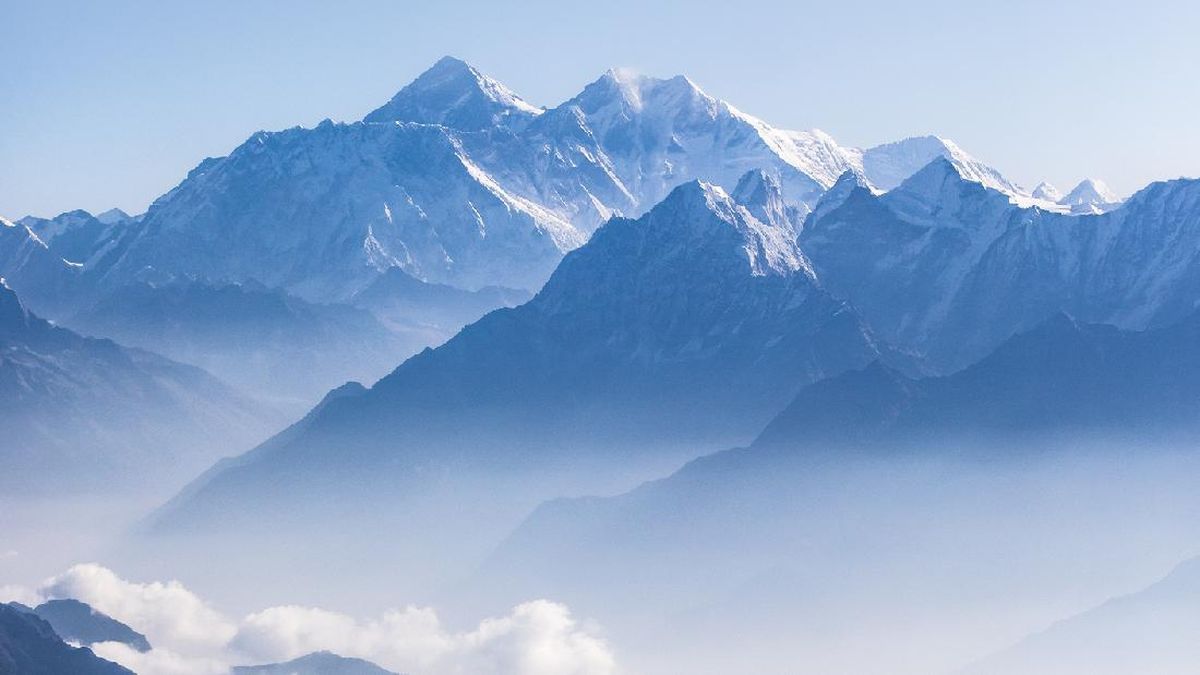
Mount Everest, located in Nepal, has long been known as the world’s highest mountain, standing at 8,849 metres above sea level. However, is there a mountain taller than Everest?
The answer remains a mystery. Nevertheless, experts state that a number of geological clues may help to estimate the locations of the highest mountain peaks in the distant past.
Geologists do not yet have sufficiently detailed data to determine with certainty which mountain was the highest hundreds of millions of years ago.
“Unfortunately, we will never be able to achieve that level of detail,” a professor of geology at the University of Adelaide, Australia, told Live Science on Saturday (17 October).
However, clues from sedimentary remains trapped within the Earth’s crust provide a glimpse of the grandeur of ancient snow-capped peaks.
Scientists study these crustal layers to determine how deep they extend. This information can help reveal the estimated heights of ancient mountains.
Mountains are formed from continental crust that is pushed upwards as tectonic plates slowly collide. This crust is extremely heavy and has a much larger volume than is visible at the surface.
Very high mountain peaks, such as Everest, are supported by sections of the crust lying far below the Earth’s surface.
When part of the crust is pushed upwards to form a mountain peak, another part is also pushed deep below the surface.
Collins and Ziyi Zihu, a geochemist from Curtin University in Australia, compared mountains to icebergs, which reveal only a small fraction of their total mass above the surface.
“We can infer or estimate that [the largest mountains] are located in regions where the crust extends deep below the surface,” said Zhu.
For example, geologists estimate that the Earth’s crust beneath the Himalayas extends to a depth of 50 miles or 80 kilometres, whilst Everest’s height reaches 29,000 feet.
Consequently, the world’s highest mountain represents, at most, only around 14 per cent of the total mass of rock that makes it up. This suggests that there is a limit to the height a mountain can reach before it eventually collapses under its own weight.
The Himalayan mountain range began to form around 50 million to 40 million years ago as a result of the collision between the Indian and Eurasian tectonic plates.
In the history of mountain formation, the Himalayas are relatively young. This is one of the reasons why the range remains so high.
The highest mountains, with their steep summits, erode rapidly over time. Nevertheless, the Himalayas continue to grow taller as the two plates continue to collide.
However, such intercontinental collisions have occurred many times before. The Super Transgondwana mountain range is one such example.
Gondwana was an ancient mountain range that once lay in the region now forming part of East Africa, beginning to form around 650 million years ago. This process took place when Africa and South America collided with the regions of Arabia, India, Australia and Antarctica, forming the supercontinent of Gondwana.
Gondwana subsequently broke apart again. Nevertheless, evidence of these mountains can still be found in a number of regions, such as southern India, Sri Lanka, Tanzania and Kenya.
This evidence suggests that the length of this mountain range was three times that of the Himalayas.
“If you were to walk through that region today, you could see the rocks that once formed the base of this mountain range,” said Collins.
On average, he estimates that the Earth’s crust in these regions is deeper than that beneath the Himalayas, or even thicker.
The crustal layers found in these regions also provide clues as to the height of these mountain ranges. Some parts of the crust extend to a depth of 18 miles or 30 kilometres, despite having undergone erosion over around half a billion years.
“At one time, these layers were likely situated in the middle of a crustal column reaching a depth of 60 kilometres (37 miles),” said Collins.
Consequently, the mountains situated atop this base section would likely have been as high as Mount Everest.
In the Himalayas, the highest mountains are situated around the edge of the Tibetan Plateau. This plateau is the highest-elevation region on the planet, averaging around 3.7 miles or 6 kilometres above sea level.
According to Collins, the Transgondwana mountain range likely featured a similarly high plateau in the region that is now the southern part of Madagascar.
If so, the edge of this high plateau may have extended as far as eastern Madagascar, southern India and eastern Antarctica.
Another candidate for the highest mountain range is the Greenville Mountains, which formed alongside the formation of the supercontinent Rodinia around 1.3 billion years ago. Remnants of these mountains can be found around south-eastern Ontario and north-western Vermont.
According to Collins, information regarding this extinct mountain range remains limited. Some scientists suggest that its height may not have matched that of the Transgondwana Mountains or the Himalayas.
Meanwhile, around 2 billion years ago, the formation of the supercontinent Nuna, also known as Columbia, also left evidence of the existence of enormous mountain ranges.
In his research, Zhu discovered evidence of these giant mountain ranges by examining the composition of zircon crystals remaining within the Earth’s crust, directly beneath the now-vanished mountain ranges.
However, if we trace Earth’s history even further back, the picture becomes increasingly unclear.
According to…
Source: CNN Indonesia ›




Comments (0)
No comments yet.