Summit in Berlin: New momentum for private motorway expansion?
Road construction projects in a public-private partnership are again increasingly discussed – including at the investment summit on Tuesday. In France, the advantages of the model are evident.
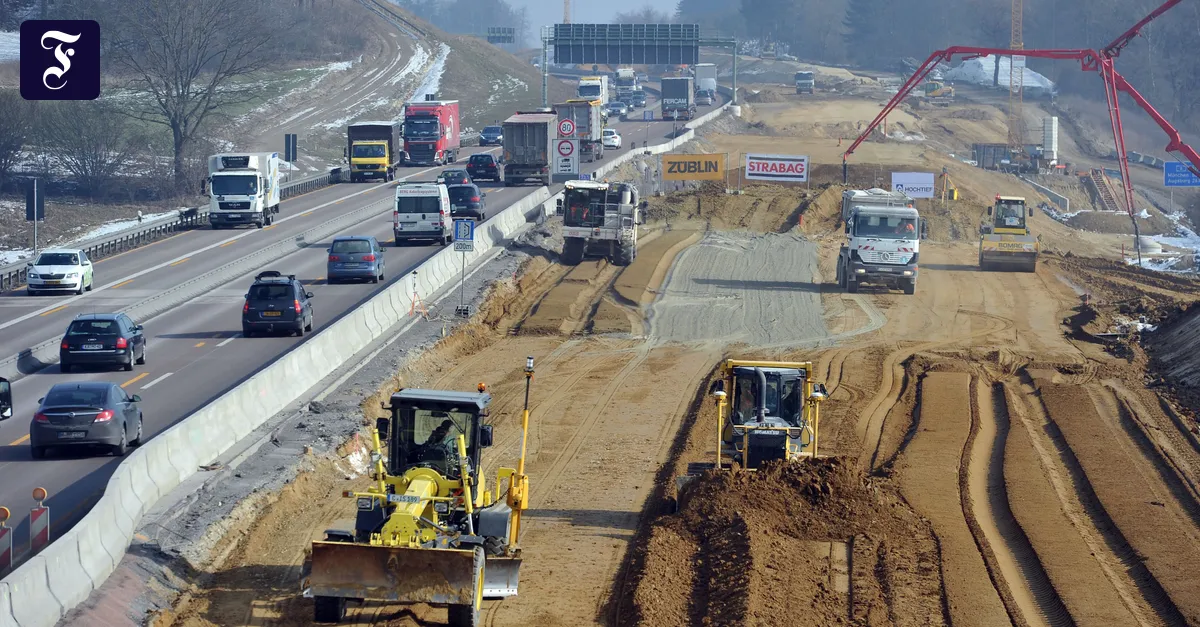
The need for modernization of the German motorway network is growing rather than decreasing. However, the operation, maintenance and expansion of the approximately 13,200 kilometres route cost and last, and the state funds are scarce. Against this backdrop, a renaissance for road construction projects in public-private partnership, or PPP for short, has been emerging for some time. “In the medium term, we want to enable the increased use of private capital,” says the coalition agreement of the German government. PPP experience a re-evaluation, it said for months from Berlin government circles. In such a project, a private-sector consortium takes care of the operation, maintenance and expansion of a longer motorway section – while in public projects in Germany, smaller sections are usually addressed individually. PPPs usually lead to a higher rate of modernisation. The consortium has clearly defined contractual obligations and receives full compensation only when they are fulfilled – either depending on the traffic volume and thus on the truck toll generated or simply for maintaining the route as agreed. As Europe’s largest construction and infrastructure group, Vinci is in the starting blocks when Germany increasingly relies on the private sector. "We do not lobby to say that you have to privatize airports or implement PPPs," said Pierre Anjolras, CEO of the F.A.Z. and the "stock exchange newspaper". But if there is a “momentum” and political interest in it, you are happy to participate in this adventure. Vinci is not a newbie in Germany The Federal Government’s investment summit could move things forward. Anjolras belongs to the small circle of corporate heads who meet this Tuesday morning with Chancellor Friedrich Merz (CDU). Discussions are then planned. There will also be announcements in the area of infrastructure. Just a few days ago, the federal government has launched a bill with which the federal highway company should become creditworthy from 2027. This new financing structure is also intended to create more opportunities for PPPs, which were rather critical of a first wave in Berlin in the late zeros. Costs were regularly incorrectly estimated in advance, complained the Federal Audit Court and the audit courts of the states. Vinci is not a newbie in Germany. Like its domestic rival Eiffage, the French group is rather a permanent fixture on privately managed highways. These include the A4 between the state border of Hesse/Thuringia and Gotha, the A5 between Malsch and Offenburg, the A7 between Göttingen and Bockenem and the A9 between the municipality of Lederhose and the state border of Thuringia/Bayern as well as part of the Bundesstraße 247. That is a total of 234 kilometres. Eiffage, a competitor of Vinci in the construction and infrastructure sector, also operates in Germany: The company has recently completed the modernization of the A3 between Würzburg and Erlangen. “Growth is much stronger in Germany” More than one billion euros have already been invested in the German motorway network, highlights Vinci CEO Anjolras, who had his first points of contact with Germany during a student exchange in Eberbach. Already last week he was for a meeting of the Vinci Board of Directors in Germany. The almost 25,000 employees there implemented around seven billion euros, says Anjolras. However, around 80 percent of this was due to energy and digital infrastructure, not to the motorway business. Vinci is also involved in the construction of charging stations, power grids and data centers. After France, Germany is the second most important market for the Group – and its importance is growing. Vinci has just acquired the IT service provider All for One from Filderstadt. “In the 1990s, sales in Germany amounted to a few hundred million euros,” says Anjolras, adding: “Growth is much stronger in Germany than in France.” There, Vinci is the country’s largest motorway operator with around 4,400 kilometres, where concession models have been common for decades. The ever-increasing car toll is always causing heated discussions in the French public. There is significantly less road damage and construction sites than in Germany.
Source: FAZ ›

Comments (0)
No comments yet.