Immendorff in Düsseldorf: Where do you stand with your art, colleague?
The threshold is low: The Museum Kunstpalast in Düsseldorf dedicates a retrospective to Jörg Immendorff. It could have been an engaging show.
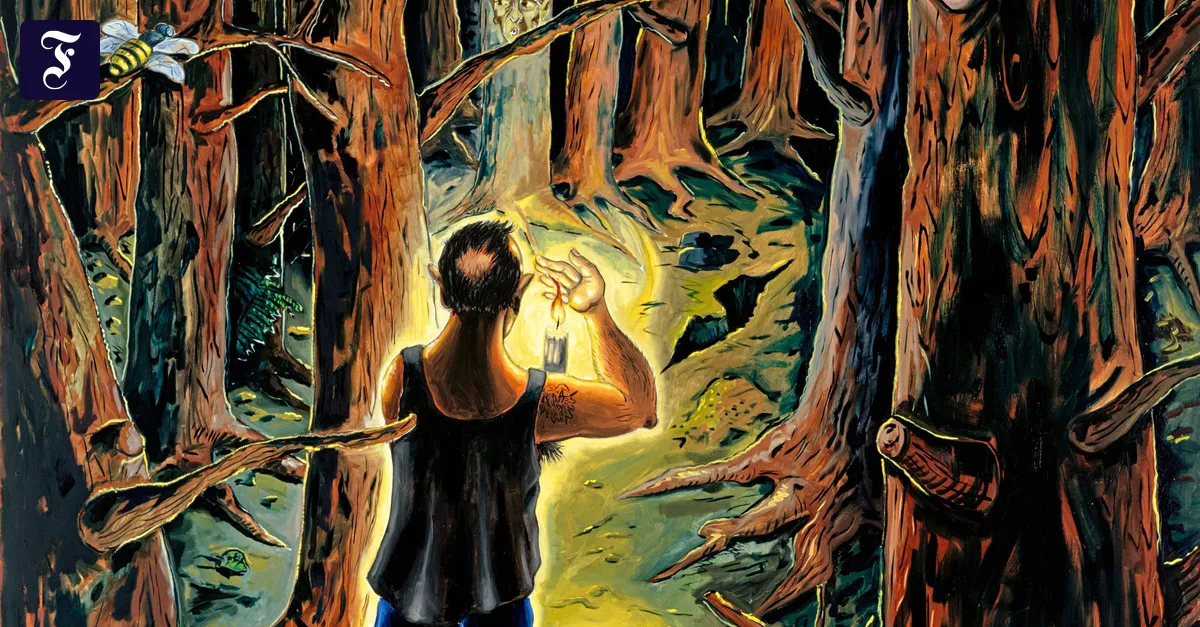
According to the 1966 anecdote, a picture hung on the wall in the famous room 19 of the Düsseldorf Art Academy, for which Professor Beuys had only one word left: “shit picture”. The student named Jörg Immendorff was kinked and smeared it with the appeal “Stop painting”. When the man came back with the felt hat, he commented on it again only with one word: “top image”. To this day it is one of Immendorff’s most famous works. In the end, he had come so far as to be commissioned with the state-supporting Chancellor portrait. Immendorff paid homage to Gerhard Schröder, who, like himself, came from small backgrounds, in the nobilitating round form of the tondo and gave the former Chancellor as a national hero, like a Fritz Walter of German politics (so one can be mistaken in a male friendship). In between, an oeuvre unfolded, which went from political performance and provocation to melancholy and melancholy, went deep into the collection of the history of painting up to the German Renaissance, and thus constantly changed, without being in any way unfaithful. Immendorff did not have the qualities of Markus Lüpertz or Georg Baselitz in painterly terms, but also made less of a painter prince, more of anarcho, prolet and revoluzzer, let a worker once ask an artist at the easel in one of his pictures: “Where do you stand with your art, colleague?” This too is a painting that is inextricably linked to the name Immendorffs. After his death in 2007, he left behind a work that, in its dull-cheeked, then differentiated manner, was probably more influential in terms of broad impact than that of the two colleagues. And also had his scandals like those about cocaine possession, for which he had to answer in court. Between political kitsch and theatrical vitality Almost twenty years after his agonizing death due to illness, the oeuvre of the painter and sculptor born in 1945 in Bleckede, North Germany, is still relevant in terms of topics and techniques. Already in the late seventies Immendorff, inspired by the friendship with the Dresden painter A.R. Penck, had painted in the work group “Café Deutschland” completely intrepid flaming pictures about the division of Germany and its overcoming, so happened in a time when this goal was still considered absolutely utopian, if not – especially in the Maoist-left circles of the artist – as a reactionary idea. Immendorff then found a sometimes glaringly contoured style between “Politkitsch” (Benjamin Buchloh) and theatrical vitality. His iconographic imagination was evidenced by the idea of gathering heads of contemporary history and his personal surroundings in large, even huge group portraits, such as Heiner Müller, Bertolt Brecht, Robert Havemann (the GDR regime critic behind barbed wire) or Penck – and thus setting up a manifesto that was as personal as it was political. In these urgent stage rooms, which owed their initial studies to the stage designer Teo Otto, the temporary secondary school teacher and later Düsseldorf Academy professor demonstrated how political activism can be translated into art. Already in the sixties he had campaigned for social cohesion, free debate, direct democracy and peaceful communities in happenings and actions under the loud-painted Dadaist title “LIDL” with his wife Chris Reinecke. Paralyzed by ALS, he became “Raphael without hands” Remarkable and topical to this day, Immendorff’s practice of painting, which was inevitably tested in the end, was in his last years of life, after he had been diagnosed with the disease of the nervous system, ALS, and he could no longer paint himself. So he instructed his assistants to sketch pictures on the computer after models of Hans Baldung Grien, Bosch, Bruegel and Goya and to bring them to the screen according to his instructions, which earned him the (well-meaning exaggerated nickname “Raffael without hands”). In Immendorff’s late work, allegorical death is present, and he himself, as one experienced in his studio in Düsseldorf’s Stephanienstraße, looked at death courageously, without any larmoyance in the eye. All of this could have made a captivating show of work. However, the exhibition “Immendorff” in the Düsseldorf Museum Kunstpalast only touches on a lot without deepening it. The Kunstpalast remains on a low-threshold line, which for some time has consisted, for example, in pushing the person of the artist into the foreground in wall-sized photographs, whereas even the largest formats of painting have to assert themselves. In a restless exhibition design, the walls are full of Erkläext, which would be better off in a booklet to let the view come to itself undisturbed. Sticking original artworks like a brooch on the lapel to these photos is not acceptable. Of course, one does not have to kneel in front of the small Lidl wooden block in black-and-red-gold from 1967, which was confiscated by the police at the time when Immendorff dragged him behind him in Bonn near the Bundestag. But that’s why you don’t have to degrade it to an appendage of a dominant display. The academy city of Düsseldorf still has an art audience that does not go to the museum for Blumenbouquet and Dog Day. Hopefully, the Kunstmuseum Karlsruhe Immendorff will have more vocal power out of itself during the next stop of this exhibition. Immendorff. Museum Kunstpalast, Düsseldorf, until 10 January 2027, from 7 March to 30. May 2027 at the Kunstmuseum Karlsruhe. The catalogue costs 29.80 euros.
Source: FAZ ›




Comments (0)
No comments yet.