Paris Cultural Center: All wheels stand still
The feat of a real estate tycoon: On the Parisian Île Seguin, where the Renault factory once stood, one of the largest new cultural buildings in France, the Large, opens. Is it a win for the city?
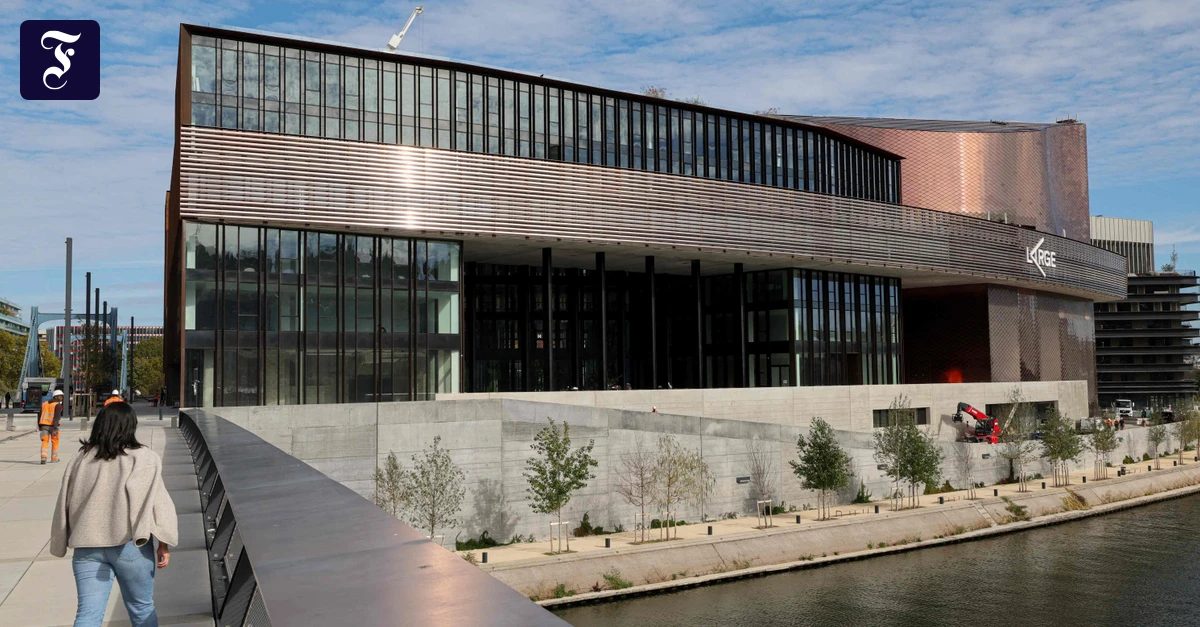
When the name Seguin falls, the French of the late 18th already knew that. Then you have to be prepared for surprises, for good and less good. Because the chemist, researcher and businessman Armand Jean François Seguin must have been, by all we know of him, an eccentric and strange man. He researched human breathing and the effects of opium, enjoyed receiving slippers and published brochures with financial tips. And because he also liked to experiment with people, he once, if we can believe his biographer Arthur Lévy, let a surprise fireworks light directly in front of his own guests on his estate. When the guests wanted to run away in panic from the noise and the flying sparks, however, they crashed into well-camouflaged hunting traps that Seguin had previously had unearthed. Despite such character defects, the approximately one-kilometer-long island in the Seine west of Paris, which he bought in 1794, still bears his name today. However, she became famous for another person: After the First World War, car manufacturer Louis Renault bought it to build a factory here, which remained in operation until 1992 and became part of the collective memory of France. In 1936, supporters of the Popular Front occupied the factory, in 1970 Jean-Paul Sartre spoke to the workers here. At the same time, since 1945, after the expropriation of the collaborator and anti-Semite Louis Renault, Renault has been a state-owned enterprise that has made a contribution to the well-being of its striking and combative workers and has contributed not only to the industrial but also to the social progress of France. When Renault abandoned the island in 1992, the old, light factory from the 1920s, one of the most beautiful and important industrial monuments in France, became a popular place for Parisian youth, who celebrated festivals and left graffiti behind. But after the then still careless logic of demolition and new construction, the long hall was finally demolished in 2004 in order to market the island as expensive building land. Luxury entrepreneur François Pinault wanted to build a palace here for his private art collection, but at some point he left for Venice because of bureaucratic obstacles and ongoing protests, where he had the Punta della Dogana rebuilt for his collection. When Paris gave itself the ball, the architect Jean Nouvel was commissioned with a master plan. He planned five skyscrapers, a mini-Manhattan with a cultural center, but the residents protested, and the mayor buckled, again nothing happened. In 2017, at the northern end of the island, the Seine Musicale, designed by Shigeru Ban, opened, a concert hall with glued laminated carrier, which now lies there like a disco ball pressed in pumpkin form and around which a mobile solar sail for energy production revolves. There were still many proposals for the lower end of the island, including a digital campus of Bolloré, a cancer research institute and a European contemporary art centre. Ultimately, however, the real estate entrepreneur and art collector Laurent Dumas secured the top of the island and, after consultation with the district mayor, commissioned the architects RCR and CALQ with a 450 million euro development without any further public competition. Dumas is the founder of a real estate company called Emerige (from “aimer” and “ériger”, which means “love to build”) and has specialized in lucrative quarter developments, which can also be criticized as transforming normal urban spaces into partially sterile, partially crazy overdesigned luxury habitats. Dumas likes to equip his real estate projects with contemporary art. He has also long been interested in the conversion of existing properties, such as the conversion of offices into housing. He might soon be able to practice this on his own project – because on Seine Island, where a cultural location was supposed to be created by the radiance of a small Centre Pompidou, Dumas himself had the majority of offices built. In addition, there is a Pathé cinema complex, gastronomy, a hotel and, as a centerpiece, a 5000 square meter exhibition venue called Le Large. It accounts for about ten percent of the total building volume – and has now been opened with an exhibition worth seeing curated by Cecilia Alemani. It is called “Moteur Imaginaire” and is dedicated to the art and cultural history of the car as an aesthetic fetish object, as a social enabling machine and as an ecological problem. There are works from the car company’s large art collection, Robert Doisneau’s impressive back-light photographs of the life of Renault workers in the factory from the mid-thirties, for example. In addition, there is Op-Art by Vasarely, who also designed the Renault logo in 1972 and thus gave each car customer a small readymade work of art – just as the company advocated for the aesthetic education of workers: The canteen adorned a colorful circulating work by Julio Le Parc, which can now be seen at the Large. By Thomas Bayrle, a burlesquely beautiful work reminiscent of Jacques Tati can be seen, in which two windshield wipers mounted on a rack wriggle back and forth and look like the arms of a wildly gesticulating human or robot. Randa Maroufi stages women mechanics in the traditional male domain of the auto workshop and thinks about roles and the car as an object of female self-empowerment, as does Shirin Aliabadi from Tehran, who shows how driving around and cruising in the car is the only way for women to go out, flirt, conquer the city together. Mohamed El Khatib places an overloaded green Renault 12 in the hall, which commemorates the migrant workers’ journeys home and their fates. Aleman..
Source: FAZ ›


Comments (0)
No comments yet.