Political Books: Russia, Invented by Germany
Political scientist Gwendolyn Sasse has used social science methods to investigate why many Germans still like Putin and his system.
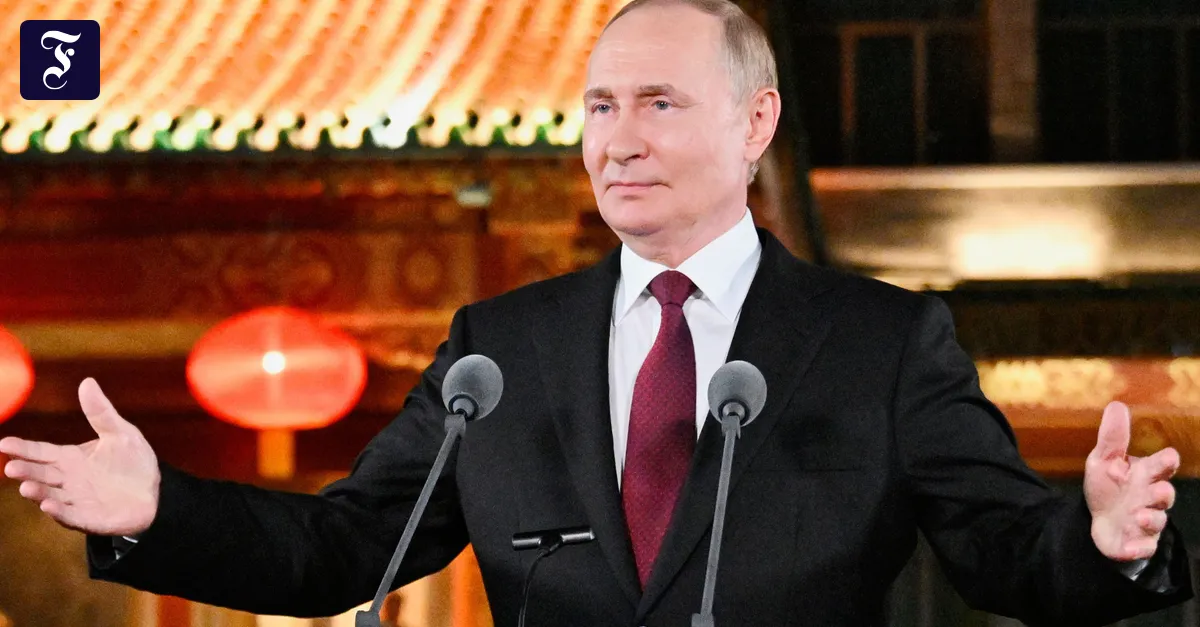
Why is it that Vladimir Putin is still viewed with sympathy by many Germans? And why is Russia, despite dictatorship and war, viewed positively by a considerable part of the Germans? Political scientist Gwendolyn Sasse has addressed this question. She notes that even “a war of previously unimaginable dimensions, which has already cost the lives of hundreds of thousands”, has so far only been able to change the German view of Russia. Still, blinkers prevented recognizing Putin’s authoritarian system and perceiving Russia’s imperial expansion drive. Even the shock, the Moscow attack on Ukraine of the 24th. In politics and society, it has only partially led to self-critical reflection on which decisions of German Russia policy were wrong and which illusions the Germans had about the Moscow regime. Sasse calls this inventory “disturbing.” But why is that? Sasse, director of the Center for Eastern European and International Studies (ZOiS) in Berlin, is looking for an answer with social science methods. She has conducted several representative surveys, moderated discussions in focus groups and in-depth interviews with individuals, some using AI. With her approach, she wants to let “normal people” speak. They express their associations and views on Putin and Russia, their feelings of security and insecurity. The statements of the interviewed persons make up a large part of the book, which makes the reading sometimes exhausting. Since the project began in 2019, Sasse can describe what changed after Russia’s 2022 attack. Russia as a big brother and protector A large part of the results confirms what has been known or suspected so far. Thus, before the Russian aggression of 2022, the proportion of people who see Putin as an “effective president” is higher in East Germany than in the West of the Republic. Some respondents call him a “charismatic leader” who stands by his word and wants to do something for the people. The proportion that Putin perceives as a threat is again higher in the West than in the East. After 2022, the German image of Putin and Russia changes. The Russian ruler is now seen largely negatively, the predominant association of the Germans with Russia is now the war. Positive associations are further to be found among supporters of the AfD. It is the only party that has not changed its program with regard to Russia after 2022, but continues to oppose sanctions and to resume Russian energy imports. However, many AfD supporters who used to praise Putin as assertive and because of his authoritarian leadership style are now projecting these qualities onto another leader: Donald Trump. The reasons why many East Germans view Russia differently than West Germans are manifold – and ambiguous. In the GDR there was a forced proximity to the Soviet Union. Students had to learn Russian. Few wanted it. And most did not even speak the language so far after several years of teaching that they could have a simple conversation. At the same time, membership in the Society for German-Soviet Friendship (DSF) was mandatory. But even forced proximity can work. The GDR was so small, “to have such a big brother, nothing can happen to you,” recalls a participant of the emotional closeness to the Soviet Union, which he felt as a child. Soviet recruits were considered “poor pigs” Sasse argues that the closer proximity of the East Germans to the former occupiers also has to do with the fact that the ideology of the GDR, which was then only moderately successful among the citizens, is effective in retrospect. Not only memories of the GDR period would be glossed over, but also the ideology of that time and its propaganda tools. “That which could not be implemented in GDR times succeeds over three decades later,” writes Sasse. Ideological formulae and phrases that concerned the desired coexistence of the GDR and the Soviet Union were today converted into the call for peaceful relations with Russia. Dadran may be something. More important, however, seems to be the widespread feeling in the East that it is better not to mess with Russia. It is probably the fear of “the Russians” that is still more effective in East Germany than in the West German federal states. The conviction that the great power is already on the longer lever and nothing can be oriented against it has apparently passed on. At the same time, as can be seen from the documented discussions, many GDR citizens saw the simple Soviet recruits in the GDR as “poor pigs” who had to serve under miserable conditions and were mistreated by their officers. At the same time, they encountered the occupiers with a certain sense of superiority. Many East Germans also see a parallel when it comes to the often difficult experiences they and the Russians went through after the system change and transformation. The differences between Russian predator capitalism and the transformation in the former GDR are great, but the feeling that “the West” is to blame seems strong. In this context, the state-ordered anti-Americanism from GDR times has an effect. The scepticism towards NATO, the USA and the West is great in the East German countries – and today it is mixed with the left anti-Americanism of West German character. Sasse makes a caveat when it comes to the more positive attitude towards Russia in East Germany: The successes of the parties AfD and BSW with an affinity for Russia were greater in East Germany, but they belonged..
Source: FAZ ›


Comments (0)
No comments yet.