Rubber Soul: When The Beatles Learned To Say "Me"
Already with "Rubber Soul" the Beatles made 1965 era by using the recording studio as an instrument. On the new, historical-critical edition of the album, the story of its creation can be heard.
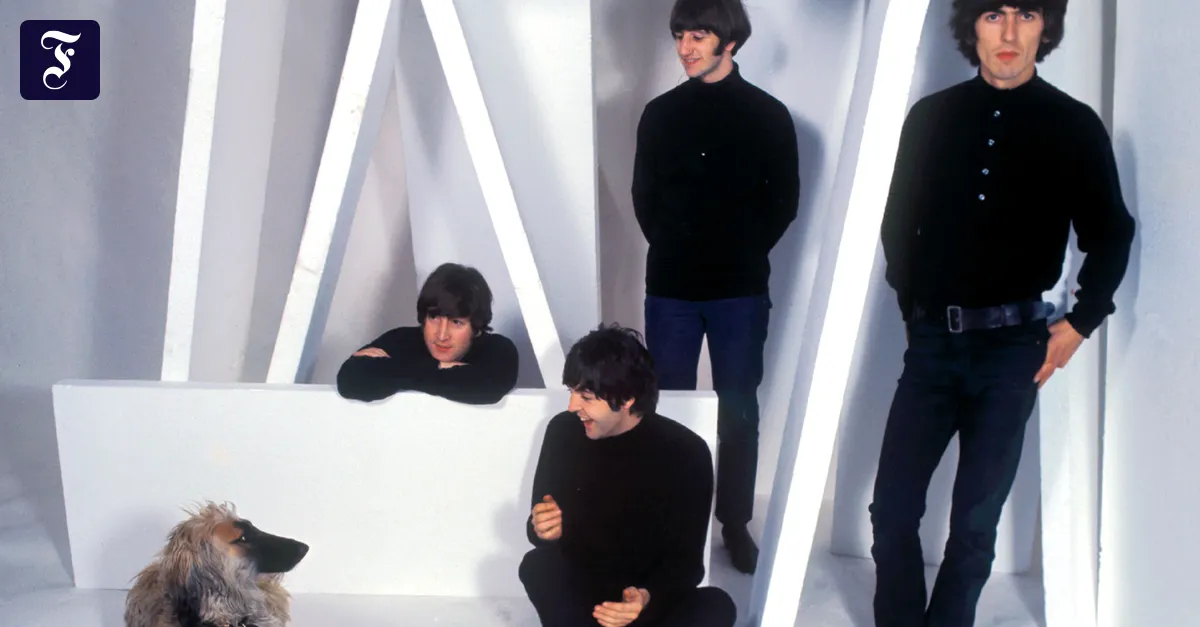
If it is true that 1965 was the year in which rock music experienced a tremendous boost, then, apart from the almost in the air, so lavishly expressed creativity, was also favored by the comparative clarity of the scene. There just wasn't that much. Those who were ambitious and had ideas could more easily have a groundbreaking effect than today. Mutual orientation and stimulation often resulted by themselves. In retrospect, it is striking how many important records that really have something new to say appeared in this one year, at the end of which the crowd was particularly big: Kracher such as "Out Of Our Heads" by the Rolling Stones, "The Kink Kontroversy" by the Kinks, "My Generation" by the Who, three by the Beach Boys alone, the first two byrds albums, the drug-induced folk rock founder as well as "Bringing It All Back Home" and "Highway 61 Revisited" by Bob Dylan, who had switched to electricity and a real band. It is therefore in the very best order and by no means (only) due to money trimming, when Universal Music (Parlophone/Capitol Records/Apple Records) now brings out an album - new in mono and in stereo mixed by George Martin's son Giles and with previously unreleased so-called outtakes - which once again occupies a prominent position under this already legendary output: "Rubber Soul" by the Beatles, released on 3rd. December 1965 in Great Britain (6th in America and 7th in Germany). The fact that this album always appears on the eternal leaderboards only behind "Revolver" and "Sgt. Pepper" does not change anything. They learned to say "I" Rock music at that time not only swung up to more energy, hardness and aggressiveness, but also learned to say “I”. The subjectivization of songwriting, except in Dylan, took on this one record with which the Beatles entered the phase of their absolute mastery, probably their most valid early form at that time. Of course, the transition to it was fluid and already occurred on “Help!”, which had come out in August and contained Paul McCartney’s “Yesterday”. On "Rubber Soul" but was once and for all with the hitter compatible, non-binding declarations of love; The lyrics became more personal and deeper, ambiguous, playful, ironic. „I always took the songs personally. To me, I always meant it. I always wrote about myself. I’m a first-person journalist: What John Lennon claimed for himself now also applied to the other three. The now fully developed self-confidence, which the Beatles had not leased for themselves, already communicates about the cover, whose accidentally distorted spatiality was deliberately left so. Even “Beatles For Sale” did not show any more carefree bachelors; but on the complete “Rubber Soul” shoot, which was taken care of by photographer Robert Freeman, the last remnant of zeal to please the audience with charm and wit has vanished; They are musicians to whom the maturation can be seen on the face and who radiate a calm seriousness that sometimes results from artistic rank. Refrigerated, strangely lodging, almost condescendingly, they present their new work to the audience. The turtle collars they wear mark an intellectual claim that they fulfill with their music. And such a brown suede jacket as here Dylan first wore on the cover of “Blonde On Blonde” (1966). Such externalities were absolutely part of it and are an expression of increased self-confidence. The garment stores, especially on the King’s Road in London, the handle in hand; Most British rock musicians were dedicated followers of fashion, as Ray Davies put it in the Kinks piece full of self-irony, and considered their wardrobe an integral part of their group identity, in the care of which nothing was left to chance. However, the album as Gesamtkunstwerk Zuvörderst expressed itself in the music. With these, in the European version, 14 acoustic folk, folk rock, hard beat and soul-injected titles, of which “Drive My Car”, “Norwegian Wood” and “Michelle” are still the best known, the Beatles have established the record, which until then was mainly traded as a single collection, as a (total) work of art. And even if the finesse was increased afterwards – here was probably for the first time to experience the complexity that rock music, provided suitable staff, was capable of at that time. No other important band has evolved so much in such a short time without playing claim against mass effectiveness. Rubber Soul was perhaps the decisive milestone in this development. Given its remarkable coherence or even seclusion despite its stylistic diversity, it may seem coherent that, after the almost popular “Help!” coup, the Beatles artistically set off into spheres in which they enjoy an enduring, probably eternal respect, but were increasingly socially isolated. With this in mind, one might be inclined to attest to the album a kind of claustrophobia, even though the Beatles were open after so many pages. In any case, they had now set the bar for the competition frighteningly high. Purely in terms of recordings, Dylan, whose ambition was more in the however revolutionary poetry and who was content with his just worked hard-defiant, but not really demanding sound, could not keep up here. The fact that he, together with the Beach Boys and the Byrds, nevertheless gave the standard on which the Beatles in turn oriented themselves – especially the “Subterranean Homesick Blues” was an initial spark – also had an impact on the general rule
Source: FAZ ›




Comments (0)
No comments yet.