The moon continues to shrink, scientists reveal the cause
The latest research revealed the Moon shrunk due to internal cooling. It's less by 50 meters in 400-800 million years.
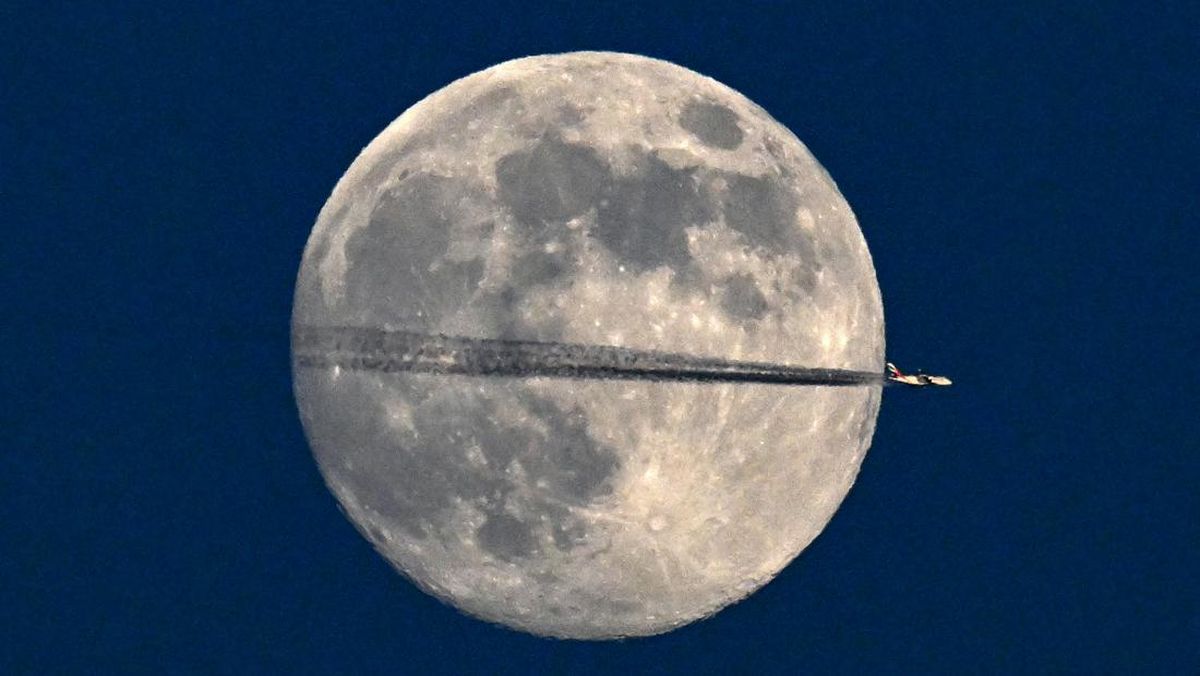
Scientists say the size of the Moon is increasingly shrinking because of the deep cooling gradually over time.
The findings of the Earth's satellite conditions are written by researchers in a "Thrust Fauling and Late- Stage Contraction of the Moon" journal.
This study published by The Planetary Scine Journal identified over 10,00000 young sesar that spread across the surface of the Moon and predicted that the fingers of the Moon had been reduced to about 45 meters over the last 400 to 800 million years.
In this study, scientists used the observations of the Lunar Reconnication Orbiter Camera that mapped the lobate scarps or thousands of landscape that formed due to depreciation, as well as small backs in the Mare plains. This mapping was made on the plateau of the Moon and Mare, the vast, dark land lying on the surface of the Moon.
Experts also estimate that if the speed of the Moon's finger depreciation remains constant during that period, it shows that the Moon size shrinks about 6 to 11 centimeters per year, or about 0.1 micrometers per year.
This number is much smaller than the average of the Earth's plate movement, which is about 1.5 centimeters per year. They estimate this movement to be roughly the same as the rate of nail growth.
The movement of the Earth's plate is driven by the release of heat from the interior of the Earth.
He is the Lord of the Universe. Unlike the Earth which is made up of over 15 lithosphere plates that are made up of mosaic, one Moon plate acts like a whole shell.
Therefore, when the inside of the Moon cools and shrinks, the sesar is unconcentrated along the plate limit, but it spreads widely across its stage.
And the earthquake seized them on account of a while.
This latest study also reveals some areas that have more venues than others. Meanwhile, the parts of the Moon with the most thick crust seem to have the least sesar.
Scientists call this showing the region may be the most stable part.
They've also found the formation of sesar widely didn't occur in the early stages of the Moon evolution. The base, the thick, porous, riveted moon crust acts as a layer of adhesive constriction that blocks the release of heat from the inside.
This condition is called slowing down the cooling and filtering process to a relatively new period.
"As the cooling process and intravenation of the Moon, new sesar growth is expected to continue until today," said Thomas R. Watters as the leading director of this research in his statement, Wednesday (14 / 10).
Watters was a senior scientist at Center for Earth and Planetary Studies. He did this research with some other scientists like Maria Banks, Cole Nypaver, and Mark Robinson.
Source: CNN Indonesia ›



Comments (0)
No comments yet.