It took me 15 years to find this chin. What's so special about it?
A group of scientists took 15 years to find the dice containing 60 sides that could be used to play fair.
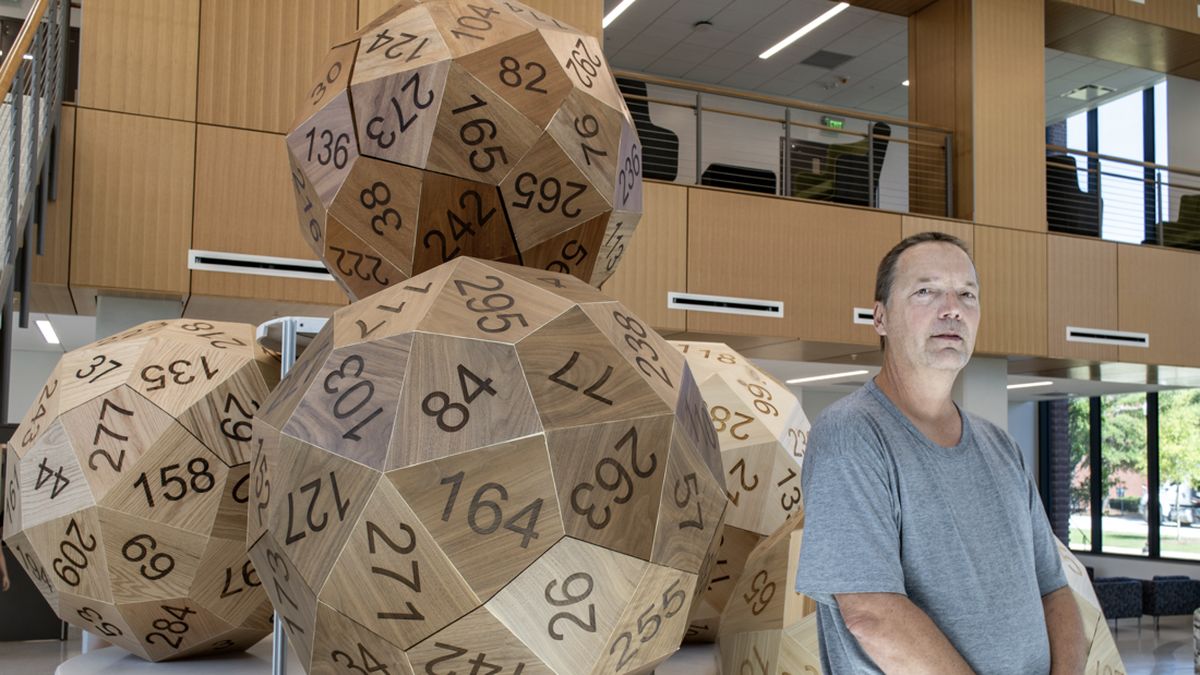
Playing board games with friends is fun, especially when it starts fighting over who goes first. Normally, rolling dice would be the easiest way to determine. But, if the numbers come out the same, it's okay.
Usually, they have to roll the dice again until one of them gets a higher score. It turns out to be a pretty complicated mathematical problem.
A group of mathematicians finally figured out a way to set a fair play turn using five-sided dice. This plan takes about 15 years to solve and allows players to determine a sequence without a series or recast.
Live Science, the dice were developed by Eric Harshbarger, mathematician from Auburn University, United States, along with a number of collaborators. They want to make a set of dice that can be used to make the first turn fairly, whether two people play or when the number of players reaches five.
On average dice with six sides, two players could've gotten the same number. If that happens, they need to roll the dice again to decide who's playing first.
To solve that problem, Harshbarger and his team designed a set of five dice each with 60 sides. And if combined, those five dice have 300 sides that contain 1 to 300 with no repeat numbers.
With this arrangement, the two players who roll the dice differently won't get the same number. The highest-score player can take the first turn without repeating the pitch.
The challenge, the design must also remain fair when the number of players is changed. That is, every player has to have the same opportunity to win, whether at two, three, four, or five people play.
Not only does it determine who plays first, it also allows the whole sequence to be fair. For example, if there are four players, the order of A-B-C-D must have the same opportunity as C-BD-A. That way, no player will benefit more just by choosing a particular dice.
The dice for five players turned out to be much more complicated than for three or four people. According to Harshbarger, the sequence search that meets all requirements involves approximately 10 to 128 possible combinations.
It's so large that it's impossible to check every possible one by one practically. The team has to find a mathematical pattern that can narrow the search.
For years, they found some plans. However, some need dice with too many sides so it's hard to make and to use them in everyday games.
Harshbarger wants to find a solution that not only meets the mathematical rule, but can also be realized into a really usable dice.
The breakthrough finally arrived in the mid 2023. A Canadian software engineer, Paul Meyer, contacted Harshbarger after studying the patterns of the dice the team previously developed.
Meyer then created a program to search for a set of numbers that met all the requirements. From the process, he found a configuration of five-sided dice that fit the criteria.
Harshbarger re-checked the results to make sure the arrangement is qualified. After about 15 years since the initial question came up, the go dice problem finally found the answer.
Source: CNN Indonesia ›




Comments (0)
No comments yet.