The scientist: Amelie Reigl grows skin and knows the key to all our problems
Amelie Reigl is founder and CEO of the Würzburg-based biotech startup TigersharkScience. The company develops in vitro skin models as an alternative to animal testing and thus provides human-relevant test methods for the cosmetics, pharmaceutical and chemical industries. ntv.de wanted to know what exactly she does in her laboratory.
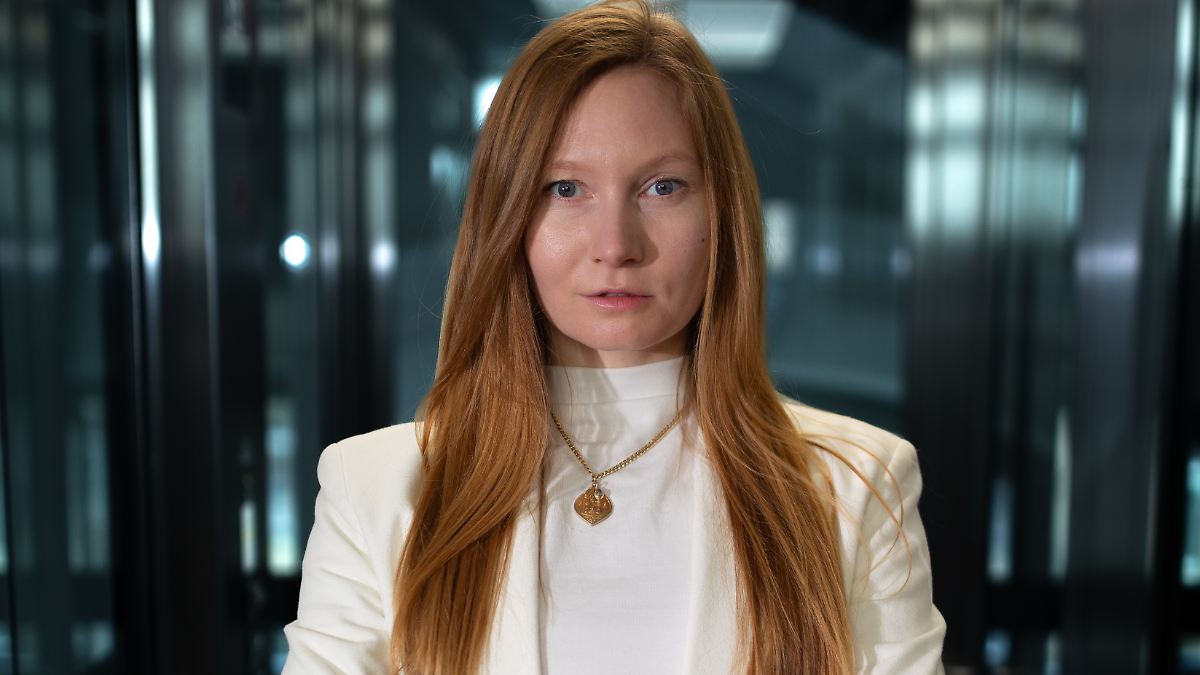
Amelie Reigl is founder and CEO of the Würzburg-based biotech startup TigersharkScience. The company develops in vitro skin models as an alternative to animal testing and thus provides human-relevant test methods for the cosmetics, pharmaceutical and chemical industries. ntv.de wanted to know what exactly she does in her laboratory.
Under the name "@diewissenschaftin", the founder and CEO of the Würzburg-based biotech startup "TigerShark Science", Amelie Reigl, is committed to science communication and reaches more than 400,000 people via social media. A considerable number. If you listen to Amelie Reigl, however, you suddenly find much more interesting. "We want to take you on our journey and into our laboratory, because science concerns us all!" Science must not take place in the ivory tower, it belongs in the middle of society, she posts on Instagram, and yes, you click on it.
Reigl explains: We grow human skin in the laboratory to reduce animal testing. And to enable better research for the pharmaceutical and cosmetics industries. She says it as if it were the most normal thing in the world. For them it is also: "We have different skin models in the laboratory, and can then carry out the tests." We can develop creams and medicines faster together with the companies and also reduce animal testing.
She burns for her subject, so much is clear. With her "TigerShark Sciences" team, she is not only working on reducing animal experiments, but also wants to use the grown human skin as multiply as possible. We work at high pressure, because we want to make skin grafts possible for therapies. But we still need a lot of studies, time - six to eight years before it can really end up with the patient - and around 20 million. She is confident - Reigl is already a professional in attracting funding.
The fact that there is a great need for their company’s product became clear at the latest in the fire disaster in Crans-Montana earlier this year: A week after the fire disaster in the Swiss ski resort, hospitals in Zurich had received 9.3 square meters of donor skin for fire victims - the skin of dead donors.
Donor skin is used in such cases as a temporary skin replacement to protect the wounds of severely burn injured, to prevent infections and to support healing until the insertion of the body's own skin is possible. Artificially grown donor skin could reduce the need in the future - provided that such grafts can be produced safely and on a large scale.
But how does cultured human skin form? TigersharkSciences works with human stem cells from the European Stem Cell Bank. "You can actually buy them there," says Reigl, "that means we buy different age groups, genders and different skin types."
Normally, the pharmaceutical industry is researching a male, white skin model, "but we also have female skin models," she points out. In the case of stem cells, however, there is always the question: is this allowed at all? "We do not use embryonic stem cells, but induced pluripotent stem cells," she explains.
For this technique there was already 2012 the Nobel Prize for Physiology and Medicine. 'The researchers discovered that mature, specialized body cells could be taken from any cell in the body and programmed back to a stem cell,' says Reigl. This stem cell has the property that it can then be developed again in body cells: "That means we take the stem cell, make skin cells from it and can build our skin model."
Sounds a bit like "My first chemical toolkit", but is much more: My very first lecture in Würzburg has my later doctoral supervisor Prof. Dr Florian Groeber-Becker. He talked about the fact that there are skin models that can be grown in the laboratory. These were still very simple skin models, but Amelie Reigl knew at that moment that she wanted to do something in that direction. She then wrote her master’s and doctoral thesis with her very first professor.
"And finally we even spun off together with Dr. Dieter Groneberg." In addition to my doctoral thesis at the University of Würzburg, I have further developed the skin models at the Fraunhofer Institute, which already exist in simple form, so that they are much more realistic, i.e. become more and more similar to our human skin. ‘
Reigl is very active on social media, wants to bring her followers closer to science as easily as possible. She also posted, "Others marry and build a house my age, I have my own laboratory."
As a young woman, do you still have to choose one or the other today? She doesn’t believe that at all: I started with science communication on social media because I lacked the information in this area. You can find everything - makeup tips, movie recommendations, recipes, but nothing about the scientific phenomena that surround us. And I was often asked what the everyday life of a scientist is, I’m not just a nerd, she laughs. "I use lipstick and like to dress well, I go to the gym and have other interests than my research."
Reigl wants to show that you can also have fun in science. But she also considers it important to comment on the topics of career, family and their compatibility. I think in science, as in all other fields, it’s still harder for women. In college, 60 percent were female students. But not everyone came to the promotion. Of the men all. I still believe that both can be done, because I see that in two of my mentors, P..
Source: n-tv ›




Comments (0)
No comments yet.