Schaeffler in China: The robot builds itself
Are humanoid robots the future of industry? German automotive supplier Schaeffler is opening a lighthouse factory in China. Europe is nevertheless at eye level, says a manager.
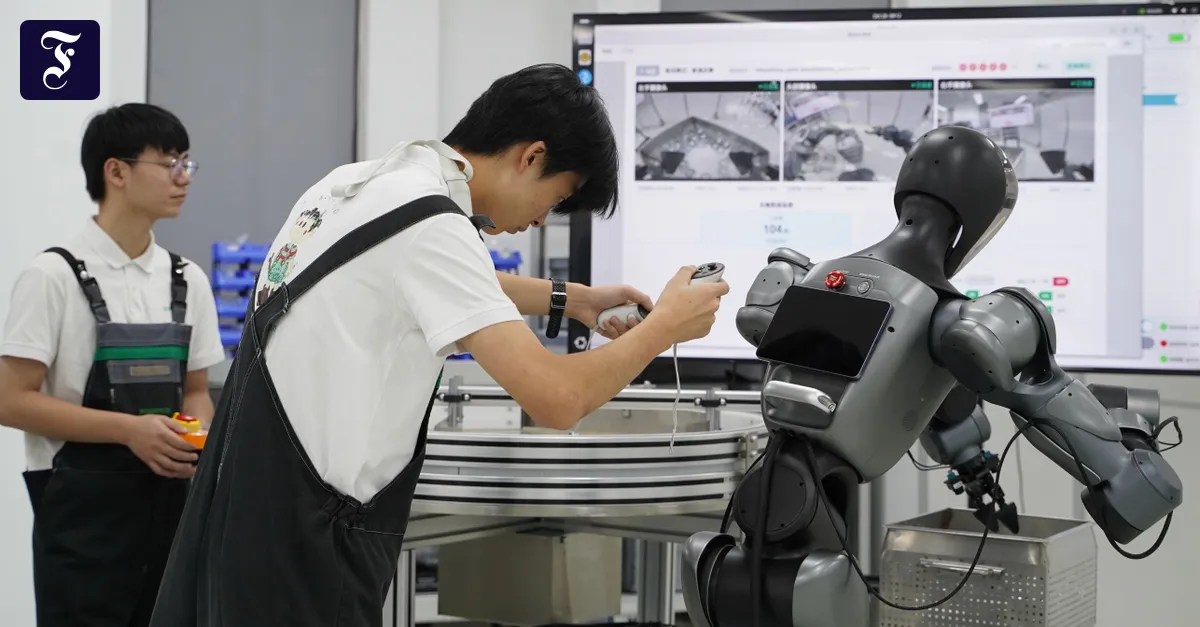
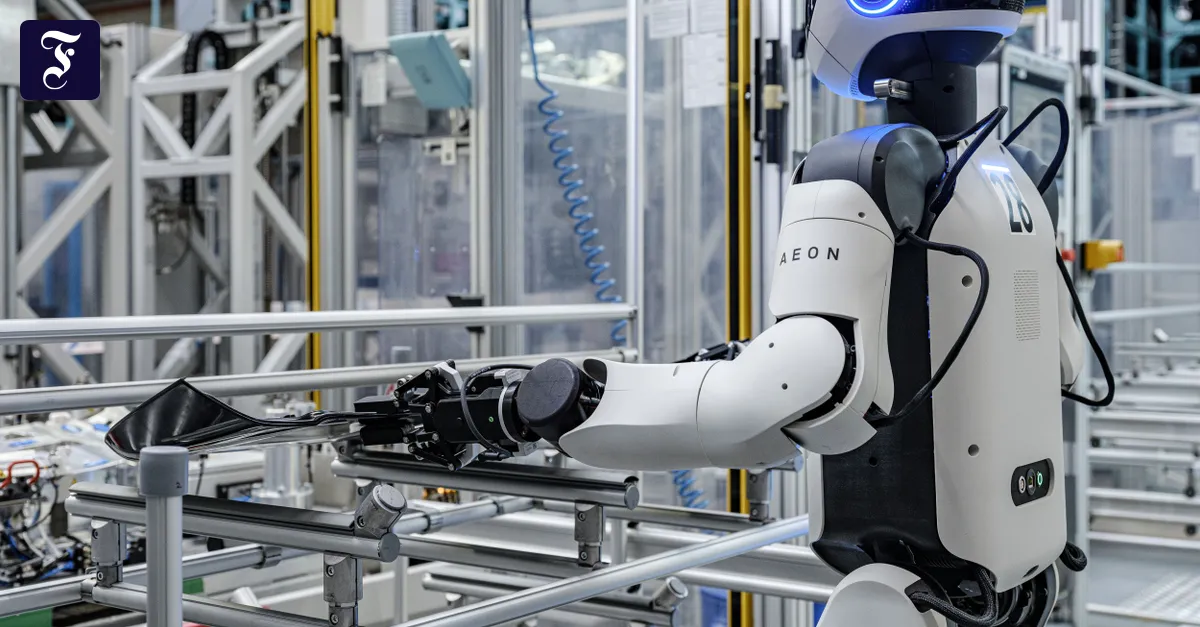
An unadorned industrial area in Taicang, the most German of all cities in China, just outside Shanghai. In the neighbouring building, young Chinese are trained as tool mechanics according to the German model. In 2001, the then Federal Chancellor Gerhard Schröder (SPD) and Zhu Rongji, once Prime Minister of China and recently deceased, inaugurated the training center. China wanted to learn from the German model of dual education. Taicang, where more than 500 German companies are based today, was the ideal place for this. A quarter of a century later, the German automotive supplier Schaeffler opens its first lighthouse factory for humanoid robots in the world. Under one roof, the factory connects a data centre and a training centre as well as a pilot line in which six robots in human form produce components for new humanoid robots. The group from the Frankish Herzogenaurach already calls it mass production and speaks of a “closed loop”. The robot builds itself. The circle also closes on the upper floor as Jochen Schröder takes a tour of the training center. The former Chancellor’s namesake has been responsible for production and purchasing on the Schaeffler Board of Management for about half a year. On the tour, the local employees first present him with the typical green circuit boards with numerous circuits, the mechanically highly complicated robot hands and the actuators that are so important for robots, i.e. the components that make movements out of the signals. Then we go to the training centre. But here no more German masters introduce Chinese young people to the German art of tool mechanic. Instead, young adults from China are now teaching robots the art of being human, or at least the art of human movement. They are wired with sensors on the forehead and in the hand that record their human movements. The robot copies and internalizes them. It has something of a dance when man and machine bow synchronously. This is not about dancing. The fact that China’s humanoid robots can do flips and kung fu has been proven in countless performances. But then they look more like expensive toys and less like the future of global industrial production. In conversation with the F.A.Z., Schröder makes it clear that he is concerned about the factories. We are currently putting the first humanoid robots on the line. This is already paying off, especially in a high-wage country like Germany. But we are still at a very small number of pieces. How useful it is to build robots in human form is the crucial question of the booming industry in China. According to figures from market research firm Counterpoint Research, companies delivered 22,000 devices in the first half of the year. The five largest manufacturers all came from China. The country accounts for more than 90 percent of all deliveries. So far, however, it is often still an artificial, politically driven demand. According to Counterpoint, a third of the robots shipped are used for entertainment at trade shows, a quarter for research and data collection, and around a fifth for services such as cleaning. Only one in eight robots actually works in factories, only one in twenty in logistics. In most cases, these are still pilot projects. That is why Schröder is fighting and considers the competition to be open. He sees American, Chinese and European robots side by side in his laboratory every day, he says in a media round in which only Chinese journalists participate except for the F.A.Z.: “China has not yet won.” When it comes to real applications and not dance or sporting events, the world regions are on an equal footing. Schaeffler is also struggling in China but the Chinese are doing their utmost. Humanoid robots are one of the core industries of the 15th adopted earlier this year. Five-year plan of Beijing. Local governments court companies with subsidies and other benefits. According to information from the F.A.Z., Schaeffler receives an average single-digit million for the lighthouse project from the Taicang government. In addition, there are furnishings and the fact that the Group receives a complete building within eight months. How much Schaeffler himself invested in the project, the Group did not disclose. Taicang has a decades-long history with German companies. The party secretary of the city of Chen Gao, who once studied English for foreign trade, and several other local party cadres are coming to the opening. Several Schaeffler representatives repeatedly praise the close cooperation with the government. Taicang is the Group’s most important location in China, employing 8,000 people. But the crisis in the German car industry is also hitting here. Due to the weak electric car business of German manufacturers in China, Schaeffler just had to write off 240 million euros. Instead, the group now wants to cooperate more with Chinese car manufacturers and with the humanoid robots, because many of the components are the same as in a car. There are already 45 customers, including Chinese manufacturers of humanoid robots, says Schröder. According to the Group, order intake in this area is around 400 million euros. But how much of it turns into sales also depends on the success of the industry. And that the robots so quickly become a rescue for the industrial group, is almost impossible. There are 40 employees working at the lighthouse factory, with more than 100 soon, says Schröder. And don’t forget the six robots.
Source: FAZ ›


Comments (0)
No comments yet.